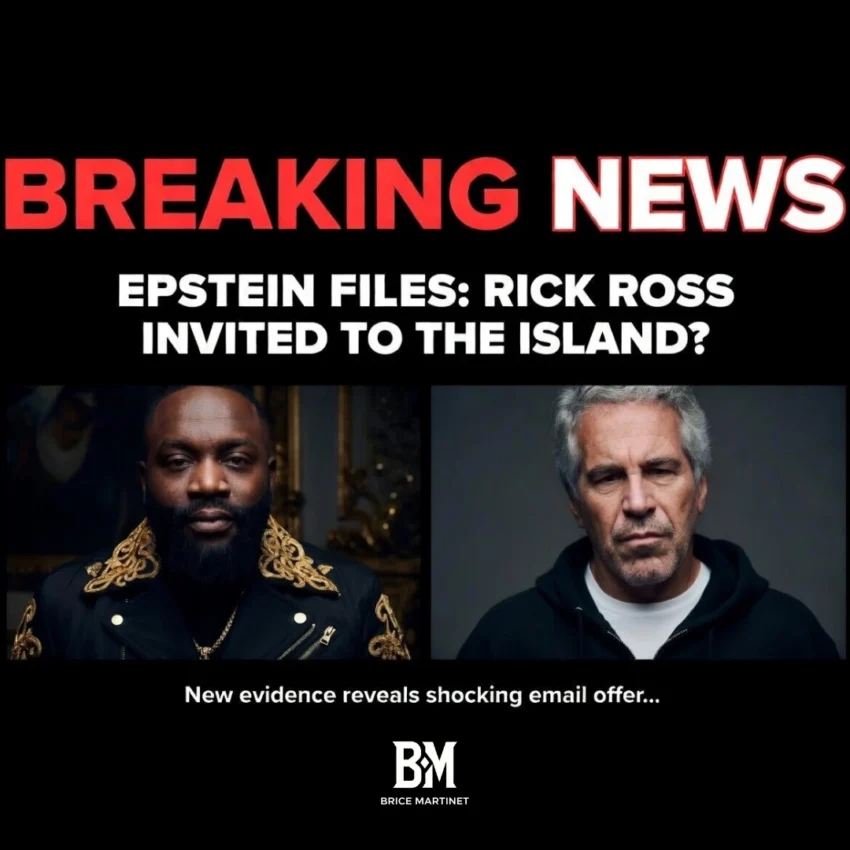
A new wave of viral posts circulating on social media is drawing attention to the massive archive of documents connected to the late financier Jeffrey Epstein. The posts claim that newly examined materials—including millions of pages of emails, photographs, and records—contain a strange message referencing rapper Rick Ross and an alleged invitation to Epstein’s private island.
While the claims have spread rapidly online, investigators and journalists caution that many details remain unverified, highlighting once again how the Epstein case continues to generate speculation years after his death.
Court records and investigative files related to Epstein are enormous in scope. Legal experts estimate that the combined materials gathered over years of civil lawsuits, criminal investigations, and federal probes amount to millions of pages.
These documents include:
Emails and correspondence
Flight logs connected to Epstein’s private jets
Financial records
Witness testimony from victims and former associates
Photographs and personal contact lists
Many of these materials became public through court proceedings and document releases connected to lawsuits filed by Epstein’s victims.
However, a large portion of the archive remains sealed or partially redacted due to privacy laws and ongoing litigation.
The newest claim circulating online centers on an alleged email exchange discovered among these files.
According to posts shared across multiple platforms, the message was supposedly sent by an unnamed billionaire who asked Epstein to invite Rick Ross to Little Saint James, Epstein’s private island in the U.S. Virgin Islands.
The message allegedly offered to pay any amount required to arrange the visit and reportedly included a crude and explicit remark explaining the sender’s motivation.
Screenshots of the supposed message have been widely reposted, quickly fueling curiosity and confusion among social media users.
But there is a significant problem: no confirmed investigative report or court document has publicly verified the existence of this specific email.
Journalists who have examined thousands of pages of Epstein-related documents say they have not found verified records confirming the claim.
Legal experts note that Epstein maintained an enormous contact network that included politicians, celebrities, financiers, and business leaders. His address books and email records contained thousands of names—many of whom had little or no documented involvement in his criminal activities.
Because of this, unverified excerpts or manipulated screenshots can easily spread online and appear convincing, especially when detached from their original context.
Investigators say any legitimate discovery within the Epstein archive would likely appear first in court filings, investigative journalism reports, or official statements—not anonymous viral posts.
Epstein’s private island, Little Saint James, remains one of the most controversial locations tied to his case.
Prosecutors alleged that Epstein used the property as part of a wider sex-trafficking operation involving underage girls. Survivors have testified that victims were transported to several of Epstein’s homes, including the island.
After Epstein’s arrest in 2019 on federal sex-trafficking charges, authorities searched his properties as part of the investigation. Weeks later, he died in a Manhattan jail while awaiting trial.
His associate Ghislaine Maxwell was later convicted in 2021 for helping recruit and groom underage victims and is currently serving a 20-year federal prison sentence.
Experts say the Epstein case has created a perfect environment for rumors and unverified stories.
Several factors contribute to this:
Incomplete public records – Many documents remain sealed or redacted.
High-profile connections – Epstein’s contact list included influential figures from multiple industries.
Public distrust – Some believe key information about the case has not been fully revealed.
When new “leaks” appear online, they often spread rapidly before journalists or investigators can verify them.
Even years after Epstein’s death, public fascination with the case shows no sign of fading.
Document releases, lawsuits from survivors, and investigative reporting continue to uncover pieces of the broader network that surrounded Epstein. At the same time, misinformation frequently spreads alongside legitimate findings.
For now, the alleged email referencing Rick Ross remains unconfirmed.
But the viral story illustrates a larger truth: the Epstein files are so vast—and the unanswered questions so numerous—that almost any new claim can ignite global attention overnight.
Until verified evidence emerges, experts say the public should approach sensational claims with caution and rely on confirmed reporting rather than viral screenshots.
The Epstein archive may still contain revelations.
But separating fact from rumor remains one of the biggest challenges surrounding the case today.