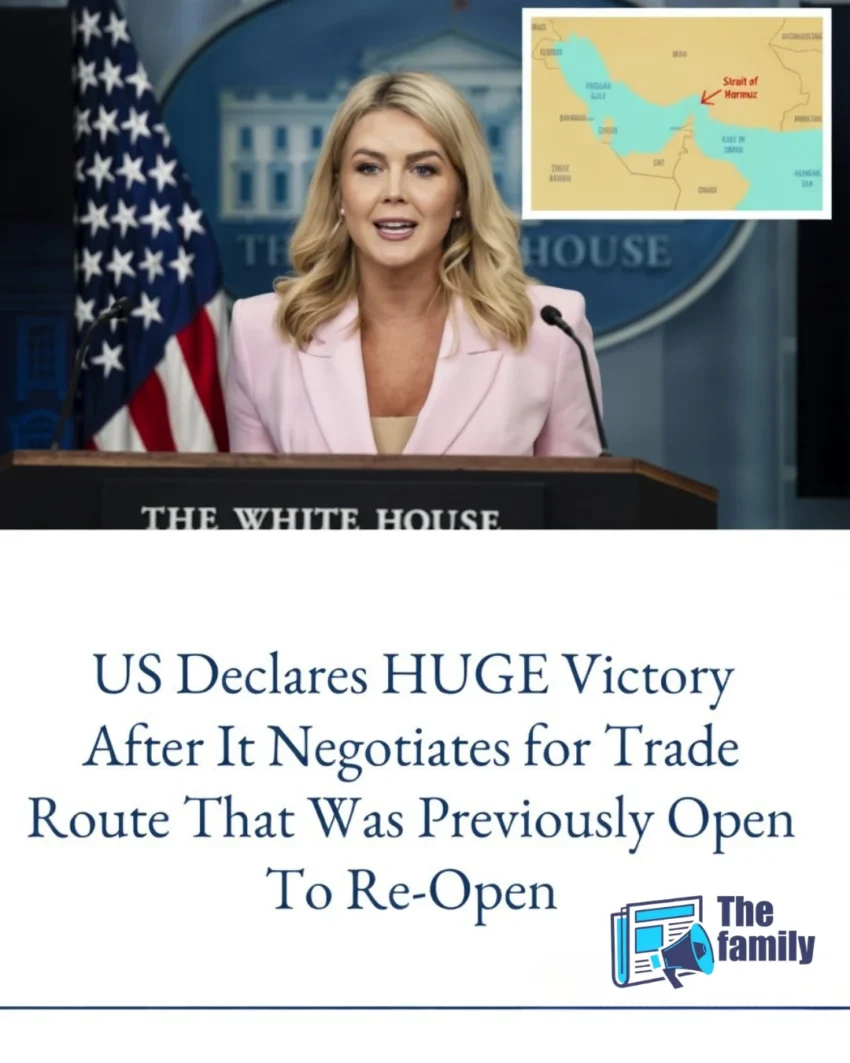
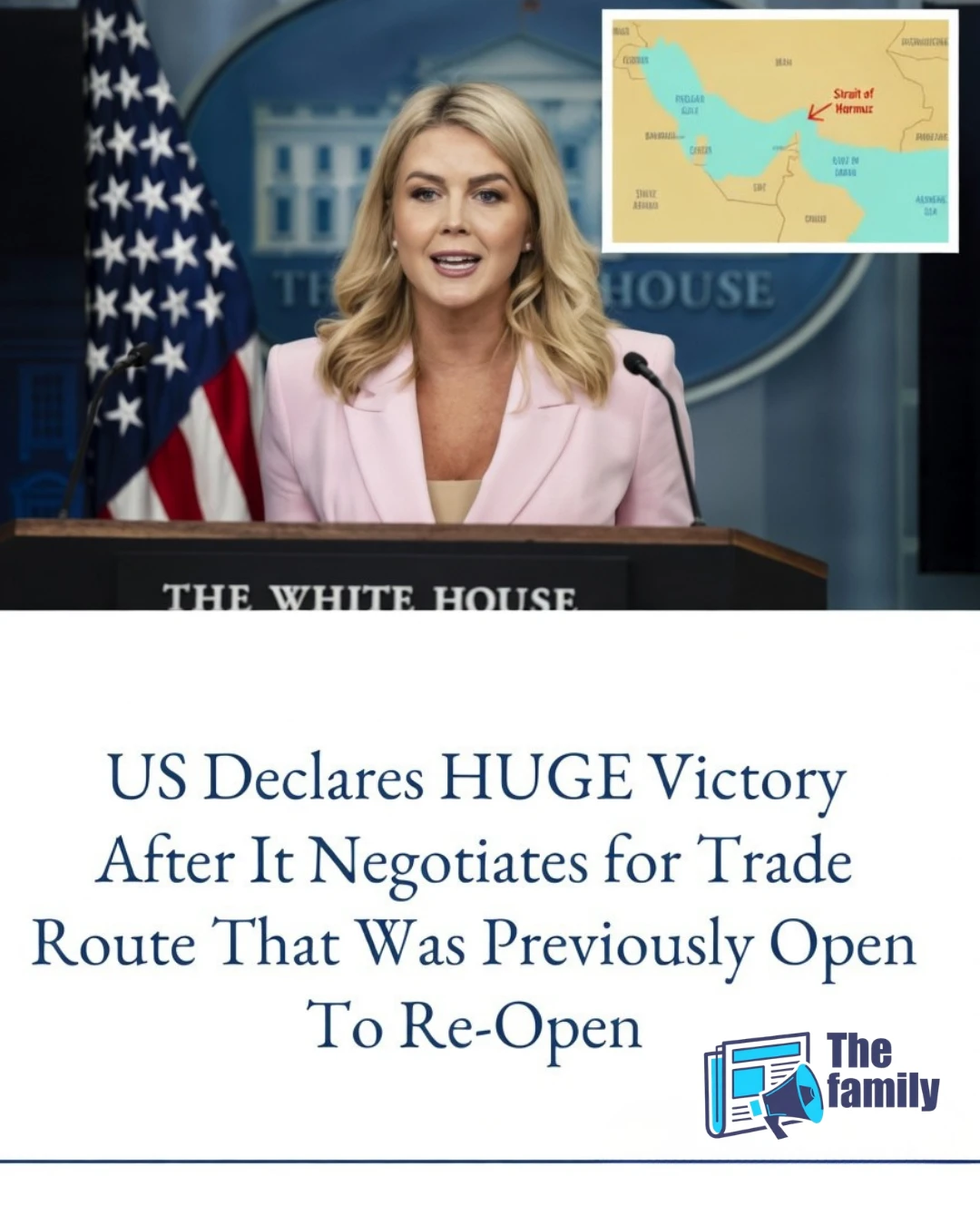
In a statement that has already sparked debate across political and international circles, the White House has declared a “major victory” following negotiations to reopen a critical Middle Eastern trade route—one that, until recently, had functioned largely without disruption for decades.
At the center of the announcement is a simple claim: stability has been restored. The Strait of Hormuz—one of the world’s most strategically vital shipping lanes—is open again. Oil flows are expected to normalize. Markets, at least temporarily, may breathe a cautious sigh of relief.
But beneath the surface of that declaration lies a far more complicated reality—one that challenges the very definition of victory in modern conflict.
According to official remarks from White House Press Secretary Karoline Leavitt, the outcome reflects the administration’s success in restoring order after a period of instability.
“The Strait of Hormuz is open, leadership in Iran remains unchanged, and the region is stabilizing,” she stated, emphasizing that diplomatic efforts had succeeded in bringing tensions down.
Yet the framing has drawn scrutiny.
Critics argue that the end state described—open trade routes, existing leadership structures, and ongoing geopolitical tensions—closely resembles the situation before the conflict escalated. In that sense, the war appears not to have transformed the region, but rather to have interrupted and then restored a fragile equilibrium.
This has led some observers to ask a difficult question: if the outcome mirrors the starting point, what exactly was achieved?
While official statements focus on restored stability, the cost of reaching that point is harder to overlook.
Reports indicate that the conflict required tens of billions of dollars in military and logistical expenditures. Thousands of lives—military personnel and civilians alike—were lost or permanently altered. Infrastructure across parts of the region sustained damage, and economic ripple effects were felt far beyond the immediate conflict zone.
Global markets responded with volatility. Energy prices surged during peak tensions, placing additional strain on economies already navigating inflation and supply chain disruptions. Allies expressed concern, with some questioning both the timing and the long-term implications of the escalation.
In this context, the reopening of a trade route becomes more than a logistical achievement—it becomes a focal point for evaluating whether the costs incurred align with the results obtained.
The Strait of Hormuz is no ordinary shipping lane. Roughly one-fifth of the world’s oil supply passes through it, making it a critical artery for global energy markets.
Any disruption to this narrow passage has immediate and far-reaching consequences. Even the threat of closure can send oil prices climbing and trigger uncertainty across international markets.
From this perspective, ensuring the Strait remains open is undeniably important.
But that importance also raises another question: if the route was already functioning prior to the conflict, was the war necessary to secure it?
The language used in the aftermath of the conflict has itself become part of the story.
Officials aligned with Donald Trump have framed the outcome as a demonstration of strength and negotiation skill. The argument is that decisive action created the conditions necessary for renewed stability.
Supporters point to the eventual de-escalation as evidence that pressure can produce results.
However, critics see the messaging differently. They argue that declaring victory in such terms risks oversimplifying a complex situation. By focusing on a single outcome—the reopening of the Strait—broader consequences may be overlooked.
This divergence highlights a recurring feature of modern conflicts: the gap between political narratives and lived realities.
Another layer of concern centers on the long-term impact within the region itself.
While the immediate crisis may have subsided, underlying tensions remain unresolved. Iran’s leadership structure is intact. Strategic rivalries persist. And the broader dynamics that contributed to the conflict have not fundamentally shifted.
In fact, some analysts suggest that the conflict may have deepened divisions.
Military engagement can reshape public perception in ways that extend beyond the battlefield. Generations may carry forward the memory of conflict, influencing future relations and complicating efforts at diplomacy.
From this perspective, the restoration of surface-level stability does not necessarily equate to lasting peace.
The international response to the conflict and its resolution has been mixed.
Some allies have welcomed the de-escalation, emphasizing the importance of maintaining open trade routes and avoiding prolonged instability. Others have expressed concern about the broader implications, including the precedent set by the escalation itself.
Adversaries, meanwhile, may interpret the outcome in different ways—either as a demonstration of resolve or as evidence of strategic inconsistency.
Global perception matters. It shapes alliances, influences negotiations, and affects how future actions are interpreted.
In this case, the perception of victory is not universally shared.
Beyond the immediate human and political dimensions lies an economic reality that cannot be ignored.
Wars are expensive—not only in direct military spending but also in long-term consequences. Reconstruction, veteran care, debt accumulation, and economic disruption all contribute to the overall cost.
When measured against an outcome that appears to restore pre-existing conditions, the economic equation becomes more difficult to justify.
For policymakers, this raises a broader challenge: how to balance strategic objectives with fiscal responsibility in an increasingly interconnected world.
Perhaps the most striking aspect of the current situation is its apparent impermanence.
Even as officials declare victory, there is an underlying acknowledgment that stability may be temporary. The conditions that led to the conflict have not disappeared. They have, at best, been managed.
Peace, in this context, is not a fixed state—it is a moment.
And moments can shift quickly.
For many observers, the situation reflects a familiar pattern in modern geopolitics:
This cycle raises difficult questions about the effectiveness of such approaches. If the end result is a return to the status quo, is the cycle itself sustainable?
At the heart of the debate is a fundamental question: what does victory mean in today’s geopolitical landscape?
Is it the achievement of specific objectives, regardless of cost?
Is it the restoration of stability, even if temporary?
Or is it something more elusive—a lasting change that justifies the sacrifices made?
In this case, the answer remains contested.
For some, the reopening of a vital trade route represents a tangible success. For others, it underscores the limitations of military solutions to complex political challenges.
As the immediate crisis fades from headlines, attention will shift to what comes next.
Will the current stability hold?
Will underlying tensions resurface?
And perhaps most importantly, what lessons—if any—will be drawn from this episode?
These questions do not have immediate answers.
What is clear is that the story does not end with a declaration of victory. It continues, shaped by decisions yet to be made and consequences still unfolding.
The reopening of the Strait of Hormuz may mark the end of one chapter, but it does not close the book.
It stands as a moment of resolution—partial, contested, and fragile. A moment that invites reflection not only on what was done, but on why it was done, and whether it achieved what it set out to accomplish.
In the end, the true measure of victory may not lie in what has been restored, but in what has been learned.
And that, as history often shows, is a far more complicated calculation.