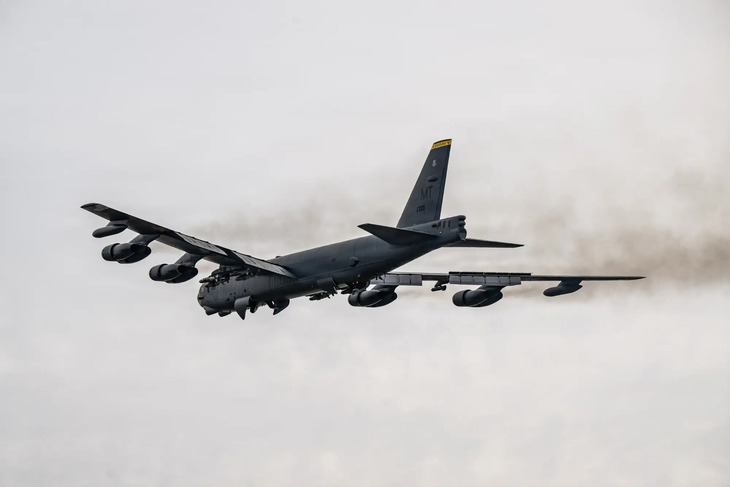
The United States has begun deploying B-52 strategic bombers to fly directly over Iranian territory for the first time since the conflict began, as Washington claims it has gained near-total control of Iranian airspace.
A U.S. Air Force B-52 Stratofortress takes off to support operations targeting Iran. (Photo: Reuters)
Speaking at the Pentagon on March 31, Defense Secretary Pete Hegseth said growing air superiority has enabled the U.S. to carry out B-52 missions over mainland Iran — a move widely seen as evidence that Tehran’s air defense systems have been significantly weakened.
Chairman of the Joint Chiefs of Staff, General Dan Caine, said that over the past 30 days, U.S. forces have struck more than 11,000 targets, focusing on dismantling logistics networks tied to Iran’s missile, drone, and naval capabilities.
“Over the past 30 days, we’ve hit more than 11,000 targets,” he said. “As air superiority has increased, we’ve also launched B-52 missions over land.”
The use of B-52 bombers carries particular significance. The aircraft are large, non-stealth, and traditionally vulnerable to modern air defense systems.
As a result, sending B-52s directly over Iran signals strong confidence from Washington that much of Iran’s air defense capability has been neutralized — making it increasingly difficult for Tehran to shoot them down, according to The New York Times.
Still, Hegseth acknowledged that Iran retains the ability to retaliate using missiles and drones against targets across the region.
“They will fire missiles — and we will shoot them down,” he said, adding that the U.S. is now “closer than ever to victory,” though he declined to provide a specific timeline for the end of the conflict.
He noted that the timeline will depend on President Donald Trump and ongoing negotiations, which he described as “active, substantive, and showing signs of progress.”
Shortly afterward, Trump stated that the U.S. could end its military campaign against Iran within two to three weeks. Tehran has also indicated it would be open to a ceasefire if guarantees are in place to prevent further attacks.
However, Iran denied engaging in direct negotiations. Foreign Minister Abbas Araghchi said Tehran has not responded to a 15-point proposal from the U.S. and has not put forward any proposal of its own.
As the conflict continues, economic impacts are becoming more visible. U.S. gasoline prices have surpassed $4 per gallon for the first time since 2022, while oil and gas prices have surged amid prolonged instability.
At the same time, global oil prices have recently eased to around $100 per barrel, and stock markets have rebounded on expectations that the conflict could end soon.
Regarding the Strait of Hormuz — a critical shipping route that carries roughly one-fifth of the world’s oil supply and has been disrupted — Trump urged other nations to “step up and take it back,” signaling that Washington may reduce its direct role in securing the region.