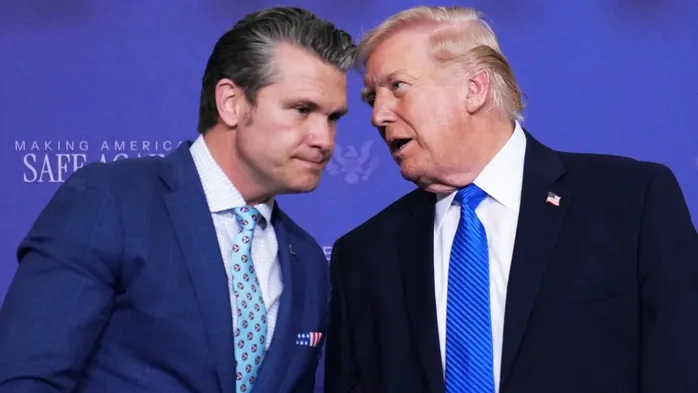
As the joint U.S.-Israeli military campaign against Iran enters its fourth week, President Donald Trump has injected fresh controversy into the narrative surrounding the conflict. Speaking at a roundtable in Memphis, Tennessee, on March 23, the President detailed the deliberations that led to the late-February escalation, raising new questions about the origins and ultimate objectives of the mission.
“I called Pete. I called General Kane [General Dan Caine, Chairman of the Joint Chiefs of Staff]. I called a lot of people,” Trump told the audience.
“I said, ‘Let’s have a discussion. We have a problem in the Middle East. Iran is getting very close to a nuclear weapon,'” the commander-in-chief recounted, noting that he had suggested a “short journey in the Middle East” to permanently neutralize a major threat.
Turning toward Secretary of Defense Pete Hegseth, Trump remarked: “Pete, I think you were the first one to speak up, and you said, ‘Let’s go do it because we cannot let Iran have a nuclear weapon.'”
The President’s comments have ignited a firestorm of debate across the political spectrum. According to HuffPost, critics and analysts are divided on the intent behind the public “shout-out.” Outlets such as The New Republic and Rolling Stone suggested that the President may be “scapegoating” Hegseth—effectively shifting ownership of the strike to the Pentagon chief to deflect responsibility as the conflict fails to produce an immediate, decisive victory.
Conversely, Mediaite offered a dual interpretation: the remarks could be viewed as high praise for a loyalist, or conversely, the “groundwork for a cabinet shake-up” at the Pentagon, depending on how the situation in the Middle East evolves. Despite Trump’s claims that peace negotiations are underway, Tehran has issued a flat denial that any such talks are occurring.
The President also took aim at domestic media reports suggesting he is retreating from his original objectives—specifically regime change and the total elimination of Iran’s nuclear capabilities.
As reported by the Deccan Herald, the fog of war remains thick, with several competing theories regarding the catalyst for the conflict:
The Israeli Factor: Some analysts argue that Israel was prepared to strike unilaterally regardless of U.S. support, effectively forcing Washington’s hand.
The Nuclear Threshold: Others maintain that intelligence showing Iran on the brink of a nuclear breakout necessitated the intervention.
Amid these reports, President Trump’s own messaging continues to be characterized by inconsistency, further complicating the domestic and international perception of the war’s trajectory.