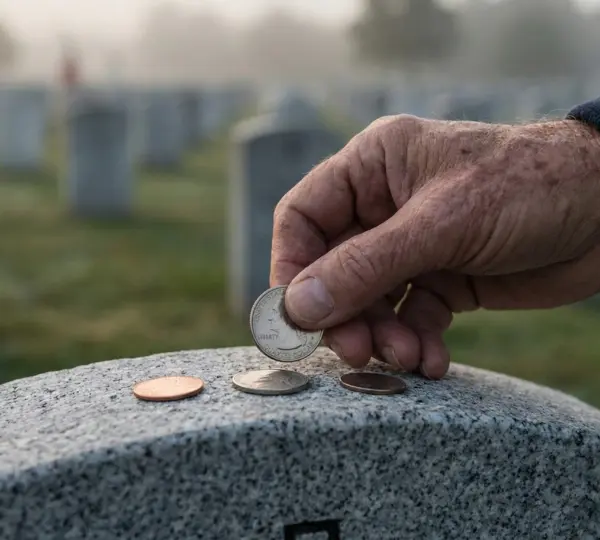
At first glance, a few coins resting on a gravestone may seem insignificant—easily overlooked beside flowers, flags, or wreaths. Yet within many American military cemeteries, these small objects carry a powerful and deeply personal meaning. They are not случайно left behind. Each coin represents a deliberate message—one of remembrance, respect, and connection.
This quiet tradition is most often seen at the graves of soldiers who died in service to their country. For veterans, family members, and visitors, coins become a symbolic language, expressing emotions that words often fail to capture. What appears to be simple spare change is, in reality, a meaningful gesture rooted in history and shared experience.
The origins of leaving coins for the dead date back to ancient civilizations. In Greek and Roman mythology, coins were placed with the deceased to pay Charon, the ferryman who carried souls across the river Styx into the afterlife. Similarly, ancient Egyptians buried valuables with their dead to ensure protection and safe passage beyond death. Over centuries, this idea of providing for the departed evolved across cultures.
In the United States, however, the modern meaning of coins on gravestones took shape during the Vietnam War. Returning soldiers often faced misunderstanding and social division, leaving grief and remembrance unspoken. In response, many veterans began leaving coins at the graves of fallen comrades as a quiet way to say, “I was here. I remember you.” It was a deeply personal act—simple, yet profound.
Over time, this practice developed into a recognized tradition within military culture. Each type of coin carries a specific meaning, creating a silent code understood by those familiar with it.
A penny represents the most basic message: someone has visited the grave. It is a sign of respect, acknowledging the life and sacrifice of the fallen. Though simple, it reassures families that their loved one is not forgotten.
A nickel carries deeper significance. It indicates that the person who left it trained alongside the deceased. This reflects shared experiences of discipline, hardship, and preparation—moments that often forge lifelong bonds.
A dime represents an even stronger connection. It signifies that the visitor served with the fallen soldier during active duty. This means they likely faced danger together, shared missions, and relied on one another in life-threatening situations.
The quarter holds the most profound meaning of all. It indicates that the person leaving it was present when the service member died. This is a powerful tribute, honoring not only the fallen but also acknowledging the witness to their final moments—a bond marked by sacrifice and loss.
To outsiders, these coins may appear ordinary. But to veterans and military families, they form a quiet record of loyalty, shared history, and enduring connection. Each coin tells a story—one that often remains unspoken but deeply felt.
For families visiting graves, discovering coins can be incredibly moving. It offers reassurance that others remember their loved one—that the bonds formed in service continue beyond death. In many cases, these small tokens bring comfort, reminding families that their loss is shared and honored by others.
The tradition also creates a space for reflection. In a fast-paced world, placing a coin slows time. It allows individuals to pause, remember, and connect with the past in a personal and meaningful way. There are no speeches or ceremonies—just a quiet moment of respect.
Unlike public memorials, this gesture is intimate. The message is not meant for everyone, but for those who understand its significance. It becomes a private conversation between the living and the deceased, carried out through a simple, physical act.
Veterans often describe leaving coins as a way to maintain a connection with fallen comrades. It expresses gratitude, solidarity, and remembrance—feelings that can be difficult to articulate. In this way, coins become symbols of invisible bonds that continue long after service has ended.
Across generations, the tradition endures. Younger service members learn the meanings behind each coin, ensuring that this silent language of respect is preserved. In many cemeteries, coins accumulate over time, forming a mosaic of memory—each one representing a life remembered and a connection that remains.
Ultimately, the power of this tradition lies in its simplicity. It shows that remembrance does not require grand gestures. Sometimes, the smallest acts carry the deepest meaning.
Coins on gravestones are more than objects. They are symbols of honor, sacrifice, and enduring human connection—quiet reminders that those who served are never truly forgotten.