Blood was dripping from Elijah Reynolds’s nose before anyone in first class understood that the flight attendant had just turned a question about policy into a medical emergency.
Never Miss a Word Again
These discrete, rechargeable hearing aids deliver crystal-clear sound and advanced noise cancellation. Perfect for watching the news, busy restaurants, or family gatherings.
Secure transaction via Amazon.com
The droplets landed on his white T-shirt in small red bursts, shocking against the cotton, each one a visible measure of how quickly control had vanished from the cabin.
One moment, the sixteen-year-old boy had been sitting upright in seat 3A with a clear nasal cannula resting beneath his nose, his portable oxygen concentrator humming softly at his side.
Never Miss a Word Again
These discrete, rechargeable hearing aids deliver crystal-clear sound and advanced noise cancellation. Perfect for watching the news, busy restaurants, or family gatherings.
Secure transaction via Amazon.com
The next, the tubing had been ripped from his face.
His breath caught.
His hands flew up.
Never Miss a Word Again
These discrete, rechargeable hearing aids deliver crystal-clear sound and advanced noise cancellation. Perfect for watching the news, busy restaurants, or family gatherings.
Secure transaction via Amazon.com
His eyes widened in panic as his body, already compromised by pulmonary fibrosis, suddenly lost the supplemental oxygen it needed to endure cabin pressure at altitude.
“What have you done?” Dr. Terrence Reynolds lunged forward, his voice cutting through the ambient thrum of the aircraft.
Victoria Mercer, senior flight attendant on Skyline Airways Flight 427 from Chicago to San Francisco, stood in the aisle with the disconnected tube in her hand.
Never Miss a Word Again
These discrete, rechargeable hearing aids deliver crystal-clear sound and advanced noise cancellation. Perfect for watching the news, busy restaurants, or family gatherings.
Secure transaction via Amazon.com
Her expression carried the brittle satisfaction of someone who believed she had finally enforced order.
“Not permitted equipment,” she said.
Then she tucked the tube behind her back as if hiding the evidence would make the act itself disappear.
Terrence was already reaching into his jacket pocket.
His medical license appeared in his hand with the speed of a reflex honed across years of operating rooms, trauma calls, emergency consultations, and the disciplined terror of holding a human life open beneath bright surgical lights.
“I am a cardiothoracic surgeon,” he said, each word hard and clear. “That is FDA-approved medical equipment. My son has documented pulmonary fibrosis. Give me the tube now.”
Victoria’s eyes narrowed.
“I am responsible for safety in this cabin.”
“No,” Terrence said. “You just endangered a patient.”
But the argument was already behind them.
Elijah’s oxygen saturation was dropping.
His caramel-brown skin had begun taking on an ashen cast around the mouth. His lips were paling. His chest heaved, trying to compensate for a sudden loss his lungs could not easily absorb.
For a fraction of a second, he looked at his father not as a brilliant student headed to Stanford’s summer science program, not as a teenager embarrassed by his medical equipment, not as the resilient boy who had spent four months learning to rebuild his life around a diagnosis.
He looked like a child asking whether he was going to die.
That look changed Terrence Reynolds forever.
It changed Skyline Airways too.
Because by the time the aircraft diverted to Denver, by the time passengers had uploaded the videos, by the time Monica Reynolds, Elijah’s mother and one of the most formidable civil-rights attorneys in the country, walked into her son’s hospital room with fury cold enough to feel surgical, the incident was no longer one flight attendant’s mistake.
It had become proof.
Proof of bias.
Proof of institutional negligence.
Proof that an airline had trained its people to treat certain passengers’ medical needs as suspicious before it trained them to treat those passengers as human.
And Elijah Reynolds, who only wanted to breathe long enough to reach California, would become the center of a fight that reached federal court, Congress, the Department of Transportation, and every major airline in America.
The morning had started with hope.
Terrence woke before dawn in their lakeside home outside Chicago, the house still quiet except for the low hum of the refrigerator and the faint movement of traffic beyond the trees. He stood for a moment in the doorway of Elijah’s room and watched his son sleep.
At sixteen, Elijah was all angles now.
Long limbs.
Narrow shoulders.
A face still caught between boyhood and the man he was becoming.
The oxygen concentrator beside his bed pulsed softly. The clear tubing curved over his cheeks, and even in sleep his breathing carried that slight effort Terrence had learned to hear everywhere.
Pulmonary fibrosis had entered their lives four months earlier after what first seemed like a stubborn case of pneumonia. Elijah had been a runner before that. Not elite, not varsity-star material, but fast enough to love movement for its own sake. He ran with his friends after school, raced his father up the driveway, forgot jackets in winter because teenage boys believe bodies are indestructible until biology corrects them.
Then came the cough.
Then fatigue.
Then the imaging.
Then the pulmonologist’s voice shifting into the careful register doctors use when they know a family’s life has just split into before and after.
Rare form.
Serious but treatable.
Supplemental oxygen required, especially during air travel.
Monitoring.
Medication.
No unnecessary risk.
Elijah had listened bravely, but Terrence had seen the humiliation settle in him. Not fear first. Humiliation.
The cannula.
The equipment.
The stares.
At sixteen, needing oxygen felt to Elijah less like treatment than announcement.
It told strangers something was wrong before he chose to tell them anything about himself.
This trip to California was supposed to restore something.
The Stanford Summer Science Program had accepted only fifty students nationwide. Elijah had earned his place with a research proposal on respiratory biometrics inspired, quietly, by his own diagnosis. He wanted to develop tools that could predict breathing distress earlier in patients like him. Terrence had read the proposal three times, each time feeling the same ache of pride.
His son had turned fear into science.
That deserved a plane ticket.
That deserved joy.
“Elijah,” Terrence called gently after knocking. “You awake?”
A groan came from under the blanket.
“I’ve been awake since five.”
“Excited?”
“Nervous.”
“Good. Nervous means it matters.”
Elijah appeared twenty minutes later in the kitchen with his documentation folder clutched against his chest. He wore a white T-shirt beneath a zip hoodie, jeans, and sneakers he had cleaned the night before. The cannula rested against his face, the tubing running to the portable concentrator secured in a travel case at his hip.
“Got everything?” Terrence asked.
“All the doctor’s notes,” Elijah said, opening the folder with teenage seriousness. “FAA approval forms. Airline medical desk confirmation. Letter from Dr. Martinez explaining the pulmonary fibrosis. Backup battery certification. Your extra copy. Mom’s extra copy. The copy you told me to make in case the copy of the copy got lonely.”
Terrence smiled.
“Excellent.”
Monica Reynolds entered in a tailored navy pantsuit, coffee in one hand, phone already buzzing in the other. She had a hearing that morning in a discrimination case against a major housing developer, which meant she would join them in California four days later.
She looked at Elijah, and her attorney’s armor softened into motherhood.
“I wish I could come today.”
“You’ll be there by Friday,” Elijah said.
“I know.” She hugged him carefully. “Call me as soon as you land.”
“I promise.”
Monica turned to Terrence.
“You triple-checked the documentation?”
“Quadruple.”
“Medical desk approval?”
“Printed, digital, and in the airline record.”
“Device battery?”
“Charged.”
“Backup?”
“Charged.”
“Do not make that face at me, Terrence Reynolds. I cross-examine billion-dollar corporations for a living. You think I’m not going to cross-examine my own husband before our son flies with medical equipment?”
Terrence lifted both hands.
“I would expect nothing less.”
The drive to O’Hare was smooth.
Too smooth, Terrence would later think, as if the morning had used all its mercy early.
At TSA, the first warning arrived.
A security officer named Ryan Thompson lifted Elijah’s oxygen concentrator and turned it over in his hands with exaggerated suspicion.
“What is this device?”
“It is a portable oxygen concentrator,” Terrence explained. “My son requires supplemental oxygen due to a pulmonary condition. We have documentation.”
Thompson frowned at Elijah, then at the machine.
“We’ll need medical proof and approval.”
Terrence handed over the folder.
Everything was there.
Still, Thompson flipped through the pages slowly while the line grew behind them and Elijah stared down at his shoes.
“You’re saying you’re his doctor?” Thompson asked.
“I am his father. I am also a physician, but his pulmonologist prepared the medical documentation.”
Thompson called a supervisor.
Five more minutes.
Five minutes of passengers shifting behind them.
Five minutes of Elijah feeling watched.
The supervisor, Maria Gonzalez, resolved it quickly.
“Everything is in order. Sorry for the inconvenience, Dr. Reynolds.”
Terrence thanked her.
Elijah said nothing until they were past security.
Then he muttered, “Just the usual.”
Terrence put a hand on his shoulder.
“I know.”
That was the terrible thing.
He did know.
He knew how scrutiny accumulated, especially on Black children already navigating a world eager to misread them. Now Elijah carried a visible medical device, and the scrutiny doubled. People stared at the oxygen like it was suspicious. Then at Elijah like he was responsible for their discomfort.
At the gate, for a brief moment, dignity returned.
The gate agent, Trevor Phillips, approached them with a tablet.
“Dr. Reynolds? I noticed you are traveling with approved medical equipment. I just wanted to confirm we have you properly seated with space and power access if needed.”
Terrence almost sighed with relief.
“Yes. Thank you. We have all documentation if you need it.”
“No need, sir. It is all in our system. You are in 3A and 3B in first class. We’ll board you early.”
Elijah exhaled.
“That was normal.”
“That is how it should always be,” Terrence said.
Then boarding began.
Victoria Mercer was waiting near the jet bridge entrance.
Her blonde hair was twisted into a tight bun. Her uniform sat perfectly on her frame. Her name tag read Victoria Mercer, Senior Flight Attendant. Everything about her posture suggested she viewed the boarding lane not as a point of service, but as a checkpoint under her personal command.
When she saw Elijah’s oxygen equipment, her face tightened.
“What is this?”
Terrence had explained the device so many times that the sentence had become almost automatic.
“My son uses a portable oxygen concentrator. It is approved in your system and documented here.”
Victoria barely glanced at the papers.
“I’ll need to verify this with the captain once we are onboard.”
“Of course.”
As they stepped past her, she added under her breath, loud enough for both of them to hear, “Some people think they deserve special treatment.”
Elijah’s shoulders drew inward.
Terrence stopped walking.
He turned back.
“Excuse me?”
Victoria smiled with professional emptiness.
“I said welcome aboard.”
Terrence held her gaze for one second longer, then continued into the aircraft because Elijah had already endured enough.
Seat 3A gave Elijah the window.
He loved windows.
Even after the diagnosis, even with anxiety about flying and oxygen saturation, he loved the moment the aircraft lifted and the world below became a map. Terrence settled beside him in 3B, checked the concentrator, confirmed the cannula position, and placed the documentation folder in the seat pocket within reach.
Miguel Hernandez, another flight attendant, stopped by with warmth that felt like a correction to Victoria’s coldness.
“Dr. Reynolds. Elijah. I’m Miguel. I saw your medical equipment noted in the briefing. Need anything specific before takeoff?”
“We’re all set,” Terrence said.
Miguel nodded.
“Press the call button if anything changes.”
The plane lifted into a clear blue sky.
For a while, the trip became what it was supposed to be.
Elijah looked out the window, talking about Stanford, research labs, dorm food, whether everyone there would already know calculus beyond him, whether he would stand out too much because of the oxygen.
Terrence adjusted his son’s cannula gently.
“When I began surgical residency,” he said, “I was the only Black doctor in my cohort. Some people assumed I was there because of affirmative action, not because I graduated top of my class.”
“What did you do?”
“I let my work speak. Excellence cannot be denied forever.”
Elijah smiled faintly.
“And you, my son, are excellent.”
The seat belt sign turned off.
Victoria returned.
Her posture was rigid, her expression set.
“Sir, I need to inspect that device again.”
Terrence looked up.
“It has already been verified at the gate and noted by your crew.”
“I am the senior flight attendant on this aircraft. I determine what equipment can be used in flight.”
“No,” Terrence said evenly. “Federal regulations and airline medical approval determine that. The device is approved.”
Victoria reached for the documentation folder without asking, lifted it from Elijah’s lap, and began flipping through the pages with theatrical skepticism.
“These papers could be anything.”
“They are airline approval documents, physician letters, FAA guidance, and battery certifications.”
“I will need to consult with the flight crew.”
She walked away with the folder.
Elijah looked at his father.
“Is this going to be a problem?”
“No,” Terrence said, though uncertainty had begun to tighten beneath his ribs. “We are in the right.”
Minutes later, Victoria returned with First Officer Dennis Palmer.
Palmer looked uncomfortable from the start. He glanced at the oxygen concentrator, then at Victoria, then at Terrence.
“I understand there is concern about medical equipment.”
“There should not be,” Terrence replied. “Everything is approved. Ms. Mercer is holding the documentation.”
Palmer looked at the folder, but Victoria kept it close against her side.
“The concern is whether the equipment was properly vetted for aircraft safety.”
“It was. This model is specifically approved for in-flight use. It is listed in the documentation.”
Palmer hesitated.
“I’ll take this to the captain.”
Victoria returned alone.
“The device needs to be turned off for the duration of the flight.”
“That is not possible,” Terrence said. “My son requires supplemental oxygen.”
“Then you should have made special arrangements with the airline medical desk before booking.”
“We did. It is on page three of the documents in your hand.”
Victoria pulled the folder farther away when he reached for it.
“Well, I do not see that approval here.”
A passenger in 2C began recording.
Victoria snapped toward her.
“Photography is not permitted during flight.”
“I am not taking photos,” the woman said. “I am documenting a medical situation. I’m Laura Winters, journalism professor at Berkeley.”
“This is a private matter.”
“It is a passenger safety matter.”
Victoria’s face flushed.
“That device is interfering with aircraft communications.”
Terrence stared at her.
“That is scientifically impossible for an approved concentrator. These devices are shielded and tested. That is why they are permitted.”
“I am confiscating it for safety reasons.”
“Do not touch my son’s oxygen.”
She did anyway.
The movement was quick, angry, and completely unprofessional.
Her hand went not to the concentrator itself, but to the tubing. She grabbed the nasal cannula line where it connected and yanked hard.
The force ripped the prongs from Elijah’s nose.
One edge scraped the inside of his nostril.
Blood appeared instantly.
The oxygen stopped.
Elijah gasped.
Everything after that became emergency.
Terrence rose, medical license in hand.
Dr. Sophia Diaz, a pulmonologist from UCSF seated in row four, stood and moved forward.
“That young man needs oxygen immediately.”
Laura Winters spoke loudly from 2C.
“I have it all on video. She just ripped oxygen equipment from a minor patient.”
Miguel Hernandez appeared, saw the blood, saw the tubing in Victoria’s hand, and went pale.
“What happened?”
“She removed medically necessary oxygen,” Laura said.
Victoria snapped, “The device was not cleared.”
Miguel cut her off.
“It was cleared. I saw it in the pre-flight briefing.”
Terrence focused on Elijah.
“Elijah, breathe slowly. Look at me. In through your mouth. Slow.”
But Elijah’s breathing had become ragged. His skin color was changing. Panic made the oxygen demand worse.
“Emergency oxygen,” Terrence ordered. “Now.”
Miguel moved immediately.
Dr. Diaz positioned herself beside the seat.
“His lips are showing cyanosis. We may need diversion.”
A man in 1A went to alert the cockpit.
Victoria stood in the aisle holding the tube, her face shifting from defiance to dawning fear as multiple passengers filmed and two physicians took command of the situation she had created.
“I was following procedure,” she said.
Dr. Diaz looked at her coldly.
“You assaulted a minor patient by removing life-supporting medical equipment. I am documenting this as an independent medical witness.”
Miguel returned with the aircraft emergency oxygen bottle. Terrence and Dr. Diaz stabilized Elijah with a mask while checking the concentrator and reconnecting the tubing Victoria had withheld.
Captain Benjamin Sullivan entered the cabin moments later.
Former military, late fifties, composed under pressure.
“What is the situation?”
Dr. Diaz answered first.
“Medical emergency. Sixteen-year-old male with pulmonary fibrosis requiring approved supplemental oxygen. His equipment was forcibly removed by your senior flight attendant, causing injury and oxygen deprivation.”
Sullivan turned to Victoria.
“Is that accurate?”
“I was enforcing safety protocols.”
Miguel held up the documentation.
“The approval is in the folder. It was cleared before boarding.”
Sullivan reviewed it quickly.
His face darkened.
“This is in order.”
Then he looked at Terrence.
“Doctor, what does your son need?”
“His equipment reconnected and medical evaluation after the hypoxic episode. He is stabilizing, but he needs assessment.”
Sullivan nodded.
“Ms. Mercer, report to the rear galley. Mr. Hernandez will take over first class. We are diverting to Denver.”
Victoria opened her mouth.
Sullivan’s voice hardened.
“That was not a request.”
The descent into Denver felt endless.
Elijah stabilized physically, but his hands shook. He refused to look toward the aisle where Victoria had stood.
“I’m embarrassed,” he whispered through the mask.
Terrence held his hand.
“You have nothing to be embarrassed about. Nothing that happened was your fault.”
Dr. Diaz nodded.
“What happened to you should not happen to anyone.”
A woman in a crisp blazer from row five approached and showed Terrence her credentials.
“Leah Jacobson. Federal Air Marshal. I witnessed and documented the incident. Ms. Mercer’s actions were outside protocol and potentially criminal.”
The words added gravity, but not comfort.
By the time Flight 427 landed in Denver, emergency medical personnel waited at the gate. So did a regional PR director for Skyline, Jordan Fischer, whose concern sounded rehearsed before he finished his first sentence.
“Dr. Reynolds, on behalf of Skyline Airways, we want to express our deepest concern.”
“What happens to Ms. Mercer?” Terrence asked.
“We are conducting a full investigation.”
Terrence looked at him.
“My son nearly lost consciousness because your employee removed his oxygen.”
Fischer’s expression faltered.
“We will ensure appropriate action.”
“That is not an answer.”
The videos began spreading before Elijah reached Denver Memorial Hospital.
Laura Winters’s footage showed everything clearly: Victoria’s contempt, the yank, the blood, the “not permitted equipment” line, Elijah’s distress, Dr. Diaz’s intervention, Miguel confirming approval.
By the time Monica Reynolds burst into Elijah’s hospital room six hours later, #OxygenJustice was trending nationally.
She went first to her son.
Then to the chart.
Then to Terrence.
“Tell me everything. Leave nothing out.”
Terrence did.
Monica listened with the stillness that made opposing counsel nervous. When he finished, she opened the video and watched once.
Then again.
“This is assault,” she said. “Against a minor, with disability discrimination and possible racial targeting. And if that device was approved in their system, then this is not a misunderstanding. This is either reckless training, institutional failure, or both.”
Elijah spoke softly from the bed.
“I don’t want money from them.”
Both parents turned.
“I want this to never happen to anyone else,” he said. “No one should have to be afraid to breathe.”
That sentence became the case.
Skyline’s first statement used all the expected corporate language.
Aware of an incident.
Passenger medical device.
Safety highest priority.
Crew member on administrative leave.
Investigating.
Monica read it and nearly laughed.
“They are not apologizing. They are positioning.”
Then Miguel Hernandez texted Terrence.
Dr. Reynolds, this is Miguel from the flight. Please contact me privately. There are things about Skyline you need to know.
The call changed everything.
Miguel told them about the Passenger Attention Protocol, known internally as PAP. Officially, it flagged passengers requiring extra coordination. Medical devices received an M code, which was standard enough. But Skyline also added secondary codes: A for additional verification and S for special attention.
According to Miguel, passengers of color with medical accommodations were flagged S at rates far beyond white passengers with comparable needs.
A second flight attendant, Natalie Parker, had been collecting evidence for nearly a year.
“They train us to be extra skeptical,” Miguel said. “They never say race. They say unusual accommodation patterns. They say possible abuse of medical exceptions. But the examples in the training videos are almost always passengers of color.”
Monica’s legal mind assembled the structure immediately.
“This is institutional discrimination.”
The Reynolds family built a three-pronged response.
Legal action designed not for a quiet settlement, but forced disclosure.
Medical expert standards for in-flight accommodations.
Public pressure strong enough to prevent Skyline from burying the story when the next news cycle arrived.
Monica brought in Diego Mendes, a leading civil-rights attorney. Terrence contacted experts in pulmonology, aviation medicine, and patient rights. Dr. Sophia Diaz agreed publicly to serve as a medical witness. Leah Jacobson filed an official air marshal report confirming that Victoria’s actions created unnecessary safety risk.
Skyline fought back.
First through silence.
Then through settlement offers.
Then through insinuation.
Anonymous airline sources suggested Terrence had been difficult.
A medical commentator questioned whether brief oxygen removal was truly dangerous.
A blog implied Monica had a history of using discrimination claims for publicity.
Stanford called Elijah with logistical concerns about the attention surrounding his attendance.
Northwestern board members connected to Skyline’s parent company quietly asked questions about Terrence’s public comments.
The strategy was obvious.
Make fighting expensive.
Make the family look opportunistic.
Make the victim tired.
But Elijah’s sentence had already defined the stakes.
No one should have to be afraid to breathe.
The lawsuit, Reynolds v. Skyline Airways, was filed in federal court the following week. It named Victoria Mercer for assault, battery, and intentional infliction of emotional distress. It named Skyline for negligent hiring and supervision, Air Carrier Access Act violations, Title VI discrimination, ADA-related failures, and systemic discriminatory treatment of passengers with medical accommodations.
The complaint demanded preservation of all PAP data, training materials, algorithm parameters, demographic outcomes, internal complaints, and disciplinary records.
Skyline dumped three hundred thousand pages of mostly irrelevant documents into discovery while claiming PAP materials were too broad and proprietary.
Judge Elena Fernandez was not impressed.
She ordered full production within fourteen days.
That ruling broke the case open.
The PAP documents showed disproportionate flagging of passengers of color with medical needs. Internal emails showed executives discussing the “optics problem” while defending the system’s “efficiency benefits.” Victoria’s personnel file revealed seven prior complaints involving passengers of color, three related to medical accommodations, each resolved quietly with vouchers and no real discipline.
Then Victoria asked for a meeting.
Diego suspected a trap.
Monica suspected mitigation.
Terrence wanted to hear her.
Elijah decided, after therapy and long conversations, to attend.
Victoria entered Diego’s conference room in a navy suit, smaller without her uniform, her authority stripped of altitude, aisle, and company badge.
She admitted removing the oxygen was wrong.
At first, her wording was careful.
Concerns.
Protocols.
Training.
Then Elijah asked the question that broke the room open.
“When you took my oxygen away, what did you think would happen to me?”
Victoria looked at him for the first time.
“I didn’t think,” she said, voice barely audible. “I was focused on enforcing what I thought I had been trained to enforce. I was taught to be suspicious. I saw your file, the S code, the medical device, and I treated you like a problem before I treated you like a person.”
“I couldn’t breathe,” Elijah said. “I thought I was going to die.”
Victoria’s face crumpled.
“I know. And there is no excuse.”
Her attorney placed a thumb drive on the table.
It contained training videos, internal memos, and executive communications not yet produced in discovery. Evidence that Skyline knew the PAP system produced discriminatory outcomes and chose discretion over reform.
“Why give us this?” Monica asked.
Victoria looked exhausted.
“Because what happened to Elijah was my failure, but Skyline built the conditions that made my failure more likely. I have to answer for what I did. They have to answer for what they trained me to become.”
The case became impossible for Skyline to contain.
Miguel testified.
Natalie testified.
Victoria testified.
Medical associations filed statements.
Disability-rights organizations joined as amici.
Congress scheduled hearings on air travel discrimination and medical accommodations.
Elijah, who had once wanted only to forget, chose to speak.
Before the House Transportation Committee, he sat between his parents and read from a prepared statement.
“I had done everything right. I had all the documentation. My equipment was FAA approved. My condition was legitimate. None of that mattered because someone looked at me and decided I did not deserve the same right to breathe as everyone else on that plane.”
The hearing room was silent.
That sentence did what no financial chart could.
It made the issue human.
Skyline’s CEO, Gregory Wittmann, resigned three weeks later.
The airline agreed to settlement terms only after Judge Fernandez made clear that any resolution must include structural remedy, not merely compensation.
The final agreement was sweeping.
Skyline abolished PAP.
It created independent oversight for passenger medical accommodations.
It funded third-party civil-rights audits for five years.
It required public demographic reporting on accommodation-related removals and escalations.
It retrained all crew under standards written with medical and disability-rights experts.
It established a passenger medical-rights notification process at booking and check-in.
It created mandatory discipline for unauthorized interference with approved medical equipment.
It funded a national education program named, at Elijah’s insistence, Breathe Without Fear.
Victoria Mercer accepted personal liability and agreed to testify in aviation training programs about bias, authority, and the danger of dehumanizing passengers. She lost her job and her license to fly. Criminal charges were resolved through a plea involving probation, community service, and mandatory public education work.
Elijah did go to Stanford.
Not that summer.
He deferred one year.
When he arrived the following June, he brought his oxygen concentrator, a thicker skin than any teenager should need, and a research proposal sharpened by lived experience.
His project on respiratory biometrics won the program’s top award.
Years later, he would study biomedical engineering.
Terrence kept operating.
Monica kept litigating.
And every time they flew afterward, Terrence carried the same folder of documents, even though the law was clearer now, the training better, the systems harder to abuse.
Old fear leaves habits behind.
If there is a true ending to the story of Flight 427, it is not that a flight attendant yanked oxygen from the wrong teenager and faced consequences after the videos went viral.
That is the dramatic version.
The version people share because outrage needs a face, and Victoria Mercer gave it one.
The deeper ending is harder.
A Black teenager with a documented medical condition boarded a plane having done everything correctly.
A father who happened to be a surgeon watched policy become prejudice in real time.
A mother who happened to be a civil-rights attorney refused to let the airline purchase silence.
A pulmonologist stood up because medicine demanded it.
A flight attendant told the truth about her own company.
Whistleblowers risked careers.
A judge forced documents into daylight.
And a boy who had been made afraid to breathe used his voice to change the rules for people who would never know his name.
That is why the case lasted.
Not because it punished one woman.
Because it exposed the machinery behind her hand.
Elijah once asked his father whether it was strange that the worst day of his life had helped people.
Terrence thought carefully before answering.
“Yes,” he said. “It is strange. And unfair. You should not have had to suffer for others to be safer.”
“But they are safer?”
“Yes.”
Elijah nodded.
“Then I can live with that.”
Terrence looked at his son then, at the oxygen tubing resting against his face, at the courage no diagnosis had given him but every trial had revealed, and felt something deeper than pride.
Awe.
Because breathing is supposed to be automatic.
Dignity should be too.
And when a system makes either one conditional, someone has to fight until the condition is removed.
On Flight 427, Victoria Mercer took away a boy’s oxygen.
She did not know she was giving him a cause.
She did not know she was handing his parents a case.
She did not know the whole country would watch a teenager gasp for breath and finally ask how many others had been doubted, flagged, questioned, delayed, humiliated, or endangered quietly enough that no camera caught it.
But the camera caught Elijah.
The court heard him.
Congress heard him.
The industry changed because of him.
And somewhere, on flights he would never board, passengers with oxygen concentrators, feeding pumps, ventilators, mobility devices, medications, and invisible conditions began traveling with clearer rights because one boy refused to let terror be the final word.
No one should have to be afraid to breathe.
That became Elijah Reynolds’s sentence.
His testimony.
His foundation.
His legacy.
And the answer to every airline, every policy, every employee, every executive, and every system that ever looked at a vulnerable passenger and saw inconvenience before humanity.
Fourteen-year-old Emily Carter had mastered the art of becoming invisible in crowded places.
It was not a skill anyone taught her on purpose.
It came from funerals, from airport terminals, from adults lowering their voices when they said her father’s name as if grief were a contagious substance that might spill if handled too directly. It came from the long awkward years after Captain Daniel Carter died, when people either looked at her with painful pity or did not know where to look at all.
So by the time she walked through Terminal C at Dallas–Fort Worth with her backpack snug against one shoulder and her boarding pass damp in her hand, she already knew how to disappear among the living.
That morning the airport was all polished floors, hurried shoes, rolling luggage, and overpriced coffee. Families argued about snacks. Business travelers glared at phones. A toddler in a bright red sweater sat on the floor near a charging station and screamed with the full conviction of someone who believed gates should rearrange themselves around his emotions.
Emily kept her eyes down and moved steadily through the crowd.
Flight 219. Gate C17. Seat 7A.
Simple enough.
She was traveling alone to Washington, D.C. for a school-sponsored leadership program, the sort of opportunity guidance counselors describe as life-changing and teenagers usually pretend to find embarrassing. She had not wanted to go at first. The idea of spending a week among strangers who would ask careful questions about her family and then go too quiet when they learned the answer held no appeal at all.
But her mother insisted. Her father would have insisted too.
Daniel Carter had always believed in forward motion.
He was the kind of man who filled a room without trying. An Air Force pilot with the call sign Falcon, a laugh that arrived quicker than most men’s tempers, and the habit of turning ordinary moments into tiny rituals of affection—whistling old country songs over pancakes, tucking notes into lunchboxes, tapping her nose when she overthought things and saying, “Eyes up, little Falcon.”
That was what he called her.
Little Falcon.
Not because she was small.
Because he said she watched everything.
She still carried his old leather flight jacket folded in her backpack, tucked under books and sketchpads like contraband. The sleeves were too long, the lining worn smooth at the collar, the smell faded but not gone—still a trace of engine oil, old cologne, and something metallic that always made her think of hangars at dusk.
She did not take the jacket out in public anymore.
But she needed it near.
The flight boarded on time.
The attendant at the scanner gave her the practiced sympathetic smile adults reserve for young people traveling alone, and Emily answered with the smallest polite nod she could manage before slipping down the jet bridge and into the cabin.
Row 7A.
Window seat.
Perfect.
She stowed the backpack carefully beneath the seat in front of her and rested one hand on it for a second longer than necessary. Around her, passengers negotiated the familiar ballet of commercial air travel. A mother in row six wrestled snack bags away from two sugar-charged children. A businessman across the aisle had his laptop open before they even pushed back. Two college students farther behind were already whispering about a concert in D.C. as though the flight itself were a mere hallway between them and the rest of their lives.
No one paid much attention to Emily.
She preferred it that way.
When the aircraft lined up on the runway and the engines spooled, she felt the old thrill move through her despite everything.
The pause.
The roar.
The heavy bodily shove of acceleration.
The moment the ground finally surrendered.
Her father used to say takeoff was the nearest thing human beings had ever invented to defiance.
The city fell away beneath them in geometric pieces. Clouds streaked past the window. Emily pressed her forehead lightly to the glass and let the low engine hum settle into her bones.
She put in her earbuds and started a playlist of songs her father used to love—country ballads, old rock, voices that sounded like road trips and summer drives and the years before uniforms folded into flags.
To everyone around her, she looked like any teenager zoning out during a flight.
Inside, she was somewhere else entirely.
Back in the garage at home, where her father’s old simulator rig glowed in the dark while he coached her through headings and altitudes with mock-serious authority.
Back in the living room when she was nine, curled in star-patterned pajamas while he polished boots and told her every pilot earned a call sign, never chose it.
“Falcon,” he had said, tapping his chest. “Fast, sharp, impossible to shake once it locks on.” Then he tapped her nose. “And you, little one, are my Little Falcon.”
She had laughed so hard she nearly spilled her cocoa.
Now the memory made her throat tighten.
Two years earlier, two officers in dress uniform had knocked on their front door and her life had split cleanly in half.
Training accident.
Jet lost.
No one could have survived.
Every adult afterward called him a hero.
Emily never disagreed.
She just hated how little that word covered.
Hero did not mean the man who braided her hair badly when Mom worked late. It did not mean the one who left drawings in her lunchbox or taught her radio phrasing like it was a game. It did not mean the way he bent down every night to kiss her forehead no matter how late he got home.
Hero was too public a word for someone she still missed privately.
By the time the seatbelt sign blinked off in cruise, Emily had read three chapters of her paperback, drawn two rough jet silhouettes in the margins of her notebook, and nearly dozed off to the sound of her father’s old playlist.
The flight should have stayed ordinary.
That was the cruel elegance of it.
Nothing visible announced the turn.
No screaming.
No storm wall.
No dramatic dive.
Just a small change in the cabin that only a few people noticed at first.
The seatbelt sign flicked back on, though the air was smooth.
A flight attendant in the galley whispered something to another and did not quite manage to hide the tension in her mouth.
The intercom crackled, and the first officer’s voice came through too carefully.
“Ladies and gentlemen, we’re experiencing minor technical difficulties with communications. Please remain seated with your seatbelts fastened.”
Minor technical difficulties.
Emily sat up straighter.
Her father had taught her something about pilots long before he taught her anything about radios or aircraft systems.
When they used vague language, it usually meant the real problem was large enough that plain speech might start panic.
She glanced toward the cockpit door.
The businessman across the aisle looked up too, then frowned and returned to his laptop in the deliberate way people do when they are trying not to become the first person to take a situation seriously.
The hum of the cabin remained mostly intact, but beneath it another atmosphere had started to form.
Flight attendants made too many trips toward the front.
One tried the in-flight phone near the galley and came back pale.
Another kept glancing at the cockpit door as though willing it to open with better news than it seemed prepared to deliver.
Emily’s skin prickled.
The plane still flew smoothly, but wrongness had entered the air in a way she knew from her father’s stories and simulator lessons.
Not because she understood everything.
Because she recognized systems pretending to be less troubled than they were.
Far away, radar screens had already begun tracking Flight 219 as something more dangerous than a delayed arrival.
At military command centers, unresponsive commercial aircraft near restricted airspace do not remain abstract for long. Alerts escalated. Phones lit up. Protocols snapped into place. At Langley Air Force Base, personnel ran across concrete under sirens while two F-22 Raptors waited hungry on the tarmac, already half-claimed by urgency.
Major Ryan Cole and Captain Sarah Hayes had been in the ready room when the scramble order hit.
Cole was broad-shouldered, deeply controlled, and old enough in service years that younger pilots trusted his calm more than official briefings. Hayes was sharper, quicker, younger by rank if not always by instinct, with the kind of focus that looked from a distance like severity.
Both moved fast.
Coffee abandoned. Helmets on. Ladder up. Canopy down.
The Raptors launched into the sky with the kind of force that makes ground crews instinctively flinch even when they’ve seen it a hundred times.
On board Flight 219, nobody yet knew that two of the most advanced fighter jets in the world were racing toward them under rules of engagement nobody wanted to mention aloud.
Emily knew only that the silence from the cockpit had become heavier.
The flight attendants now looked openly strained. Passengers had started murmuring. A child asked too loudly why the grown-ups looked scared. One woman tried to call someone from her phone even though they were thirty thousand feet up and the attempt made no technical sense.
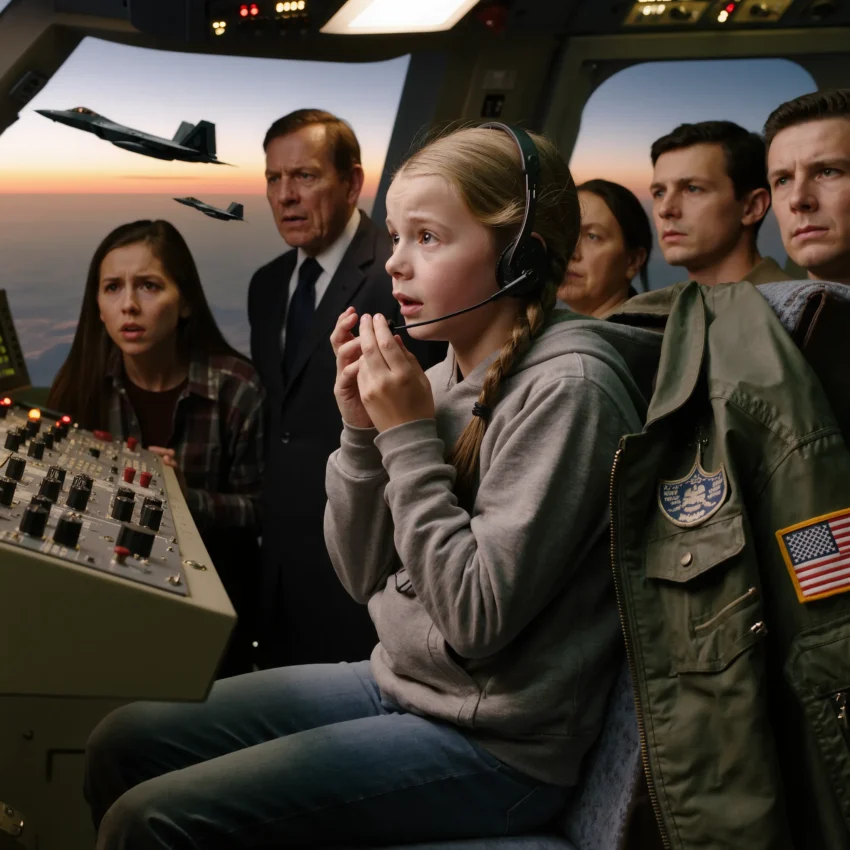
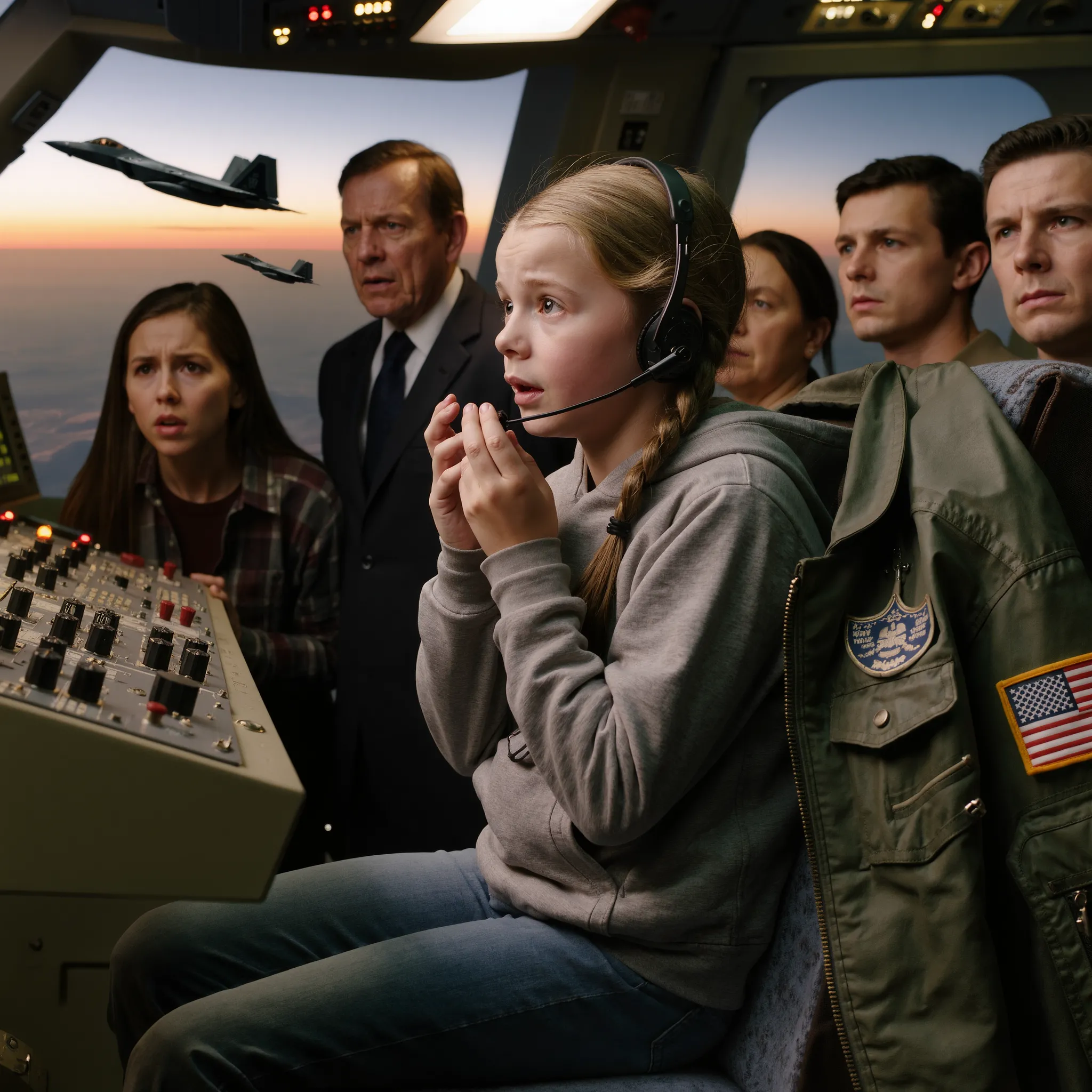
Then the jets appeared.
At first just contrails out the window.
Then shape.
Sharp, impossible, gray.
Emily felt her whole body go cold.
She knew those aircraft.
Had drawn them a hundred times in her notebooks, memorizing the brutal elegance of their angles because her father loved them in the complicated respectful way pilots love things that can kill you if misread.
F-22 Raptors.
They slid into view beside the airliner like predators deciding whether the thing they shadowed was sick, dangerous, or both.
Other passengers began to notice too.
Gasps rippled through the cabin.
Phones came up.
Children pressed hands against windows in awe while adults did the harder arithmetic and realized fighter jets do not casually escort passenger planes outside air show footage.
The intercom came alive again, but this time the voice was not from the cockpit.
“Flight 219, this is United States Air Force Interceptor Viper. You are entering restricted airspace. Acknowledge immediately.”
The words hit the cabin like a dropped tray in a church.
Passengers froze.
Then everyone spoke at once.
What did that mean?
Why was the military talking to them?
Why wasn’t the captain answering?
Emily felt the blood drain from her face.
She didn’t know the full protocol, but she knew enough.
Unresponsive aircraft.
Restricted airspace.
Interceptors.
Her father had never sugarcoated what certain flights became if communication vanished near the wrong coordinates.
Inside the cockpit, Captain Reeves and First Officer Delgado were no longer pretending the problem was temporary.
Every primary comm channel had failed. Backup attempts dissolved into static. Navigation had drifted enough to push them dangerously close to airspace no civilian crew ever wants to enter without talking to somebody. What the cabin experienced as a strange tension, the cockpit experienced as the beginning of a military decision tree.
And decision trees at that altitude do not care about people individually.
They care about risk.
The lead flight attendant—Harper, according to the name pinned at her collar—moved with escalating urgency now, checking the front galley service panel and the old emergency communication access terminal rarely touched outside drills.
Emily watched her, then heard herself stand before she had fully chosen to.
“I think I can help.”
Every nearby head turned.
Harper blinked.
“You?”
Emily almost backed down right there.
She was fourteen.
A skinny girl in row 7A holding a backpack full of grief and a flight jacket too large for her. Around her, adults were already looking with some combination of disbelief and concern and the mild alarm people reserve for children stepping into adult fear.
But if there is a cruel gift in being underestimated early, it is that you sometimes learn to keep speaking long enough for the truth to arrive.
“My dad was Air Force,” she said. “He taught me radio calls. Emergency channels. I can try the auxiliary panel.”
That last part was only partly certain.
She knew such panels existed.
Knew the language, the logic, the rhythm of communication. Knew her father had made her repeat callouts until she could say them half asleep.
Clear communication saves lives, little Falcon.
Harper stared at her one second longer, then looked toward the galley phone, the dead cockpit door, the rattled cabin, and the fighters visible through the windows.
Desperation has a way of clarifying what counts as ridiculous.
“Come with me.”
The old access panel sat behind a hatch near the forward service station, bulkier and more analog than the sleek systems in the cockpit. Emily slid into the narrow fold-down seat, pulled on the oversized headset, and had one terrible instant of wanting to cry because her father’s voice seemed suddenly so close she could almost smell coffee and hydraulic fluid.
Then she keyed the transmitter.
Static hissed.
Her first attempt came out thin.
“Flight 219 to interceptor…”
She stopped.
Reset.
Closed her eyes.
And heard him clearly this time.
Not as fantasy.
As memory under pressure.
Eyes up, little Falcon.
When she spoke again, the words arrived from somewhere steadier.
“This is Little Falcon.”
The cabin went silent.
Not because they understood.
Because the name sounded wrong and intimate and somehow powerful enough to interrupt panic.
Out in the sky, inside the Raptors, both pilots stiffened almost visibly.
Major Cole looked across instruments toward the giant airliner and then at the coded inheritance in that one phrase.
“Say again,” he said, voice lower now. “Civilian aircraft, did you identify as Little Falcon?”
Emily swallowed.
“Yes. This is Little Falcon. We’ve lost cockpit communications. Passengers are safe. Please don’t fire.”
For one impossible moment the comm line held only breathing.
Then Cole asked the question that split her chest cleanly down the middle.
“Who was your father?”
Emily’s fingers shook on the transmit button.
“Colonel Daniel Carter. Call sign Falcon.”
Hayes made a sound over the other channel that was half inhale, half grief. Cole’s face changed in a way only old loyalty can cause.
Falcon had trained them both.
Not just another superior officer.
The kind of pilot whose standards become muscle memory in the people who survive him. The kind who leaves more than stories behind. Who leaves procedures. Instincts. Names.
Hayes came through first.
“He was our instructor,” she said softly. “If you’re his little Falcon… then you’re family.”
Emily had not cried in public since the funeral.
Now tears burned instantly behind her eyes.
Not because she felt safe.
Because for the first time in two years, the name her father gave her had reached the world outside grief and been recognized on the other side.
Back in military command, the situation became more complicated and somehow more dangerous at once.
A child on the aircraft had established contact.
A child with the surname Carter.
A child using Falcon’s private nickname.
Major Cole argued immediately for more time. Captain Hayes backed him with the kind of conviction younger officers usually reserve for orders they know will cost them later. In the command room, generals stared at radar blips, legal thresholds, and the creeping geometry of an unresponsive civilian jet edging toward forbidden airspace.
No one wanted to be the person who either hesitated too long or acted too soon.
That is the burden of high command in modern democracies.
History writes bravery and failure in larger fonts than doubt, but doubt is what men like that actually live inside.
The general in charge was old enough to have known Daniel Carter by reputation and just old enough in conscience for that fact to hurt.
“We do not make national defense decisions on sentiment,” he said.
But sentiment, he knew, was not the issue.
Credibility was.
And the girl sounded disturbingly credible.
Inside Flight 219, the tension only sharpened.
Communication had bought them time, not safety.
Captain Reeves finally opened the cockpit door when Harper explained the impossible arrangement at the service panel. He looked exhausted enough to trust the wrong person if they sounded calm enough, and Emily sounded calm because terror had already stripped her voice down to essentials.
He brought her forward.
The cockpit felt smaller than her father’s simulator and infinitely more alive. Warning lights. dead radios. error messages. the physical presence of failing systems rather than the abstract cleanliness of training.
First Officer Delgado was still conscious, but barely, fighting both the aircraft and the silence wrapped around it.
Reeves gave Emily one look and made a calculation every commander eventually has to make under stress.
He did not ask whether she was old enough.
He asked whether she could be useful.
“Tell them we’re manual only,” he said. “And tell them we’re not drifting on purpose.”
Emily relayed the message.
The words mattered because drift, seen from an interceptor, can look a lot like hostile maneuvering when no cockpit can answer for it.
Outside, the Raptors tightened formation.
No longer predators.
Escorts.
Guardians of a target one decision away from becoming ruin.
The cabin sensed the shift without understanding it fully. Panic softened into a different emotion—fragile hope, maybe, or awe too nervous to trust itself.
Passengers watched the gray jets hold position beside them and began whispering less like victims and more like witnesses.
Then the stabilizer started to run away.
Emily saw it in the cockpit before anyone explained it.
Trim indicators drifting wrong.
The nose wanting to creep downward.
Captain Reeves fighting more wheel than he should have needed.
Her father had once drilled emergency trim procedures into her as a rainy-day simulator challenge because, as he put it, most pilots practice the glamorous failures and neglect the stupid ugly ones that actually kill people.
Now that lesson came back whole.
“What about the manual trim override?” she asked.
Both men looked at her.
Not because the idea was absurd.
Because it was right.
Delgado reached.
Spun the alternate wheel.
The aircraft steadied just enough to become survivable again.
“Viper, Valkyrie,” Emily transmitted quickly, “trim is responding. We’re stabilizing.”
Cole’s reply came so fast it felt like he had been waiting with his own breath held.
“Copy that, Little Falcon.”
Hayes added, gentler, “Your dad would be proud.”
That nearly undid Emily.
Nearly.
But the sky still had demands to make.
The aircraft was flying manually toward a narrow corridor of mercy, and at the far end of that corridor sat Washington and the final line of command patience. In the military room full of screens, the general extended the intercept window once. Then once more. Cole and Hayes did not just request time now; they staked themselves on her. Careers. wings. authority.
“If you don’t trust her,” Cole said at one point, voice hard enough to cut glass, “trust me.”
That sentence changed the room.
Not because rank gave him the right to defy the structure.
Because integrity under pressure is contagious in the best and worst possible ways.
People higher up now had to decide whether they trusted the pilots they trained, the daughter of the man they once respected, or their own fear of being wrong too late.
Emily heard enough over the channel to understand the truth.
This was no longer just about equipment failure.
It was about whether human beings under pressure would still recognize one another accurately.
Her father had once told her duty and fear travel together. Fear wants stillness. Duty wants motion.
Now, with the headset warm against her ear and the whole cabin behind her breathing inside that sentence, she pressed the transmit button and gave the only thing she had left that could matter.
“This is Little Falcon,” she said. “Flight 219 is under control. We are not a threat. Please let us come home.”
There are speeches and there are true things.
That was a true thing.
For a few seconds no one answered.
Then Cole did.
“Command, Viper confirms target stable. Standing down from engagement.”
Hayes came after him.
“Valkyrie confirms. We escort them home.”
The general looked at the glowing screens, at the timeline, at the risks, at the ghost of Daniel Carter hanging somewhere in the room because everyone there knew what his judgment had once been worth.
Then he said the words that reopened the future.
“Hold fire.”
The relief inside the aircraft did not arrive as a roar.
It arrived in waves.
A mother collapsing over her sleeping child.
The businessman across the aisle whispering thank God into both hands.
One of the flight attendants sitting down suddenly because her knees had finally learned they were allowed to shake.
In the cockpit, Emily removed the headset for a second and realized her own arms were trembling uncontrollably now that the worst line had moved behind them.
Harper wrapped an arm around her shoulders and held her there like someone who knew heroism is often just the body that still needs a hug after the procedure is over.
The landing, after all that, was almost mercifully ordinary.
Reeves and Delgado—helped, guided, stabilized by everything that had been won through those terrible minutes—brought the aircraft down under escort and set it safely on the runway while emergency vehicles stood ready in red-lit silence.
Only when the wheels touched and the engines finally wound down did the cabin fully explode.
Applause.
Sobbing.
Strangers embracing.
The sort of emotional collapse people postpone until the body no longer has to pretend usefulness.
Emily stayed seated for a second longer than everyone else.
Her father’s jacket was clutched in both hands now.
The leather pressed warm against her palms.
She did not feel like a hero.
She felt like a bridge.
Something old had crossed into the present through her and been recognized before disappearing again into history.
At the bottom of the stairs, under floodlights and the whipping night wind, Cole and Hayes waited beside their Raptors with helmets tucked under one arm.
Cole crouched so his eyes were level with hers.
“Your father saved my life in training once,” he said. “Today you saved all of ours.”
Hayes smiled through tears she made no effort to hide.
“Falcon’s wings never left the sky,” she said. “They just changed pilots.”
Emily almost laughed and cried at once.
Instead she answered with the one truth that felt big enough.
“I just used what he taught me.”
Cole nodded.
“That’s all any of us ever do.”
The story went everywhere, of course.
Child passenger prevents shootdown.
Fourteen-year-old makes contact with fighter escort.
Daughter of fallen Air Force pilot helps save Flight 219.
Cable news devoured it. Social media mythologized it. Pundits found angles. Politicians found statements. For several days the whole country seemed unable to look away from the image of a teenage girl in seat 7A speaking into a headset while two F-22s held the line between trust and catastrophe.
Emily hated most of that.
Not because the attention was unfair.
Because attention rarely knows what to do with reality.
Reality was not a neat story about bravery.
Reality was her father’s voice returning at the worst possible second and her body answering before doubt could fully stand up.
Reality was the crew who held the cabin together, the pilots who fought blind instruments, the interceptors who risked their own careers to buy her more time, and the general who finally chose restraint over protocol’s easiest violence.
At the press conference the next afternoon, she said exactly that.
No one saved the plane alone.
Yes, she made the call.
Yes, she helped hold communication when no one else could.
No, she was not some miracle child sent from nowhere.
She was the daughter of a pilot who had taught her to speak clearly when it mattered.
Then she said something sharper.
“I know what it’s like to be told you’re too young, too emotional, too inexperienced, too much of the wrong thing for pressure,” she said into the microphones. “But pressure doesn’t care what people called you before it arrives. It only cares whether you can act when it does.”
That line spread even faster than the footage.
Girls wrote it in notebooks.
Women in uniform messaged it to one another across bases and offices.
An eighth-grade teacher in Kansas pinned it over her classroom door.
When the offers came—and they came quickly—Emily ignored almost all of them.
Book agents. television interviews. scholarship branding. half a dozen institutions suddenly eager to retroactively associate themselves with her courage.
What she accepted instead was smaller and much more dangerous in the long term.
Influence.
She used the airline’s gratitude and the Air Force’s public interest to launch a scholarship and training fund for students told they did not fit aviation in the right shape. Girls. minority cadets. kids from towns with no flight schools and no family money and too many adults who still mistook familiarity for destiny.
The Emily Carter Flight Fund started with one announcement and a room full of cameras.
It became something real because she would not let it remain symbolic.
Years passed.
The headlines cooled.
The legend did not.
Emily grew taller. Sharper. Quieter in some ways, bolder in others. She did not become famous in the celebrity sense, because she refused the machinery that would have made her consumable. She became something harder to process and therefore more durable.
An example.
A standard.
A story passed between young flyers and cadets and underdogs with the particular force stories acquire when they are not merely uplifting, but tactically useful.
She went back to the cockpit world carefully.
Not as a prodigy, and never as a mascot.
As a student again first.
Then as an instructor.
Then as a designer of emergency-scenario training programs far more honest than the old ones. She helped build modules around communication loss, authority under uncertainty, and the psychology of command when every available option feels morally poisonous.
It turns out there is no better teacher of ambiguity than someone once forced to live inside it publicly.
One rainy evening, three years after Flight 219, a teenage boy named Jacob came to the academy office with a duffel bag at his feet and a notebook full of aircraft drawings.
He had been on the plane.
Seat 23C.
He remembered her voice over the cabin speakers and the strange unreal sight of fighter jets pacing the windows while adults prayed and cried and failed to understand what was happening quickly enough.
Now he wanted to fly.
Not because he loved glory.
Because the day almost killed him and instead showed him what he was willing to become.
Emily read through the notebook in silence.
Every page held the old familiar hunger.
The sort she recognized because no one ever completely stops being the child who wanted the sky before the world explained all the practical reasons not to.
“You’ve got the instincts,” she told him. “You just need the path.”
She accepted him into the Fund that night.
He cried.
She pretended not to notice long enough to save him embarrassment.
That became another pattern.
One student after another.
One letter after another.
One young person after another walking into her orbit carrying the same old damage disguised in different language: they told me this wasn’t for people like me.
Emily built the answer not through speeches, but infrastructure.
Scholarships. mentorship. simulator hours. honest instructors. runway time. second chances.
By the time McKenzie Ridge—yes, later named in public memory as a symbolic sister site to Flight 982’s story, though that was not her flight—became a fully modernized emergency-training strip used in national drills, Emily had already stopped trying to disentangle herself from what the country thought she represented.
That battle bored her.
Symbols are what publics make.
Work is what people choose.
She chose work.
The day she visited the Smithsonian annex and found a small exhibit about Flight 219, she stood for a long time in front of the case that held a replica headset, transcript excerpts, and a plaque describing “the unnamed courage of a teenage passenger who restored trust between a civilian airliner and military interceptors at a moment of national peril.”
It was less sentimental than she feared.
More accurate than most coverage had been.
Still incomplete.
All exhibits are.
A museum can preserve the headset, the voice log, the chain of command.
It cannot preserve the smell of her father’s jacket in her backpack or the way Major Cole’s voice changed when he heard Falcon’s name or the private violence of realizing that grief, when trained well enough, can one day become competence instead of only pain.
That remained hers.
Sometimes that is enough.
Years later, when people asked what the hardest part had been, they expected her to say fear.
Or the jets.
Or the possibility of being shot down by her own country.
She always said no.
The hardest part, she explained, was understanding that the world had been one decision away from killing everyone on that aircraft because systems are not built to trust children, daughters, or private grief speaking over emergency frequencies.
The hardest part was that she had been believed only after men in cockpits recognized her father first.
That did not make what happened less beautiful.
It made it more honest.
And honesty, Emily had learned, is where useful change begins.
So she told the full version whenever she could bear it.
The pilots in the cockpit mattered.
The attendants mattered.
The interceptor pilots mattered.
The command hesitation mattered.
Her father mattered.
And yes, she mattered too.
Not because she was miraculous.
Because she was prepared in ways no one had valued properly until emergency made that failure visible.
That is the lesson she wanted remembered.
Not that a fourteen-year-old somehow became extraordinary overnight.
But that skill can live quietly inside people institutions underestimate until history corners everyone into admitting what was there all along.
On certain nights, when the academy had gone quiet and the runway lights glowed beyond the office windows, Emily would take out the old leather jacket and drape it across the back of her chair.
Not because she still needed to grieve exactly the old way.
Because grief had changed shape.
It no longer only hurt.
It instructed.
It reminded.
It sat with her while she reviewed student applications and simulator notes and emergency debriefs, a silent witness to the simple fact that legacy is not what gets buried with the dead.
It is what keeps teaching after them.
Flight 219 never truly ended for the people who lived through it.
Some passengers still wrote her every year.
Harper sent a Christmas card without fail.
Captain Reeves once mailed her a photograph of the crew standing on a runway at sunset with the note: You were right. Nobody lands anything alone.
Major Cole and Captain Hayes both attended one of the academy fundraisers years later in civilian clothes and let the room applaud them only after Emily publicly insisted that guardians deserve witness too.
When she thanked them, Hayes smiled and said, “We still just call you Little Falcon.”
Emily laughed.
The name no longer hurt.
Not the way it once had.
It had become less a reminder of what was gone than of what endured.
That may be the closest thing grief offers to peace.
Not replacement.
Not closure.
Just continuity sturdy enough to live inside.
The final truth of the story is neither the fighter jets nor the press conference nor the viral footage of a teenager at an emergency comm panel while passengers held their breath.
It is this.
A girl sat in seat 7A carrying her father’s jacket and all the pieces of a world she thought she had lost with him.
When the sky asked for those pieces back, she gave them.
And because she did, 180 people came home.
Everything after that—the recognition, the academy, the scholarship fund, the students, the changed policies, the stories other girls would tell themselves in moments of doubt—grew from the same root.
She answered.
That was all.
That was everything.
And somewhere above every runway she ever touched afterward, the old call sign still moved with her.
Not as a ghost.
As inheritance.
Falcon had once taught a child to speak clearly under pressure.
Little Falcon did.
The sky heard both.