A constitutional crisis is brewing within America’s federal court system as the nation’s highest judicial authority confronts an unprecedented pattern of defiance from lower courts. The confrontation has reached a breaking point, prompting one of the Supreme Court’s most respected conservative justices to issue a stern warning that strikes at the heart of judicial hierarchy and constitutional order in the United States.
Justice Neil Gorsuch, appointed by President Donald Trump, delivered a scathing rebuke to lower federal courts on Thursday that has sent shockwaves through the American legal system. His extraordinary warning came as the Supreme Court handed the Trump administration a narrow but significant victory in a closely watched case involving federal research funding and diversity programs.
“This marks the third time in a matter of weeks this Court has had to reverse a lower court on an issue it had already addressed,” Gorsuch wrote in a stinging concurrence joined by Justice Brett Kavanaugh. His words carry particular weight given his reputation for measured judicial temperament and careful legal reasoning.
The justice’s frustration was palpable as he continued: “Lower court judges may sometimes disagree with this Court’s decisions, but they are never free to defy them.” This statement represents more than legal instruction—it constitutes a direct challenge to what appears to be systematic resistance within the federal judiciary to Supreme Court authority.
The timing and tone of Gorsuch’s warning suggests that the Supreme Court views the current situation as a fundamental threat to the constitutional structure of American government, where the hierarchy of federal courts has traditionally ensured consistent application of the law across the nation.
The immediate catalyst for Gorsuch’s unprecedented warning emerged from a complex dispute over federal research funding that illustrates the broader ideological battles reshaping American institutions. In a narrow 5-4 decision, the Supreme Court allowed the Trump administration to cut millions of dollars in National Institutes of Health (NIH) grants that supported projects tied to diversity, equity and inclusion (DEI) initiatives, gender identity research, and COVID-19 studies.
This ruling represents a significant victory for the Trump administration’s efforts to dismantle what it characterizes as ideologically driven federal programs. The NIH, recognized as the world’s largest source of public biomedical research funding, will no longer award grants based on race or DEI objectives under this decision, fundamentally altering how federal research dollars are allocated.
The case arose after a federal judge in Massachusetts directly defied a Supreme Court ruling from earlier this year that had already permitted Trump to cut similar DEI-related grants. This act of judicial rebellion prompted a coalition of 16 Democratic attorneys general and public health groups to file suit, alleging systematic discrimination against minority researchers and LGBTQ+ community members.
The Massachusetts court’s decision to order continued payments despite clear Supreme Court precedent represents exactly the type of judicial defiance that has prompted Gorsuch’s stern warning. The lower court’s actions suggest either a fundamental misunderstanding of judicial hierarchy or a deliberate attempt to undermine Supreme Court authority through procedural manipulation.
The Supreme Court’s 5-4 split decision revealed the complex dynamics currently shaping the nation’s highest court, with Justice Amy Coney Barrett providing the crucial deciding vote in a carefully calibrated ruling that addressed multiple aspects of the dispute.
Barrett joined conservative Justices Clarence Thomas, Samuel Alito, Gorsuch and Kavanaugh in terminating the NIH grants, demonstrating the conservative majority’s commitment to dismantling DEI-related federal programs. However, in a move that illustrates the nuanced nature of judicial decision-making, she sided with Chief Justice John Roberts and the three liberal justices—Sonia Sotomayor, Elena Kagan and Ketanji Brown Jackson—to leave intact a lower court’s decision scrapping NIH guidance documents that described the agency’s policy priorities.
This split decision reflects Barrett’s emerging role as a swing vote on certain issues, even within the Court’s conservative majority. Her willingness to break with conservative colleagues on the guidance documents suggests that she distinguishes between direct funding decisions and broader policy communications, a nuance that may prove significant in future cases.
The liberal justices’ unified opposition to cutting the research grants underscores the deep ideological divisions within the Court on issues related to diversity, equity, and federal funding priorities. Their position reflects broader Democratic concerns that the Trump administration’s policies constitute systematic discrimination against minority communities and researchers.
Gorsuch’s warning gains particular significance from his detailed documentation of what he characterizes as a systematic pattern of lower court defiance that threatens the fundamental structure of the American judicial system.
The justice stressed that the Massachusetts district court’s actions were not a “one-off” incident, pointing to two other recent cases where lower courts had actively resisted Supreme Court orders in ways that suggest coordinated resistance rather than isolated misunderstandings of legal precedent.
In July, the Supreme Court ruled 7-2 to block a district court’s attempt to override the high court’s order allowing Trump to resume third-country deportations. The overwhelming nature of this ruling—with even liberal Justice Elena Kagan, who had dissented from the original order, siding with the majority to enforce it—demonstrates the seriousness with which the Supreme Court views challenges to its authority.
Kagan’s pointed observation captures the constitutional crisis at stake: “I do not see how a district court can compel compliance with an order that this Court has stayed.” Her willingness to enforce a ruling she had originally opposed illustrates the principle that judicial hierarchy must supersede individual policy preferences.
That same month, the Supreme Court struck down another lower court ruling that sought to block Trump from firing three Democratic members of the Consumer Product Safety Commission (CPSC). This case was particularly egregious because the justices had already granted Trump authority in May to dismiss members of administrative agencies, making the lower court’s intervention a direct challenge to established Supreme Court precedent.
Gorsuch’s warning extends beyond immediate political disputes to address fundamental principles of constitutional governance that have guided American democracy for over two centuries. His emphasis on judicial hierarchy reflects core principles established in the Constitution and reinforced through centuries of legal precedent.
“All these interventions should have been unnecessary, but together they underscore a basic tenet of our judicial system: Whatever their own views, judges are duty-bound to respect ‘the hierarchy of the federal court system created by the Constitution and Congress,’” Gorsuch wrote, invoking constitutional authority to support his position.
This statement represents more than legal technicality—it constitutes a defense of the constitutional structure that ensures consistent application of federal law across the entire United States. The federal court system’s hierarchical structure serves as a crucial mechanism for maintaining legal uniformity and preventing the kind of chaotic patchwork of conflicting rulings that could undermine national governance.
The Constitution’s establishment of the Supreme Court as the final arbiter of federal law reflects the Founders’ understanding that effective governance requires clear lines of authority and mechanisms for resolving disputes between different levels of government and different regions of the country.
The specific focus on DEI-related programs in this case reflects broader cultural and political battles that have increasingly characterized American institutions in recent years. Since returning to office in January 2025, Trump has signed executive orders dismantling Biden-era DEI programs, characterizing them as “radical” and “shameful discrimination.”
This characterization represents a fundamental reframing of diversity and inclusion efforts, casting them not as remedial measures designed to address historical discrimination but as forms of reverse discrimination that violate constitutional principles of equal treatment under law.
Last April, the Supreme Court had already upheld Trump’s authority to cut teacher training grants linked to DEI initiatives, establishing a clear precedent that Gorsuch emphasized the Massachusetts court chose to ignore in the current NIH case. This pattern of established precedent followed by lower court resistance illustrates the systematic nature of the judicial defiance that prompted Gorsuch’s warning.
The targeting of federal research funding represents a significant escalation in efforts to eliminate DEI considerations from government operations. Research institutions and universities have become particular flashpoints in these battles, as they represent both significant recipients of federal funding and institutions where diversity and inclusion efforts have been most extensively implemented.
The specific actions of U.S. District Judge William Young, a Reagan appointee, in the Massachusetts case illustrate the personal and ideological dimensions of the current judicial crisis. Young’s decision to order NIH to restore the grants came after lawsuits from researchers and 16 Democratic-led states, but his reasoning and language reveal the depth of ideological commitment driving some lower court resistance.
Young used unusually sharp and politically charged language in his ruling, declaring: “This represents racial discrimination and discrimination against America’s LGBTQ community. I would be blind not to call it out. My duty is to call it out.” This statement goes far beyond typical judicial language to embrace explicit advocacy for particular policy outcomes and social groups.
The judge’s characterization of cutting DEI funding as “discrimination” reflects a fundamental disagreement with the Supreme Court’s approach to these issues, suggesting that some lower court judges view their role as protecting particular communities and causes rather than simply applying established legal precedent.
The fact that Young is a Reagan appointee makes his defiance particularly notable, as it suggests that resistance to Supreme Court authority crosses traditional partisan lines and reflects deeper institutional and ideological commitments that transcend simple political affiliation.
Justice Barrett’s concurring opinion revealed additional layers of complexity in the case that illuminate broader problems with how lower courts are handling politically sensitive disputes. Barrett argued that the case should have been filed in the U.S. Court of Federal Claims in Washington rather than in a district court, highlighting procedural irregularities that may facilitate judicial resistance.
The Court of Federal Claims typically hears disputes involving federal contracts and could award monetary damages later, but would not provide the immediate injunctive relief that plaintiffs sought in this case. Barrett’s observation suggests that strategic forum shopping may be enabling lower courts to exceed their proper jurisdiction in order to achieve desired policy outcomes.
This procedural dimension adds another layer to the constitutional crisis, as it suggests that some attorneys and judges may be manipulating jurisdictional rules to circumvent Supreme Court authority and achieve results that would not be available through proper legal channels.
The use of procedural complexity to undermine substantive legal rulings represents a particularly troubling form of judicial resistance, as it makes Supreme Court oversight more difficult while maintaining the appearance of following proper legal procedures.
The broader context of these cases involves fundamental questions about executive authority and the administrative state that have become central to contemporary constitutional law. The Trump administration’s efforts to cut DEI-related funding and fire administrative agency members reflect broader attempts to assert presidential control over the federal bureaucracy.
The Supreme Court’s support for these executive actions represents a significant victory for proponents of the unitary executive theory, which holds that the President must have direct control over all executive branch operations. This constitutional principle has become increasingly important as federal agencies have gained extensive regulatory and policy-making authority.
Lower court resistance to these executive actions suggests disagreement not just with specific policy decisions but with broader questions about presidential authority and the proper relationship between different branches of government. This constitutional dimension explains why the Supreme Court has responded so forcefully to what it views as judicial overreach.
The current pattern of lower court defiance has historical precedents that illuminate both the seriousness of the situation and potential consequences if the crisis continues. Throughout American history, conflicts between different levels of the federal judiciary have typically been resolved through established hierarchical mechanisms that ensure Supreme Court supremacy.
However, the current situation appears to involve more systematic resistance than typical disagreements about legal interpretation. The pattern of defiance that Gorsuch documented suggests institutional breakdown rather than routine legal disagreement, raising questions about the long-term stability of federal judicial authority.
Historical episodes of judicial resistance, such as during the Civil Rights era or New Deal period, typically involved clear ideological and political divisions that were eventually resolved through political processes and personnel changes. The current situation may require similar institutional responses if lower court resistance continues.
The constitutional crisis identified by Justice Gorsuch has implications that extend far beyond immediate political disputes to threaten the fundamental integrity of the American legal system. If lower courts can systematically ignore Supreme Court precedent based on ideological disagreements, the predictability and consistency that make law effective could be seriously undermined.
Legal systems depend on hierarchical authority structures that ensure consistent application of rules and precedents across different jurisdictions and time periods. When lower courts feel free to ignore higher court rulings based on policy disagreements, this consistency breaks down and law becomes arbitrary and unpredictable.
The business community, research institutions, and other organizations that depend on consistent legal frameworks for planning and operations could be seriously affected if judicial authority continues to fragment along ideological lines.
The Supreme Court’s unprecedented warning to lower courts sets the stage for potential institutional confrontations that could reshape the federal judiciary and its relationship to other branches of government. If lower court resistance continues, the Supreme Court may need to take increasingly direct action to enforce its authority.
Potential remedies could include more frequent use of emergency appeals, direct sanctions against defiant judges, or legislative action to clarify judicial hierarchy and enforcement mechanisms. However, each of these approaches carries risks for judicial independence and the separation of powers that are fundamental to constitutional governance.
The resolution of this crisis will likely determine whether the federal judiciary maintains its traditional hierarchical structure or evolves toward a more fragmented system where different levels of courts operate with greater independence but less consistency.
Justice Gorsuch’s unprecedented warning to lower courts represents more than routine judicial housekeeping—it constitutes a defense of constitutional principles that are fundamental to American governance. The pattern of defiance he documented threatens not just Supreme Court authority but the predictability and consistency that make law effective.
The specific disputes over DEI funding and administrative authority that triggered this crisis reflect broader political and cultural divisions that have increasingly characterized American institutions. However, the constitutional principles at stake transcend immediate political disagreements to address fundamental questions about judicial hierarchy and legal authority.
The outcome of this constitutional confrontation will influence not just the immediate disputes over Trump administration policies but the long-term structure and authority of the federal judiciary. Whether the American legal system maintains its traditional hierarchical character or fragments along ideological lines may depend on how successfully the Supreme Court can reassert its authority over resistant lower courts.
As this institutional crisis unfolds, it will test fundamental assumptions about judicial independence, constitutional authority, and the rule of law that have guided American democracy for over two centuries. The stakes could hardly be higher for the integrity and effectiveness of the American legal system.
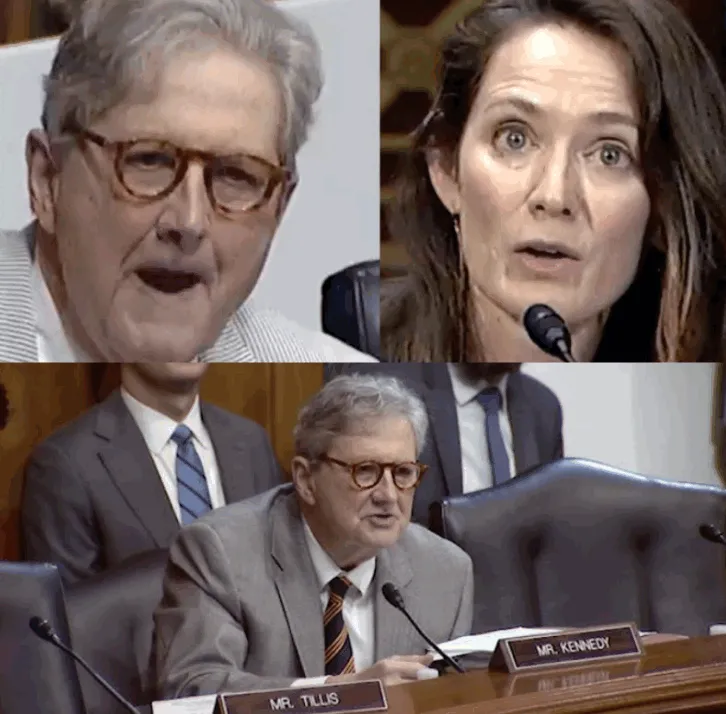
Washington, D.C. — In a Senate hearing that quickly became a viral sensation, Senator John Kennedy of Louisiana delivered a series of pointed, often scathing interrogations that left witnesses squirming, the gallery buzzing, and millions of Americans glued to their screens. Kennedy’s signature blend of Southern wit, blunt honesty, and razor-sharp skepticism exposed deep cracks in the nation’s education, banking, tech, and justice systems—all while landing the soundbite that would dominate headlines: “You know what I’m embarrassed at? That you’re teaching our kids!”
.
.
.
Fentanyl, Cartels, and the Mexican Connection
The hearing began with a focus on the deadly flow of fentanyl into the United States. Kennedy wasted no time, grilling Dr. Farfon about the Mexican administration’s approach to drug cartels. “President Lopez Obrador ran on the slogan ‘hugs not bullets,’ didn’t he?” Kennedy pressed, refusing to accept evasive answers. When Farfon tried to correct him, Kennedy doubled down, highlighting the alleged complicity of Mexican leaders with cartel interests.
He illustrated the crisis with chilling visuals—bags of fentanyl and PCP representing quantities that could wipe out entire towns. “Is fentanyl more dangerous than PCP?” Kennedy asked. “Absolutely, Senator,” came the reply. Kennedy’s frustration boiled over as he compared sentencing disparities for drug dealers. “Does that make any sense to you?” he demanded. “No, sir,” the witness admitted. “It’s like sell-deep stupid, isn’t it?” Kennedy quipped, drawing nervous laughter.
He then introduced his bill, the Fairness in Fentanyl Sentencing Act, vowing to punish dealers and lower the threshold for mandatory minimum sentences. “This bill won’t punish addicts. It’ll punish dealers. But it’s not going to help until Mexican leaders get out of the pockets of the drug cartels. But it’s a start.”
Culture Wars, Banking, and Political Bias
Moving on, Kennedy shifted the spotlight to American banks, confronting witnesses about “debanking” customers for their religious beliefs, support of the Second Amendment, or ties to fossil fuels. “Which banks?” Kennedy demanded. “Bank of America, Chase, Citi, Key Bank,” the witness replied. Kennedy called for CEOs to testify, determined to expose political bias in financial institutions.
He probed deeper, asking whether banks discriminated out of fear of regulators or personal political agendas. “When a bank holds a seminar to discuss whether a man can breastfeed, is that because of regulators, or is it the CEO’s politics?” Kennedy asked, incredulous. “It’s the latter,” the witness replied. Kennedy’s solution? “You can’t regulate that type of behavior. We need a market solution.”
Social Media: A Cesspool of Exploitation
Kennedy’s interrogation of tech and social media experts was equally fierce. “Can we agree that big parts of social media have become cesspools of snark?” he asked. “Yes,” the witness replied. “Has social media lowered the cost of being a pedophile?” Kennedy pressed. “Absolutely. It made it easy access,” came the answer.
He exposed the economic incentives for tech companies to ignore child exploitation, noting, “They want eyeballs so they can sell them advertising. For them to look is inconsistent with their economic interest.” Kennedy demanded accountability, pointing out the lack of uniform reporting requirements and the failure to punish companies that don’t comply.
Anti-Semitism and Radical Ideology on Campus
Kennedy then turned his attention to anti-Semitism on college campuses, sparring with witnesses over the role of university administrations in fueling hate. “Did you watch what happened at Columbia?” Kennedy asked. “It was clear to me the administration believes in diversity, equity, inclusion, and the right to hurt Jews.”
He challenged the Marxist framing of campus ideology, arguing, “We’re allowing ideology to drive violence. Until you admit there’s radical ideology happening, you cannot fight it.” Kennedy’s bluntness cut through academic equivocation, demanding real answers and accountability.
Supreme Court, Political Bias, and Academic Indoctrination
Perhaps the most viral moment came when Kennedy confronted Professor Franks about her writings and tweets, which accused the Supreme Court of “embracing white male supremacy” and turning the Constitution into a “homicide pact.” Kennedy read her own words back to her, asking, “Did I read that correctly? Do you really think the United States Supreme Court is guided by white male supremacy?”
When Franks tried to deflect, Kennedy pressed harder, referencing a tweet: “The majority of Americans hate women more than they love anything, including democracy.” He asked, “Did you say it?” When the professor hesitated, Kennedy retorted, “You know what I’m embarrassed at? That you’re teaching our kids.”
He continued, “Are you kidding me? You expect us to take you seriously as a witness?” His disgust was palpable. “Curb your enthusiasm? Here’s my saying—curb my nausea.”
Government Accountability and FOIA Reform
Kennedy’s focus then shifted to government transparency, grilling experts on Freedom of Information Act (FOIA) compliance. “Why don’t we just create personal liability for the person responsible for turning over documents?” Kennedy asked. Witnesses agreed that current mechanisms were ineffective and that bad-faith obstructionists should face personal consequences.
“Until Congress makes it clear we’re serious about this, we’ll keep seeing bad faith,” Kennedy declared. “Regardless of who is running the executive branch, you have an affirmative obligation to turn over documents. If you don’t do it, you’re going to be personally liable.”
Healthcare, PBMs, and Vertical Integration
Kennedy didn’t spare the healthcare industry, challenging witnesses on Pharmacy Benefit Managers (PBMs) and vertical integration. “Are prices higher because of vertical integration?” he demanded. “Yes,” the witness replied. Kennedy cut through academic jargon: “Why don’t we skip the foreplay and go right to the sex and outlaw vertical integration for Part D?”
He pushed for fiduciary responsibility and price transparency, saying, “Price transparency just tells us who’s screwing who. Fiduciary responsibility means if you’re getting screwed, I can take you to court.”
Infrastructure, Climate Change, and Housing
Kennedy’s questioning ranged from infrastructure funding to climate change and housing supply. He pressed experts on why project costs ballooned and why universities with massive endowments received the most NIH funding, often spending it on overhead rather than research.
He challenged local governments and universities, “Why can’t you live on 15% overhead when the Gates Foundation limits it to 10%?” Kennedy’s relentless logic left witnesses scrambling for answers.
Digital Assets and Congressional Competence
On the future of digital assets, Kennedy admitted Congress was outmatched by industry experts. “We don’t know as much as the professionals in digital assets know. How can we possibly catch up?” He pressed for regulatory solutions, wary of loopholes and regulatory arbitrage.
The Final Blow: Academic Bias and Judicial Critique
Kennedy’s closing exchanges were some of the most memorable. He confronted professors who had called Supreme Court justices “evil,” saying, “You’re an officer of the court and you say there are evil members of the Supreme Court. Gag me with a spoon. You’re part of what’s wrong with this country.”
His message was clear: “I’m embarrassed you’re teaching our kids.”
A Senate Hearing Like No Other
Senator Kennedy’s hearing was more than political theater—it was a reckoning. He exposed hypocrisy, demanded accountability, and refused to let ideology or bureaucracy stand in the way of truth. His questions were sharp, his patience thin, and his standards unwavering.
The hearing drew national attention, with Kennedy’s soundbites lighting up social media and cable news. Americans watched as he took on academics, bankers, tech executives, and public officials, reminding everyone that in the halls of Congress, tough questions—and tough answers—still matter.
As the dust settled, one thing was clear: Senator Kennedy’s unapologetic approach had forced a national conversation about education, justice, and the future of American democracy. And for many, his words echoed long after the cameras stopped rolling: “You know what I’m embarrassed at? That you’re teaching our kids!”