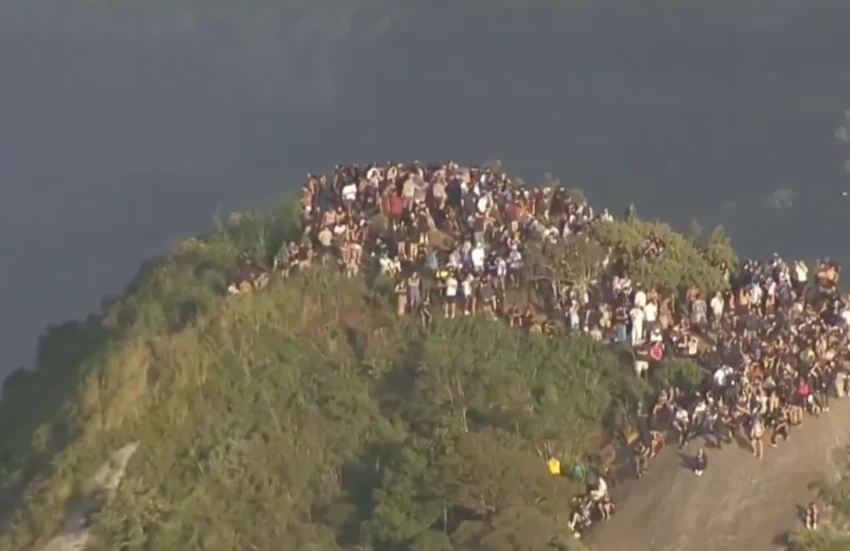
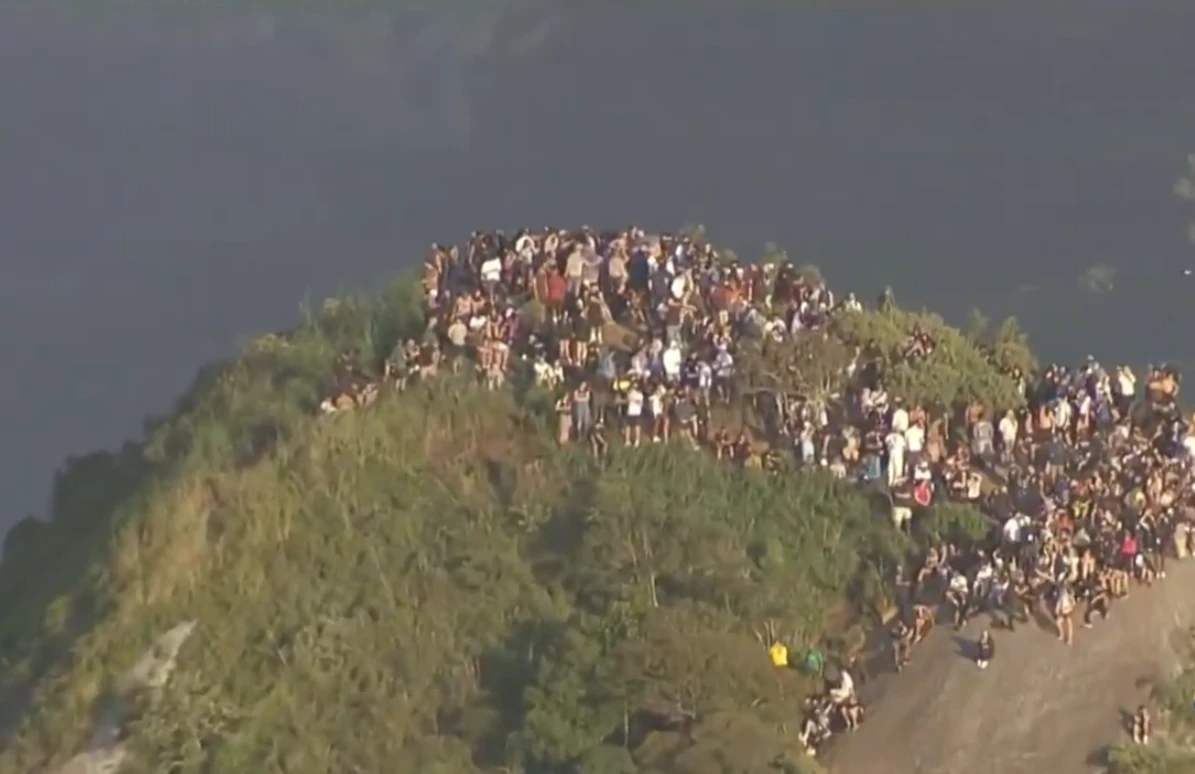
What began as a breathtaking morning high above Rio de Janeiro quickly turned into a nightmare that more than 200 tourists would never forget. Perched on one of the city’s most iconic mountain viewpoints, visitors from around the world had gathered to take photos, admire the coastline, and experience what was supposed to be a peaceful highlight of their trip. Within moments, that calm was shattered by the sound of gunfire echoing across the hills.
At first, many didn’t understand what they were hearing. Some thought it was construction noise, others assumed it might be fireworks or a distant disturbance. But confusion quickly gave way to panic as people began to scream, drop to the ground, and run for cover. The sharp cracks of gunshots grew louder, more frequent, and unmistakably close. What tourists didn’t realize was that just beyond the scenic overlook, a violent confrontation had erupted between police forces and armed gang members.
Authorities had reportedly launched an operation targeting a criminal group believed to be operating nearby, part of an ongoing effort to disrupt organized crime networks in the region. But the situation escalated rapidly when the suspects opened fire, turning what may have been intended as a controlled operation into a chaotic and dangerous shootout. The violence spread toward the tourist area, trapping hundreds of civilians in a place that suddenly became an active conflict zone.
With roads blocked and access points sealed for safety reasons, approximately 200 tourists found themselves stranded on the mountain with no clear way down. The very paths that once guided visitors to scenic views were now potential danger zones. Movement became risky, and staying still felt just as terrifying. The only option for many was to find cover and wait.
Some hid behind concrete barriers, others pressed themselves against walls or crouched behind benches. A few lay flat on the ground, hoping to stay below the line of fire. Tour guides, though visibly shaken, tried to maintain calm, instructing their groups to stay low and avoid sudden movement. But the unpredictability of the situation made reassurance difficult. Every new burst of gunfire reignited fear.
One tourist described the experience as surreal. Just minutes earlier, she had been smiling for photos with the city skyline behind her. Then, without warning, she was lying face down on cold stone, listening to bullets crack through the air. She said the most terrifying part wasn’t just the sound—it was the uncertainty. Not knowing where the shots were coming from, not knowing if it would stop, not knowing if she would make it out.
As the situation unfolded, law enforcement was forced to adapt quickly. Officers engaged in the firefight while simultaneously trying to protect the trapped civilians. Reinforcements were called in, and aerial surveillance was deployed to assess the situation from above. Helicopters circled overhead, both as a tactical advantage and as a potential means of emergency response. But extracting people from a mountainside under active gunfire was no simple task.
The geography of the area added another layer of complexity. Narrow paths, steep drops, and limited access routes made both the police operation and any evacuation efforts significantly more difficult. Every move had to be calculated, not only to neutralize the threat but also to avoid putting more lives at risk.
Reports indicated that the shootout continued intermittently for several hours. Bursts of gunfire would erupt, followed by tense silence, only to begin again. Each pause brought a brief sense of hope, quickly replaced by renewed fear when the shooting resumed. Time seemed to stretch endlessly for those trapped, every minute feeling heavier than the last.
Eventually, authorities were able to gain control of the situation. The armed suspects were pushed back, and the immediate threat began to subside. Only then could officials begin the careful process of evacuating the stranded tourists. Groups were escorted down in stages, under heavy security, with officers guiding them through what had hours earlier been a place of leisure.
Many of those evacuated were in shock. Some were silent, others visibly shaken, their expressions reflecting the trauma of what they had just endured. While early reports suggested that no tourists were physically injured, the psychological impact was undeniable. For many, the memory of that day would linger far beyond the end of their trip.
In the aftermath, questions quickly emerged about safety and preparedness. How could such a large number of tourists be exposed to that level of danger without warning? Could the operation have been conducted differently, further away from public areas? Or was this an unavoidable consequence of policing in a city where criminal networks often operate dangerously close to everyday life?
Experts noted that while efforts to combat organized crime are necessary, incidents like this highlight the risks of conducting operations near densely populated or high-traffic tourist zones. The balance between enforcement and public safety is delicate—and when it fails, the consequences can be severe.
For Rio de Janeiro, a city known for its vibrant culture and world-famous landscapes, such incidents can have broader implications. Tourism relies not only on beauty and experience but also on a sense of security. Even a single event like this can shake confidence and raise concerns among future visitors.
Those who were on that mountain came seeking unforgettable views. And they did leave with something unforgettable—but not in the way they had imagined. Instead of memories filled only with beauty, they carried with them the sound of gunfire, the feeling of fear, and the realization of how quickly a moment can change.
Now, long after the shots have stopped and the mountain has returned to its usual rhythm, one question remains—can places that exist so close to danger ever truly be safe, or is this the hidden reality that travelers rarely see until it’s too late?