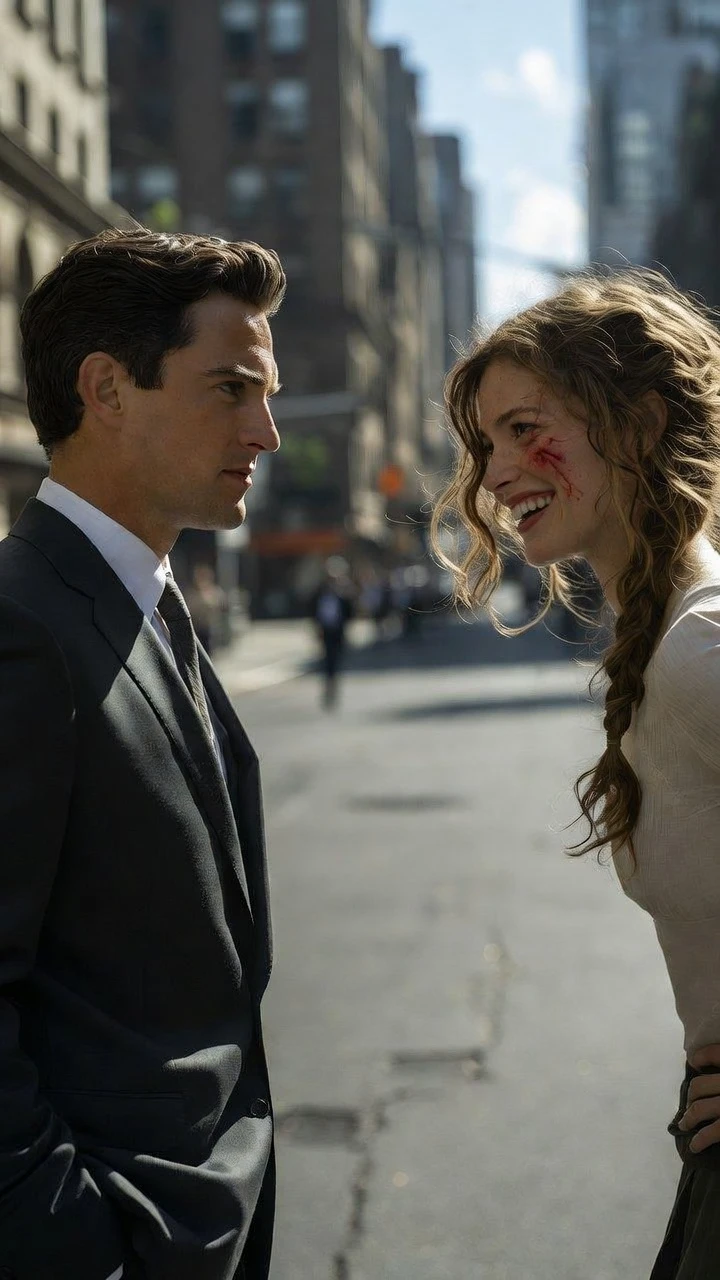
In a 2026 Manhattan, where AI algorithms could scan a face and pinpoint asymmetry to the millimeter, Julian was the “God” who possessed the hands to fix every mistake of nature.
His clinic on 5th Avenue was a cathedral of glass and steel, where supermodels and politicians came to be “restructured” into flawless versions of themselves, paying fees that could support a small town.
Scratch.
The sound of a surgical marker on a patient’s skin.
Julian drew perfectly straight lines.
Cold.
Precise.
He had just signed a massive media contract: “Project Rebirth.”
He needed a “discard” of fate to transform into an inspiring masterpiece.
A perfect marketing campaign to assert his power.
“Find me the most ruined face.”
Julian ordered his assistant.
“But the eyes must be beautiful. I need contrast.”
Beneath the Brooklyn Bridge.
The sea breeze whipped through fiery red curls.
Elara Vance stood there.
Spray can in hand.
A large, jagged, reddish scar stretched from her left temple to her chin – the aftermath of an art lab explosion five years ago.
It looked like a river of cooled lava, bisecting her delicate beauty.
But Elara didn’t hide it.
She held her head high.
Julian stepped out from his sleek black limousine.
His polished leather shoes looked absurd among the rubble and the heavy scent of spray paint.
“Five million dollars.”
Julian said, offering a glossy folder.
“I will erase it. Permanently. You will be the face of ‘Project Rebirth.’ You will be beautiful again.”
Elara stopped painting.
She looked at Julian. Her eyes were deep blue, burning with a light that no scalpel could ever reach.
She laughed.
A vibrant laugh that tore through the street’s silence.
“You think it’s a mistake of nature, Doctor?”
“It’s a horrific asymmetry,” Julian frowned.
“No.”
Elara stepped closer. Her scar in the afternoon sun glowed like red coral.
“It’s the map of my life. It reminds me that I survived the fire. I don’t need you to ‘fix’ my history.”
She turned back to her mural.
Leaving the famous surgeon standing stunned amidst a cloud of purple paint dust.
Julian was obsessed.
Not with the rejection, but with Elara’s strange confidence.
He began to watch her.
Night after night, he stood in the shadows of alleys, watching Elara paint.
She painted the people of New York: the homeless, poor children, those with keloid scars and the wrinkles of time.
Under her brush, those flaws weren’t ugly.
They were alive.
They told stories.
Julian looked in the mirror.
His face was perfect. A 120-degree chin. A straight nose.
But he felt empty.
He realized his patients after surgery all looked identical – soulless dolls mass-produced from a single template.
He saw the vitality in Elara’s eyes when she smiled at a stranger.
A radiant beauty that emanated from the scar itself.
What his algorithm called a “bug” was, in fact, a “soul.”
CRASH!
The horrific sound of twisting metal.
Julian’s sports car slammed into the median on the FDR Drive.
Speed.
Arrogance.
All vanished in a second.
When Julian woke up in the hospital, his world had collapsed.
His body had no significant scars.
But his hands – hands worth hundreds of millions – were trembling.
Post-traumatic stress tremors.
Every time he held a sharp object, his hand jerked uncontrollably.
“I’m sorry, Julian.”
The hospital director looked at him with pity.
“You can no longer hold a scalpel.”
From a “God,” he became a cripple.
Friends vanished.
Ad contracts were canceled.
Julian sat in his million-dollar penthouse, looking at his useless hands and wept.
He wanted to end it.
Because if he couldn’t create perfection, he felt he had no right to exist.
Elara found him on a bench in Central Park.
Julian was gaunt, with stubble growth and hollow eyes staring into space.
She didn’t speak words of pity.
She threw him a palette and a brush.
“Hands shaking?”
Elara asked as she sketched a gnarled old tree.
“I’m no longer a doctor. I’m trash.”
“Then be a piece of trash that paints.”
Elara took Julian’s trembling hands.
She forced him to hold the brush.
“Don’t try to draw straight lines. Let the tremor create the curves. That is your rhythm.”
Julian began to paint.
At first, angry scribbles.
Then, chaotic patches of color.
But under Elara’s guidance, he learned to accept the lack of control.
He learned to see beauty in the blots of watercolor, the crooked lines that he would have once called a disaster.
He realized that healing a wound doesn’t necessarily mean erasing it.
It means turning it into a part of the artwork.
Six months later.
A small gallery in Soho.
No glaring LED lights. No lavish suits.
The central painting was a portrait of a woman.
It was Elara.
The scar on her face in the painting was not blurred.
Julian had painted it with pure gold leaf.
It sparkled like lightning tearing through the night.
It was radiant and proud.
“Dr. Ross, aren’t you going back to the operating room?”
A reporter asked.
Julian looked down at his hands.
They still trembled slightly.
But he was no longer afraid.
“I’ve found a different kind of scalpel.”
He looked at Elara, radiant in the crowd.
“I no longer want to change how people look. I want to help them see the light within their own wounds.”
Julian smiled.
An asymmetrical smile.
A real smile.
True happiness doesn’t lie in a flawless face.
It lies in the resilience of a soul that dares to carry its scars and move forward.
True beauty is not perfection.
It is how the light shines through the cracks.
And New York tonight, for the first time in years, looked beautiful in Julian’s eyes.
Authentic.
And radiant.