
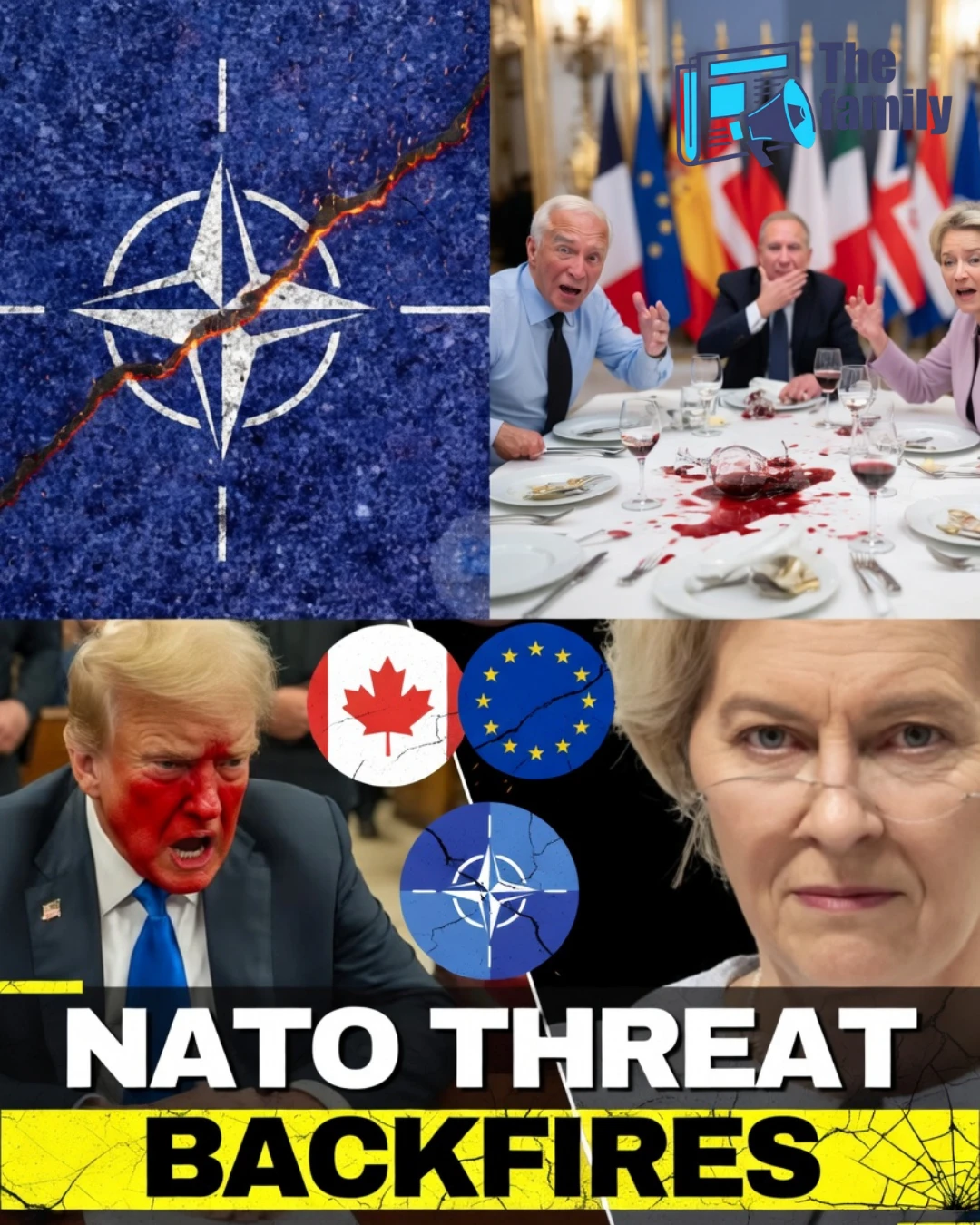
NATO at a Crossroads? How Viral Claims About Trump, Europe, and an Iran War Reveal a Deeper Geopolitical Anxiety
In recent days, a dramatic narrative has circulated online: Donald J. Trump allegedly threatened to withdraw the United States from NATO after European allies refused to join a U.S.-led war against Iran. The story goes further, describing NATO as a “paper tiger,” Europe as increasingly defiant, and the Western alliance system as teetering on the edge of collapse.
At first glance, it reads like a geopolitical earthquake—a moment that could redefine global power structures. But as with many viral narratives, the reality appears more nuanced, and in some aspects, significantly less certain than the headline suggests.
This article examines not just the claims themselves, but the broader context in which they emerge: the evolving transatlantic relationship, the limits of military alliances, and the growing appetite for narratives that frame global politics as entering a dramatic “breaking point.”
At the center of the story is a striking assertion: that Donald J. Trump told a major media outlet the United States’ withdrawal from NATO is “beyond reconsideration,” effectively signaling the end of a 77-year-old alliance.
The narrative builds from there:
Layered onto this are vivid details: European countries closing airspace, denying military access, and openly rejecting U.S. strategy.
It is a powerful storyline—one that suggests not just disagreement, but a fundamental rupture in the Western alliance.
Despite its dramatic framing, there is a crucial issue: the lack of verified, widely reported evidence supporting the core claims.
As of now:
This does not mean tensions do not exist. It means the specific scenario described may be hypothetical, exaggerated, or speculative, rather than a confirmed geopolitical turning point.
One of the most important elements in the narrative is the portrayal of NATO as failing a “test.”
This framing overlooks a foundational principle: NATO is a defensive alliance.
Article 5—the alliance’s core clause—states that members must respond if one member is attacked. It does not obligate members to participate in offensive wars initiated by another member.
Historically, Article 5 has been invoked only once: after the September 11, 2001 attacks on the United States. European allies responded by joining operations in Afghanistan for nearly two decades.
If a hypothetical conflict with Iran were initiated without an attack on a NATO member, European refusal to participate would not represent a failure of the alliance—it would reflect its design.
This distinction is critical. It highlights how narratives can reinterpret established rules to create a sense of betrayal or collapse.
While the specific claims may be uncertain, the broader theme of tension between Donald J. Trump and NATO is grounded in reality.
During his presidency:
These positions unsettled European leaders and sparked debates about the future of transatlantic security.
However, even at the height of these tensions, the United States did not withdraw from NATO. Institutional, legal, and strategic constraints make such a move complex.
A key detail often overlooked in viral narratives is the legal framework governing NATO membership.
In recent years, U.S. lawmakers have reinforced restrictions on unilateral withdrawal. Any attempt by a president to leave NATO would likely require congressional approval.
This means that even if a future president were strongly opposed to NATO, the process of withdrawal would face significant political and legal hurdles.
However, there is another possibility: a leader could weaken the alliance without formally leaving it—through rhetoric, reduced commitments, or shifting priorities.
This more subtle form of erosion is harder to measure, but potentially just as impactful.
One of the more plausible elements of the narrative is Europe’s gradual movement toward greater independence in defense and economic policy.
Across the European Union:
This does not necessarily signal a rejection of NATO, but rather a hedging strategy—preparing for a future in which U.S. support may be less predictable.
Leaders such as Keir Starmer and others have emphasized both the importance of NATO and the need for Europe to take greater responsibility for its own security.
This dual approach reflects a pragmatic reality: alliances endure, but they also evolve.
The inclusion of Iran as the catalyst for a NATO crisis is not accidental.
Iran occupies a central position in global geopolitics:
A major conflict involving Iran could indeed test alliances, especially if it were perceived as unilateral or controversial.
However, such a scenario would likely unfold with extensive diplomatic signaling, international debate, and media coverage—not as a sudden, underreported event.
Describing NATO as a “paper tiger” is a powerful rhetorical move.
It suggests:
But NATO’s history complicates this characterization. The alliance has:
Criticism of NATO’s effectiveness is not new, but labeling it a “paper tiger” often reflects political positioning rather than consensus analysis.
The rapid spread of this story points to a broader trend in how geopolitical information is consumed:
In this environment, speculative or exaggerated claims can gain traction because they resonate emotionally—even if they lack full verification.
Even if the specific claims are overstated, the narrative touches on real underlying shifts:
These changes are gradual, contested, and complex. They do not unfold as single निर्णج moments, but as a series of adjustments over time.
The danger lies in mistaking a viral story for a definitive turning point.
The idea that Donald J. Trump is on the verge of pulling the United States out of NATO over a European refusal to join a war with Iran is, at present, unverified and likely exaggerated.
But the story’s popularity reveals something important: a growing sense that the post-World War II order is under strain.
Whether that strain leads to fragmentation or adaptation remains uncertain.
What is clear is that in an era of rapid information flow, understanding geopolitics requires more than reacting to headlines. It requires examining sources, questioning assumptions, and recognizing the difference between narrative and reality.
Because in global politics, as in economics, the most dramatic story is not always the most accurate one—and the real shifts, when they come, are often quieter, slower, and far more complex than a single headline can capture.