Melania Trump Breaks Silence at the White House: Denials, Documents, and a Controversy That Refuses to Fade
For months, the story had simmered beneath the surface—fueled by documents, speculation, and unanswered questions.
Then, in a setting designed for clarity and authority, it was brought directly into the spotlight.
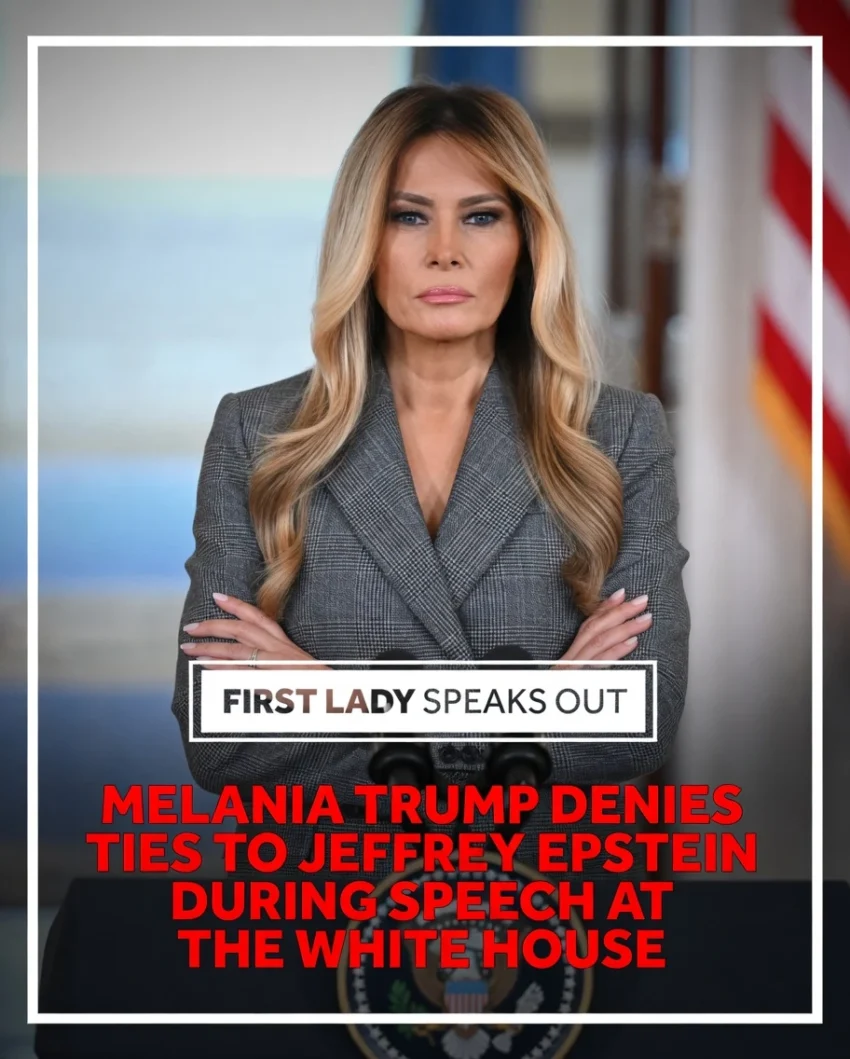
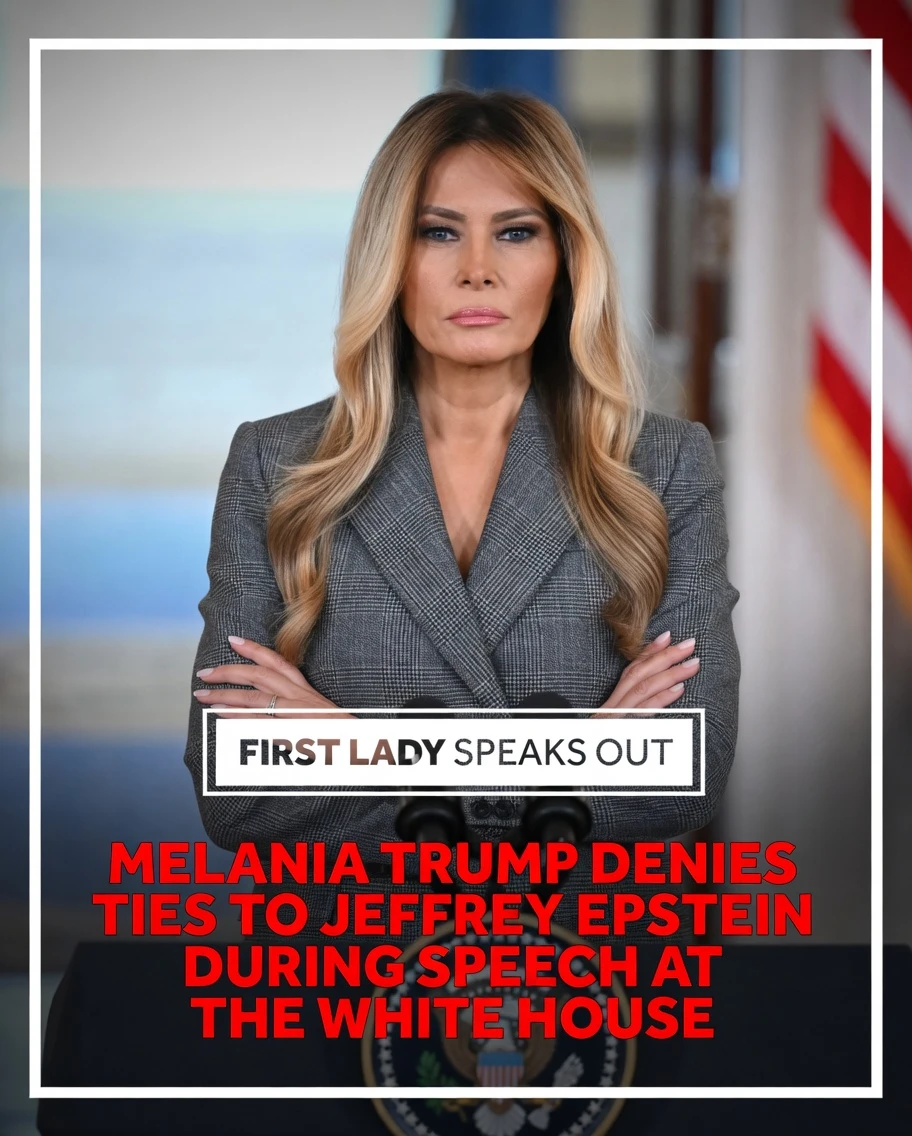
Standing inside the White House, Melania Trump delivered a rare and highly controlled public statement, firmly rejecting any connection to Jeffrey Epstein or knowledge of his crimes.
Her message was direct. Unambiguous. And clearly intended to draw a line.
“The lies linking me with the disgraceful Jeffrey Epstein need to end today.”
But instead of closing the chapter, the statement appears to have reopened a broader conversation—one that now spans legal interpretation, political reaction, and public perception.
The timing of the address was notable.
For much of the past year, controversies surrounding Jeffrey Epstein had gradually faded from the immediate political spotlight, overshadowed by other global and domestic issues.
Yet with a single five-minute statement, Melania Trump brought the issue back into focus.
Reading from prepared remarks, she described allegations tying her to Epstein as:
“Completely false”
“Unfounded and baseless lies”
Attempts to “defame” her reputation
She did not take questions.
She did not expand on specific claims.
And after finishing, she left the room—allowing the statement itself to stand without further clarification.
At the center of her remarks were two key assertions:
She had no ties or friendship with Jeffrey Epstein or Ghislaine Maxwell
She had no knowledge of Epstein’s criminal activity
However, she acknowledged something more nuanced:
That she moved in overlapping social circles in places like New York and Florida during the same period.
This distinction is critical.
Because much of the public debate does not revolve around direct evidence of wrongdoing—but around proximity, association, and context.
One of the most discussed elements in recent weeks has been a short email uncovered in Department of Justice files.
The message—dated 2002—begins with:
“Dear G!”
And ends:
“Love, Melania”
Within her statement, Melania Trump addressed this directly.
She described it as:
A “polite reply”
A “casual correspondence”
Ultimately, “a trivial note”
Importantly, she framed the email not as evidence of a relationship, but as a routine interaction within broader social networks.
Still, the existence of the message—and its tone—continues to attract scrutiny.
Because in high-profile cases, even small details can carry disproportionate weight.
The email is not the only piece of material drawing attention.
Among the documents released under federal transparency efforts are:
A photograph showing Donald Trump, Melania Trump, Jeffrey Epstein, and Ghislaine Maxwell together
References to shared social environments during the early 2000s
Individually, such images do not establish wrongdoing.
But collectively, they contribute to a broader question:
How should proximity be interpreted in retrospect?
That question remains unresolved—and continues to shape public discussion.
Perhaps the most unexpected element of the statement was not the denial—but the proposal.
Melania Trump called on Congress to hold public hearings centered on survivors of Epstein’s crimes.
Her argument:
That victims should have the opportunity to tell their stories publicly and enter them into the official record.
This move reframes the narrative in a significant way.
Instead of focusing solely on defending against allegations, it shifts attention toward:
Transparency
Accountability
Survivor testimony
Politically, this approach has already drawn responses from both sides.
The reaction in Washington was immediate—and notably mixed.
Some Republican figures praised the statement as a “brave” defense.
Meanwhile, Democratic lawmakers echoed her call for hearings—while using it to push for further investigation.
For example:
Robert Garcia urged immediate public hearings
Thomas Massie redirected focus toward prosecution and Justice Department action
This convergence—agreement on process, disagreement on implication—highlights how the issue continues to cut across political lines.
The persistence of the Epstein case in public discourse is not accidental.
It sits at the intersection of:
Power
Wealth
Institutional trust
Unanswered questions
Even years after his death in 2019, Jeffrey Epstein remains a focal point for debates about accountability and transparency.
And each new document release—or public statement—reignites that conversation.
What makes this moment particularly complex is the gap between:
What is being claimed
and
What is being inferred
On one side:
A clear, direct denial from Melania Trump
On the other:
Ongoing interpretation of documents, timelines, and associations
Neither fully resolves the issue.
Instead, they coexist—creating a space where narrative, evidence, and perception overlap.
Public statements are often designed to close chapters.
To define a narrative.
To establish clarity.
But sometimes, they do the opposite.
In this case, the statement from Melania Trump has not ended the conversation—it has intensified it.
Because beyond the denial lies a larger reality:
Documents continue to emerge
Questions remain open
Interpretations continue to evolve
And in stories shaped as much by perception as by proof, resolution rarely comes from a single moment.
It comes—if it comes at all—from what follows.
For now, the record has been addressed.
But the conversation is far from over.