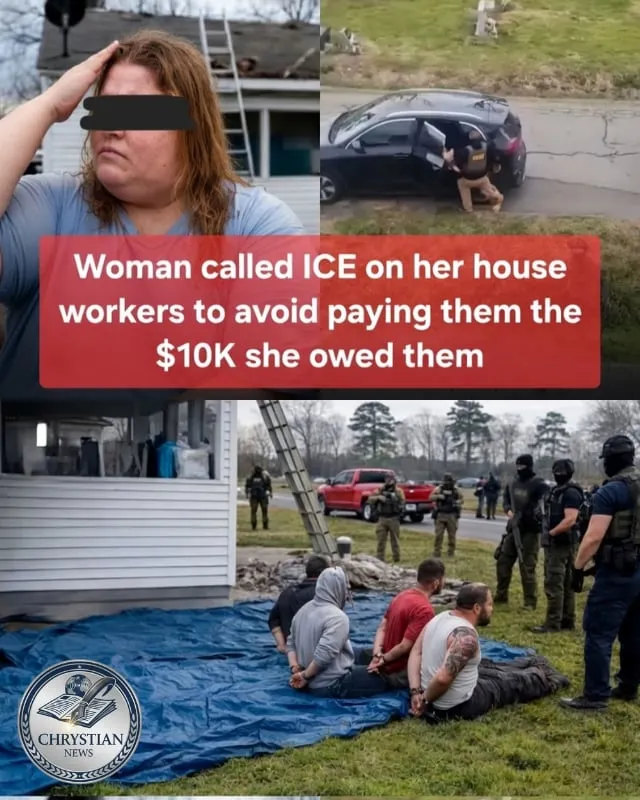
A recent incident in Cambridge, Maryland, has drawn widespread public attention after a viral video appeared to show immigration authorities detaining a group of workers on the roof of a home they were renovating. The situation quickly ignited debate online, with many initially believing the workers had been reported by the very homeowner who hired them—allegedly to avoid paying a $10,000 bill.
However, as more information has emerged, the case has revealed a more complex and nuanced reality—one that highlights the intersection of labor rights, immigration enforcement, and the risks of misinformation in the digital age.
The controversy began when a video circulated widely on social media showing agents from U.S. Immigration and Customs Enforcement (ICE) detaining six workers who were reportedly in the final stages of completing a roofing project.
According to early claims shared online, the workers—described as migrants from Guatemala—had been hired by a homeowner to perform renovation work. The narrative suggested that after several days of labor, and just before payment was due, the homeowner contacted immigration authorities to have them detained, thereby avoiding a $10,000 payment for their services.
The allegations quickly sparked outrage. Many viewed the situation as a potential example of labor exploitation, arguing that vulnerable workers may have been targeted due to their immigration status. The story resonated strongly across social media platforms, where it was widely shared and discussed.
The footage, reportedly livestreamed by a co-worker, captured a tense moment as ICE agents arrived at the property and detained the workers while they were still on the roof.
In the video, the workers appeared visibly shocked and confused as events unfolded. Their tools and equipment were left behind at the site as they were taken into custody. The livestream lasted approximately 30 minutes and contributed significantly to the rapid spread of the story online.
For many viewers, the timing of the arrests—occurring while the job was still in progress—seemed to reinforce the narrative that the situation had been orchestrated to avoid payment.
Despite the widespread belief that the homeowner initiated the enforcement action, officials from ICE have publicly disputed this claim.
According to an official statement, the arrests were part of a “targeted enforcement operation” and were not the result of a tip from the homeowner.
Authorities stated that the individuals detained had prior immigration-related issues, including final orders of removal in some cases. They also noted that the operation was planned independently and not triggered by a report from a private individual.
This version of events contrasts sharply with the viral narrative, highlighting the challenges of verifying information in real time as stories spread across digital platforms.
Even as the facts remain partially disputed, the incident has raised important legal and ethical questions—particularly around the treatment of migrant workers.
Under Maryland law, it is illegal to obtain labor or services by threatening to report someone’s immigration status. Legal experts have pointed out that if a person were to deliberately use immigration enforcement as a means of avoiding payment, such actions could potentially constitute a felony offense.
However, in this specific case, no charges have been filed against the homeowner. Authorities have not found sufficient evidence to support claims that she contacted ICE with the intent of avoiding payment.
This distinction is critical. While the allegations generated strong public reaction, the absence of confirmed evidence underscores the importance of relying on verified information rather than assumptions.
Regardless of the specific details of this case, the incident has drawn attention to broader issues facing migrant workers in the construction industry.
Workers without stable legal status often face heightened risks, including:
Advocacy groups have long argued that these vulnerabilities can create situations where workers are reluctant to come forward, even when they have been treated unfairly.
The Maryland case, whether or not it involved intentional wrongdoing by the homeowner, has become a focal point for these concerns.
One of the most striking aspects of the incident is how quickly a specific narrative took hold online.
Within hours of the video’s انتشار, many users had already formed strong opinions about what had occurred. The idea that a homeowner would call immigration authorities to avoid paying workers proved both emotionally powerful and easily shareable.
However, as official statements began to emerge, it became clear that the situation was more complicated than initially portrayed.
This sequence of events illustrates a broader trend: in the age of social media, viral content can shape public perception long before all the facts are known.
The public response to the incident has been mixed, reflecting both emotional reactions and calls for caution.
Some observers have expressed anger over what they perceive as a potential injustice, emphasizing the importance of protecting workers’ rights regardless of immigration status.
Others have pointed to the conflicting accounts and urged restraint, noting that the full circumstances of the arrests are still not entirely clear.
This divide highlights the tension between immediate emotional responses and the slower process of fact-finding and verification.
Beyond the specifics of this case, the incident raises several broader questions:
These questions are not unique to Maryland. They reflect ongoing challenges in balancing enforcement, fairness, and transparency in complex social systems.
The Maryland roofing incident remains a developing story, shaped by both verified information and widely circulated claims.
While early reports suggested a deliberate attempt to avoid paying workers by involving immigration authorities, official statements have challenged that narrative. As of now, there is no confirmed evidence that the homeowner initiated the arrests.
At the same time, the situation has highlighted real and ongoing concerns about labor practices and the vulnerabilities faced by migrant workers.
In many ways, the case serves as a reminder of the importance of careful analysis in an era of rapid information sharing. It also underscores the need to balance empathy, evidence, and fairness when evaluating complex and emotionally charged events.
As more details emerge, the story may continue to evolve. For now, it stands as both a cautionary tale about misinformation and a reflection of deeper societal issues that extend far beyond a single roofing project.