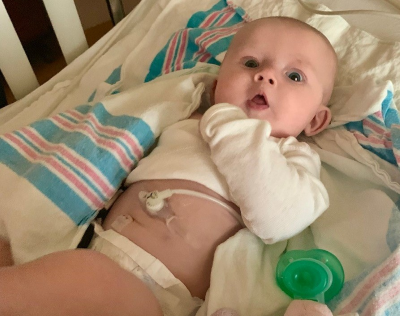
When Lila was just ten days old, a positive newborn screening for an immunodeficiency disorder sent her parents, Samantha and Philip, into a whirlwind of uncertainty, prompting an urgent trip to Lurie Children’s for additional testing and guidance. From the very beginning, Lila had struggled with feeding and swallowing difficulties, constantly spitting up through her nose, and failing to gain weight, which immediately concerned her family and the medical team.
Though the initial suspicion of immunodeficiency did not hold, genetic testing revealed that Lila was missing a part of her 22nd chromosome, resulting in a diagnosis of 22q11.2 Deletion Syndrome, a complex genetic disorder that can manifest differently in each patient.
The syndrome’s variability meant that while some children are diagnosed at birth due to congenital heart defects or immunodeficiency, others may not receive a diagnosis until later, leaving families in a prolonged state of uncertainty and searching for answers.
Samantha recalls the moment the diagnosis was confirmed as one of both fear and clarity, describing it as a puzzle piece finally clicking into place; the myriad of small health concerns that had baffled her now made sense.
Lila’s early symptoms, including her feeding struggles, potential heart defects, speech complications, and occasional hearing loss, began to be contextualized within the framework of her diagnosis, giving the family both understanding and direction.
Lurie Children’s multidisciplinary approach immediately became their anchor, providing a cohesive care plan that encompassed multiple pediatric specialties in a single coordinated effort.
Within a week of diagnosis, Lila and her parents met the 22q team at Lurie Children’s, which included immunologists, ENT specialists, speech and language pathologists, audiologists, geneticists, and social workers.
That same day, a swallow study confirmed that Lila had oral dysphagia, prompting the placement of a nasogastric (NG) tube and feeding pump, ensuring she received adequate nutrition while under careful supervision.
The coordinated efforts of these specialists not only stabilized her condition but also gave Samantha and Philip confidence that Lila was on the right path for healthy development.
Throughout Lila’s first year, her life was punctuated by regular appointments, tests, and therapies, but the comprehensive care model of Lurie Children’s helped the family manage the complexity of her treatment schedule.
Despite living in a small central Illinois village, the team’s support allowed Samantha and Philip to remain actively engaged in Lila’s care while maintaining a semblance of family life.
As Lila grew stronger and more resilient, the frequency of hospital visits decreased, giving the family reassurance and a sense of normalcy after months of intensive care.
Today, at three years old, Lila maintains annual visits to the 22q team and sees other specialists approximately five times a year, demonstrating significant developmental progress and growing independence.
Her gastrostomy tube was removed in July, enabling her to eat independently, while she continues occupational and physical therapy through weekly aquatic sessions, and receives speech therapy three times a week.
These interventions have ensured that Lila’s early struggles do not impede her ongoing development, allowing her to reach milestones appropriate for her age.
Samantha and Philip marvel at Lila’s sunny and easygoing personality, noting her love for coloring, imaginative play with her kitchen set, walking outdoors, and the companionship of her older brother and sister.
Her progress highlights the transformative impact of early, coordinated, and specialized care for children with complex genetic conditions.
Lurie Children’s integrated approach has provided not just medical treatment, but guidance and support for the entire family, empowering them to understand, manage, and celebrate Lila’s unique needs and achievements.
Reflecting on their journey, Samantha acknowledges that 22q11.2 Deletion Syndrome has strengthened the family unit, fostering resilience and empathy among her older children, who have learned to appreciate and embrace individual differences.
She credits the clinic’s compassionate and expert care with enabling Lila to thrive close to home, emphasizing the importance of early diagnosis, coordinated multidisciplinary management, and family-centered support in navigating the complexities of rare genetic disorders.
he 22q clinic has become more than a medical resource; it has been a source of reassurance, advocacy, and community for the Fords, enabling them to watch their daughter flourish.
Families facing a 22q diagnosis are encouraged to seek guidance and support from the 22q Family Foundation, a nonprofit dedicated to connecting and assisting families impacted by the syndrome.
Samantha stresses that parents do not have to navigate the challenges alone, and that specialized care, early interventions, and a supportive network can significantly influence a child’s development and quality of life.
The Fords’ experience underscores the profound difference that expertise, compassion, and family-centered care can make, turning a daunting diagnosis into an opportunity for growth, understanding, and hope.
Lila’s story serves as a testament to the power of specialized pediatric care and the resilience of families facing complex genetic conditions, demonstrating that with the right team and resources, children with 22q11.2 Deletion Syndrome can achieve remarkable progress and live vibrant, meaningful lives. The Ford family continues to be inspired by Lila’s growth, her joyful personality, and the collaborative care model that made it all possible, knowing that each milestone she reaches is a triumph of medical innovation, parental advocacy, and unwavering support.