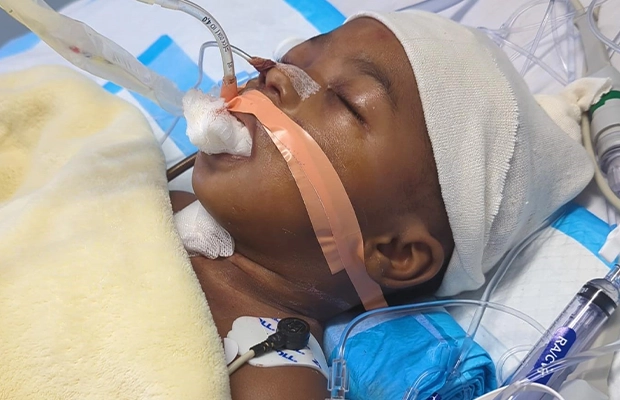
At 38 weeks pregnant, Robyn Phipps attended what she expected to be a routine prenatal visit, filled with excitement for her impending delivery. But when the medical team could not detect her baby’s heartbeat, she was immediately rushed for an emergency C-section, unaware of the life-threatening challenges her child would face.
On August 3, 2021, Joshua Phipps was born pale, blue, and unable to breathe, instantly signaling the seriousness of his condition. In the delivery room, every healthcare professional knew this was only the beginning of a complicated medical journey, one that would span years and cross borders.
An echocardiogram revealed that Joshua had tetralogy of Fallot with pulmonary atresia, a severe congenital heart defect affecting normal blood flow. He also had a patent ductus arteriosus and a double aortic arch, a rare anomaly compressing his airway and causing severe respiratory distress.
The following day, Joshua was admitted to a neonatal intensive care unit in Nassau, where the local care team stabilized him as his parents, still recovering from delivery, tried to process the magnitude of what lay ahead. His survival depended on rapid, precise interventions, and the team quickly realized that transfer to Holtz Children’s Hospital in Miami offered his best chance.
“You expect to go home with your baby. Then you don’t, and they tell you he was going to die,” Robyn said, describing the shock and grief she felt. Her hopes were tied to the expertise of Holtz Children’s pediatric cardiac specialists, who could coordinate care across countries.
At Holtz Children’s cardiac intensive care unit, Joshua came under the care of Dr. Leonardo Mulinari, chief of pediatric and congenital heart surgery. He underwent multiple procedures, including a central shunt, double aortic arch repair, and patent ductus arteriosus ligation, aimed at correcting his complex heart defects.
Joshua also faced severe airway challenges due to tracheomalacia, requiring a tracheostomy performed by Dr. Leonardo Torres to help him breathe. Dr. Mulinari performed an aortopexy, a procedure that eventually allowed Joshua to remove the tracheostomy tube and breathe independently, marking a pivotal moment in his recovery.
After three months of intensive care and specialized treatment, Joshua was stable enough to return to the Bahamas, where he continued follow-up care until May 2022. At that time, he underwent a complete repair of the tetralogy of Fallot under the guidance of Dr. Mulinari, further solidifying the life-saving outcomes of the coordinated treatment plan.
Joshua thrived at home under the care of a local pediatric cardiologist, remaining stable until May 2023 when he experienced severe respiratory distress, requiring urgent ventilation. The Holtz Children’s ECMO team, led by Dr. Desiree Machado, coordinated a groundbreaking intervention to place Joshua on ECMO in the Bahamas, a procedure never performed on a pediatric patient there before.
Because of insurance and transfer logistics, the ECMO procedure was critical to sustaining Joshua until airlift arrangements could be finalized. Adult bypass cannulas were adapted for the infant, and with virtual guidance from Holtz Children’s surgeons Dr. Mulinari and Dr. Sandeep Sainathan, the Bahamian team successfully cannulated Joshua for life support.
During the 24-hour wait for airlift approval, Joshua’s oxygen and carbon dioxide levels were critically low, demonstrating the life-saving importance of the ECMO intervention. Dr. Machado remained in constant communication with the Bahamian team, guiding them step by step through the stabilization, ventilation, and preparation for safe transfer.
Emergency visas were secured for the care team to travel with Joshua, ensuring his safe transport to Miami. Upon arrival, Dr. Torres corrected a remaining tracheal narrowing, and Joshua was finally able to return home without further complications after a 22-day hospital stay.
“I am very humble in saying that if it wasn’t for a multidisciplinary team approach, we would not have been able to save his life,” Dr. Torres said, reflecting on the coordination required across two countries. Joshua’s journey exemplified the power of collaborative medical care, demonstrating that critical interventions can succeed even across borders.
Looking ahead, Joshua will continue follow-up for at least two years, with close monitoring by Holtz Children’s and his Bahamian care team. His parents remain vigilant, prepared for potential emergencies requiring airlifts, and grateful for the team’s diligence, expertise, and unwavering commitment.
Joshua’s story illustrates the potential of global collaboration in medicine, showing how remote guidance, shared expertise, and coordinated logistics can save lives. Through quick action, cross-border teamwork, and innovative interventions, a critically ill infant was given a chance to survive and thrive.
Robyn Phipps expressed deep gratitude for the Holtz Children’s team and Bahamian medical staff. “I can’t thank Jackson Health System and the team of doctors in the Bahamas enough for saving Joshua’s life,” she said. “He is alive thanks to their incredible teamwork and dedication.”
Joshua Phipps’ survival demonstrates how life-threatening congenital heart defects and complex airway anomalies can be effectively treated when specialists unite, even across international borders. His resilience, combined with meticulous care, underscores the importance of immediate intervention, multidisciplinary collaboration, and innovative pediatric surgical techniques.