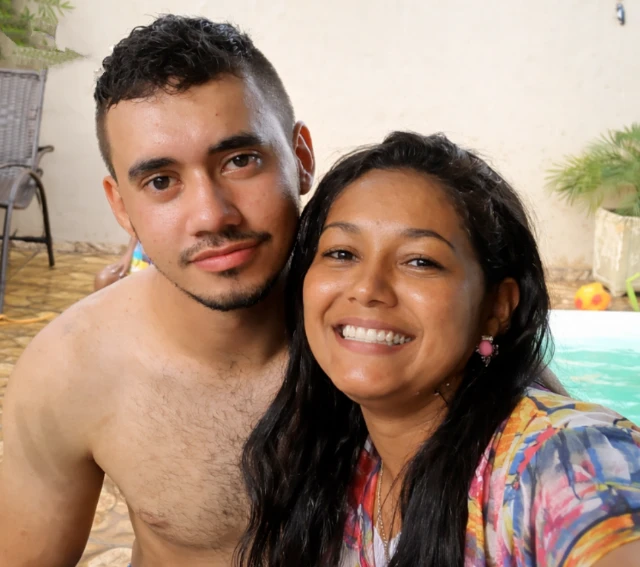
It began on a day that was supposed to be ordinary. July 3, 2016. A barbecue, family gathered, the kind of moment where laughter fills the air and nothing feels out of place. Eight-year-old Marcos was there with his mother, standing close to her in a space that should have been safe.
Then, without warning, everything shattered.
According to reports, Rafael Garcia Pedroso—his mother’s partner—attacked her in front of everyone. The violence was sudden and relentless. Marcos saw it happen. He didn’t just lose his mother that day—he witnessed her final moments, something no child should ever have to carry.
Rafael was later arrested, convicted, and sent to prison. For the legal system, the case had reached its conclusion. But for Marcos, it was only the beginning of something that would follow him for years.
After the incident, Marcos and his siblings went to live with their maternal grandmother. She worked as a domestic worker, doing what she could to provide stability in a life that had been violently disrupted. They grew up in a working-class neighborhood, surrounded by routine, but never free from what had happened.
Time passed.
Years went by.
On the surface, life moved forward. Marcos grew from a child into a teenager, then into a young man. But some things do not fade with time. Trauma does not always quiet itself. For Marcos, the memory remained vivid—the images, the sounds, the helplessness of that moment.
Eleven years later, Rafael was released from prison.
For the justice system, it was the end of a sentence. For Marcos, it was the return of something unresolved.
By then, he was nineteen years old.
And something inside him had not let go.
According to investigators, Marcos began tracking Rafael. Not for days—but for weeks. He watched his movements. He waited. He studied patterns. What followed was not impulsive. It was deliberate.
One day, outside a health center, Rafael was waiting for his wife. It was a normal moment, much like that barbecue years earlier—ordinary, predictable, unguarded.
Marcos approached from behind.
Shots were fired.
Rafael died at the scene.
Witnesses described the moment as sudden, echoing the same kind of shock that had defined the first tragedy. But this time, Marcos was not the child watching. He was the one acting.
After the shooting, he fled on a motorcycle. But according to his lawyer, there was no real plan to escape long-term. The intention, they said, was to surrender. This was not about running. It was about something else.
When Marcos was later confronted with images of his mother, reports say he broke down. He trembled. He asked for a hug. The reaction wasn’t controlled or calculated—it was emotional, raw, and immediate. He spoke about anger, about the weight of what he had seen as a child, and how that moment had never left him.
His explanation for the shooting was simple.
He had witnessed his mother’s death.
And he had carried it ever since.
For many, the case raises difficult questions that don’t fit easily into legal definitions. On paper, it is a killing followed by another killing. Two separate crimes. Two separate moments of violence. But in reality, they are connected—linked by memory, trauma, and time.
Marcos did not act in a vacuum.
He acted after eleven years of carrying something unresolved.
That does not change the outcome.
But it complicates the understanding.
From a legal perspective, the system will treat Marcos’ actions as a crime. The law does not recognize personal justice as justification for taking a life. There will be charges, proceedings, and likely a sentence. The process will move forward, as it always does.
But outside the courtroom, the story feels different.
Because this is not just about what happened in that final moment.
It is about everything that came before it.
A child witnessing something irreversible.
A family trying to rebuild in the aftermath.
A system that delivered punishment—but perhaps not closure.
And a young man who grew up with a memory he could not escape.
Some have described the case as a cycle of violence. One act leading to another. One loss echoing into the next. In that sense, there are no clear lines separating past and present. The two events are part of the same story, just told at different times.
For Marcos’ family, the tragedy exists in layers.
They lost a mother.
And now, they may lose a son to the legal system.
Two different moments.
One continuous impact.
There are no winners here. No resolution that feels complete. Only consequences that extend across years and generations.
The system did what it was designed to do—convict, sentence, release.
But for Marcos, the question may never have been about the system.
It may have been about something far more personal.
Something tied to a single moment he never stopped reliving.
As the case moves forward, there will be arguments, legal interpretations, and decisions made within the structure of the law. But outside of that, one question lingers—quiet, complicated, and difficult to answer.
Because beyond the charges, beyond the verdicts, beyond the years that passed…
What happens to a child who never truly leaves the moment he lost everything?
And at what point does that moment stop being the past… and start shaping everything that comes after?