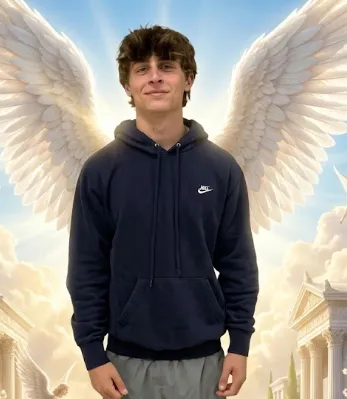
Just before 2:00 a.m. on a Sunday in downtown Hartford, the night still carried the hum of music, laughter, and late conversations spilling out of nearby bars.
Ann Street, like many entertainment districts, was alive in that in-between hour — not quite night, not yet morning.
Seventeen-year-old Camden Siegal stood waiting for an Uber.
He was going home.
He never made it.
Gunshots shattered the air around 1:50 a.m., according to authorities. Officers already patrolling the area rushed toward the sound. When they arrived, they found Camden unconscious.
He had been struck by a stray bullet.
He was transported to the hospital in critical condition. For two days, hope fought against reality. Family, friends, classmates — all waited for news that never came.
Camden Siegal died from his injuries.
He was seventeen.
At seventeen, life feels like a runway just before takeoff.
Camden was a senior at William H. Hall High School. Graduation was only months away. His name was known not because of trouble or headlines, but because of excellence.
He was a standout student.
An athlete.
A teammate.
A friend.
He played soccer and lacrosse — sports that demand both discipline and heart. Coaches described him as focused and driven. Teammates remembered his encouragement during hard practices, the way he pushed others to be better without ever making it about himself.
He was the kind of student who balanced academics and athletics with quiet determination.
The kind of young man teachers expect to see succeed.
That night, investigators say Camden was not the intended target. He was caught in crossfire — an unintended victim of gunfire that erupted near an area filled with nightlife activity.
Another man, in his twenties, was also seriously injured and remains hospitalized.
No arrests have been announced. The investigation is ongoing.
But for Camden’s family, the timeline of police reports and evidence gathering exists alongside something far more immediate:
The silence in his bedroom.
The empty chair at the kitchen table.
The future that will never unfold.
His loved ones described him as kind, generous, and full of dreams. He loved animals. He loved his friends. He carried plans for college and ambitions that were just beginning to take shape.
There is something uniquely devastating about losing someone at seventeen.
It is not just a life lost — it is a life interrupted.
Camden had not yet reached adulthood. He had not yet seen the long arc of his own potential. He was standing at the threshold of independence, preparing to step into a wider world.
Instead, violence reached him first.
The phrase “stray bullet” can feel deceptively small. It sounds accidental. Random. Almost detached.
But there is nothing random about the consequences.
A stray bullet does not wander aimlessly. It travels because someone pulled a trigger. It reaches someone because it was set in motion by a decision.
And too often, it finds those who were never part of the conflict.
Camden was simply waiting for his ride home.
He was not arguing.
He was not involved.
He was not escalating anything.
He was trying to leave.
That detail matters.
Because it highlights how public spaces — once defined by routine and familiarity — can transform in seconds. How a night meant for music and connection can fracture into chaos without warning.
For the students at William H. Hall High School, the loss is personal.
Classrooms that once held shared jokes now hold grief. Locker rooms echo differently. Practice fields feel heavier.
Guidance counselors and teachers are doing what they can — offering support, holding space for tears, reminding students that grief does not have a schedule.
But there is no manual for losing a classmate to violence.
There is only the slow, aching realization that someone who was there yesterday will never walk through the doors again.
Yet amid the heartbreak, one decision made by Camden and his family has reframed his story in a powerful way.
Even in death, Camden gave life.
He was an organ donor.
Through that choice, other families — families facing their own desperate waiting — received hope. Somewhere, in hospital rooms filled with uncertainty, surgeons prepared for transplant procedures that would change outcomes.
Because of Camden, lives were saved.
It is a profound contradiction: a life taken by violence, and lives extended through generosity.
Organ donation is not just a medical act. It is a legacy.
It means that in the darkest moment, a family chose compassion. That even through unbearable grief, they allowed something good to rise from devastation.
Camden’s heart may beat on in another body.
His gift may allow someone to watch their own child graduate.
To return home from a hospital bed.
To breathe more easily.
To live.
That is not a small thing.
It does not erase the loss. It does not quiet the questions surrounding the shooting. But it transforms part of the narrative from pure tragedy into enduring impact.
Hartford is now left asking difficult questions.
How does a teenager waiting for transportation become a victim of gunfire?
What steps can be taken to prevent crossfire in entertainment districts?
Why do so many young lives continue to intersect with violence they did not create?
These questions are not unique to one city.
Across the country, communities grapple with the same painful reality: that public spaces can shift from safe to dangerous in seconds.
The ripple effect extends far beyond the immediate scene.
Parents now hesitate a little longer before allowing their children to go out at night.
Students carry a sharper awareness of vulnerability.
City leaders face renewed pressure to strengthen safety measures.
But beyond policy and patrols, the heart of this story remains a seventeen-year-old boy with plans.
Camden’s life was not defined by the moment he died.
It was defined by how he lived.
By the effort he gave in school.
By the way he treated his teammates.
By his affection for animals.
By his decision to be a donor.
His family remembers his laughter. His friends remember his loyalty. His coaches remember his focus.
And now, others — strangers — carry a part of him forward in ways that defy tragedy.
There is a painful irony in the timeline.
He was months away from graduation.
Soon, he would have worn a cap and gown. Walked across a stage. Heard applause fill an auditorium.
Instead, his name is spoken in memorials.
Candles flicker in his honor.
Teammates gather in quiet circles before games.
The community mourns not only what was lost, but what might have been.
Camden Siegal was seventeen.
He was not meant to become a headline.
He was meant to become whatever he chose next.
And while the investigation continues, while authorities search for answers and accountability, one truth remains steady:
His story did not end entirely in darkness.
Through organ donation, part of him continues.
Part of him lives.
The question that lingers now is not only about who fired the shots or when arrests will come.
It is larger.
How many more young lives will be interrupted before prevention matches urgency?
Will the full truth of that early morning in Hartford be uncovered — or will it join a growing list of cases where closure arrives too slowly?
Camden was waiting for a ride home.
Instead, he left the world too soon — but not without leaving something behind.
️ May his memory remind us of both fragility and generosity.