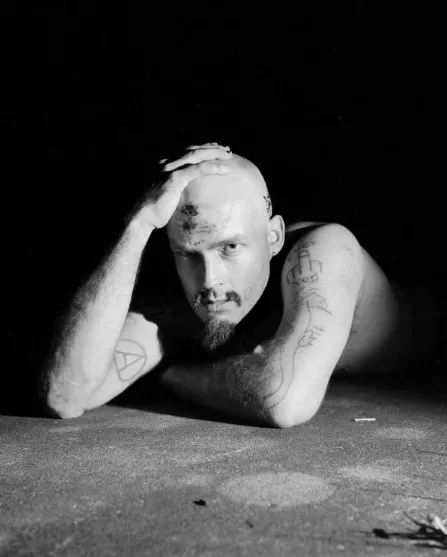
In the history of music, some artists are remembered for their talent.
Others are remembered because they shattered every boundary imaginable.
GG Allin belonged to the latter — a name that people couldn’t ignore, whether out of fascination or horror.
He was called many things: “individualist,” “anti-authoritarian,” and “unique.”
But also “violent,” “chaotic,” and “madman.”
If you had asked him how he would describe himself, he would have answered with just one phrase: “the last true rock and roller.”
And depending on how you define rock and roll, he may have been right.
GG Allin was born on August 29, 1956, in Groveton, New Hampshire, with a name as shocking as the life he would later live: Jesus Christ Allin.
His childhood was anything but ordinary.
His father, Merle Allin Sr., was a deeply religious and controlling man who ruled the household through fear.
The family lived in a log cabin without electricity or running water, isolated from the outside world.
Even more disturbing, Merle frequently threatened to kill his family.
He reportedly dug “graves” in the basement to prove he meant it.
For a child, this was not simply a difficult upbringing.
It was a psychological prison.
GG Allin would later describe those years as something closer to a sentence than a childhood.
Yet, in a strange way, he believed it shaped him into what he called “a warrior soul” at an early age.
Eventually, his mother, Arleta, managed to escape that environment, taking GG and his brother with her to Vermont.
His birth name faded.
His younger brother couldn’t pronounce “Jesus,” instead calling him “Jeejee.”
From that, the name GG was born.
In 1966, his mother officially changed his name to Kevin Michael Allin.
But the world would come to know him simply as GG.
His teenage years were marked by rebellion.
He formed bands, cross-dressed at school, sold drugs, broke into homes, and rejected authority in every form.
But even that chaos was only the beginning.
After graduating in 1975, GG Allin chose not to pursue college.
Instead, he immersed himself in music, inspired by artists like Alice Cooper, The Rolling Stones, and Hank Williams.
He began as a drummer, playing with multiple bands before finding a more stable role with the punk group The Jabbers in 1977.
With them, he released his debut album Always Was, Is and Always Shall Be.
But stability was never part of GG Allin’s nature.
By the mid-1980s, his refusal to compromise led to growing tensions, and he eventually left the band.
Throughout the 1980s, he drifted from one group to another — The Scumfucs, Texas Nazis, and others — building a reputation in the underground punk scene.
But it wasn’t just his music that drew attention.
It was what he did on stage.
After a particularly chaotic performance, he earned the nickname “The Madman of Manchester.”
Yet even that title would soon feel inadequate.
In 1985, during a performance in Illinois, GG Allin shocked audiences in a way few could have imagined.
He deliberately defecated on stage.
It wasn’t an accident.
It was planned.
And the crowd’s reaction — confusion, disgust, panic — was exactly what he wanted.
From that moment on, his performances became increasingly extreme.
He repeated the act, then escalated it — smearing feces on himself, throwing it into the crowd, and combining it with self-inflicted injuries that left him covered in blood.
His shows often descended into chaos.
Equipment destroyed.
Audiences injured.
Police intervention became common.
Many venues refused to host him again.
Some concertgoers, particularly women, accused him of assault during or after performances.
Legal trouble followed him constantly.
In 1989, he was convicted of assault after admitting to violently attacking a woman.
He served 15 months in prison.
Yet even incarceration didn’t diminish his notoriety.
Within the underground scene, GG Allin became a symbol — depending on perspective — of absolute freedom or total collapse.
His music never reached mainstream success.
But that didn’t matter.
People didn’t come for the songs.
They came for the spectacle.
For unpredictability.
For something that blurred the line between performance and destruction.
Offstage, his life was no less disturbing.
He developed a fascination with serial killers, particularly John Wayne Gacy.
He wrote to Gacy in prison and even commissioned artwork from him for album covers.
The boundary between art and darkness in GG Allin’s world was almost nonexistent.
He often spoke about death.
Beginning in 1989, he repeatedly threatened to kill himself during a live performance.
These threats created a strange anticipation.
Fans bought tickets not just to see a show, but to witness whether he would actually follow through.
In the end, he didn’t die on stage.
But his final performance still carried the chaos that defined him.
On June 27, 1993, at a venue in New York City, the show quickly spiraled out of control.
It was cut short.
A riot erupted outside.
GG Allin fled with friends to an apartment.
That night, he used heroin.
The next morning, he was found dead from an overdose.
He was 36 years old.
His death was ruled accidental.
But some believe it was intentional — a final act of control, fulfilling his long-standing threats.
Even in death, GG Allin refused normality.
He had instructed that his body not be cleaned before the funeral.
He was buried as he had lived — raw, unfiltered, and shocking.
GG Allin never intended to grow old.
He once said, “It’s not so much wanting to die, but controlling that moment.”
That statement defined his life.
A life without rules.
Without compromise.
Without limits.
And perhaps, in the end, that same philosophy defined his death.
Today, his legacy remains deeply divisive.
Was he an artist — or a man consumed by self-destruction?
A symbol of freedom — or a warning of what happens when boundaries disappear entirely?
The answer depends on how one chooses to see him.
But one thing is certain.
GG Allin lived entirely on his own terms.
And even in death, he never changed that.