Lewis McClelland set off to Thailand on what was meant to be a carefree holiday before starting the job he had worked toward for months.
He arrived on the tropical island, eager for sunshine and adventure, totally unaware that the trip would change his life in an instant.
On February 2, during a morning ride to the beach with a friend, Lewis rented a moped — a simple transaction that required nothing more than his passport.
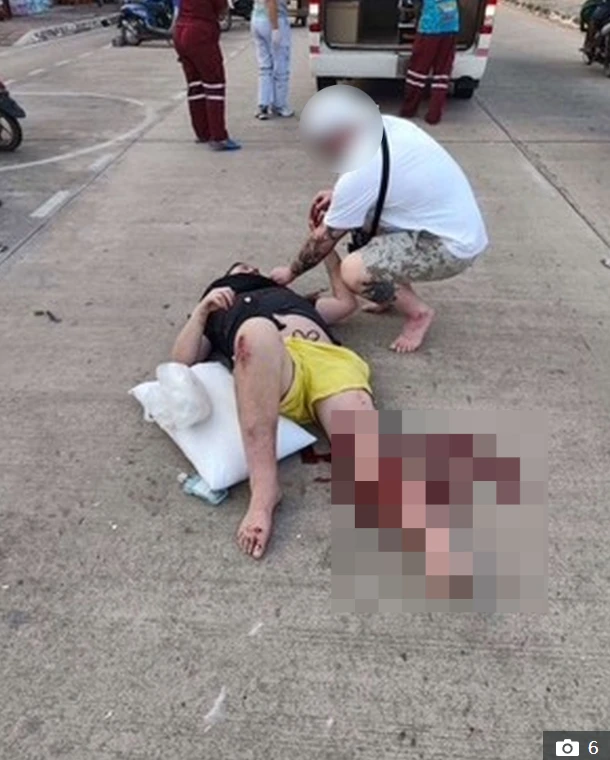
His relaxed holiday plans dissolved in seconds when his scooter collided with a tuk‑tuk vehicle on the road.
The impact was brutal, violent, and immediate — Lewis was thrown to the ground as metal and asphalt met his body at terrifying speed.
His leg, which should have carried him into his future, was left in a state his own words barely described: “hanging off.”
He suffered multiple open fractures in his leg, wrist, and fingers, and deep cuts across his face that required reconstructive surgery.
The pain, the shock, and the sheer physical trauma of the crash was something Lewis said he wouldn’t wish on his worst enemy.
“It’s a life‑changing position for me,” he said, stunned by the sudden reversal of everything he had planned.
“I’m still lucky to have my leg,” he added, acknowledging that without rapid medical intervention he might not have survived the severe bleeding and injuries.
First responders rushed to stabilise him and stop the extreme blood loss before he could be transferred for major surgery.
At the hospital, an external fixator was placed to hold his shattered leg together — a temporary measure before further surgical procedures.
Plans for a second major operation were underway, even as Lewis faced weeks or months of recovery ahead.
But while his physical injuries commanded immediate attention, a new crisis was quietly erupting behind the scenes.
When Lewis tried to claim on his travel insurance for the emergency surgery and the cost of returning home, he was met with a refusal.
His policy was voided because he did not hold the officially required riding certification — a compulsory basic training (CBT) certificate that the insurer said was necessary coverage for riding a moped.
Yet when Lewis rented the moped in Thailand, he was never asked for such a license — only his passport was required.
The discrepancy between Thai rental practices and UK insurance requirements left him stranded, thousands of miles from home, facing towering medical costs.
His mother, Liza McClelland, shared that Lewis had hoped to return to the UK on January 26, but instead found himself in a Thai hospital bed with life‑altering injuries.
The cost of his required treatment and repatriation, she said, could range from £15,000 up to £40,000 or more, an overwhelming burden for any family.
The financial reality of his situation was stark: without coverage, every single cost — from operations to flights — would fall squarely on his shoulders or those of his loved ones.
Friends and family have rallied to support him, raising funds online to help cover bills, but the amount raised so far falls short of what is needed.
Before the trip, Lewis had been preparing to start what he called his “dream job” as a window fitter in Portsmouth, Hampshire, something he had looked forward to with excitement and hope.
Instead, he finds himself facing a recovery that will take months, and perhaps years, to feel complete.
He has life‑changing scars across his face, broken limbs, and an uncertain path ahead, not just physically but emotionally as well.
The conversation he now shares with other travellers is cautionary, not carefree — a warning about road safety, rentals, and the fine print that can make all the difference when “holiday” turns into a nightmare.
In his own words, what was meant to be a simple escape turned into “such a nightmare,” a series of events that questioned everything he thought he knew about travel and safety.
“Read the small print,” he urged others, reminding travellers that laws, licences, and insurance policies may not align with what rental companies require overseas.
While he heals and gears up for his next surgery, Lewis’s story resonates with the fragility of plans, the unpredictability of travel, and the harsh reality that a split second can alter a life forever.
For now, he remains in Thailand, wrestling with pain, recovery, and a future that once looked so certain but has since been irrevocably changed.