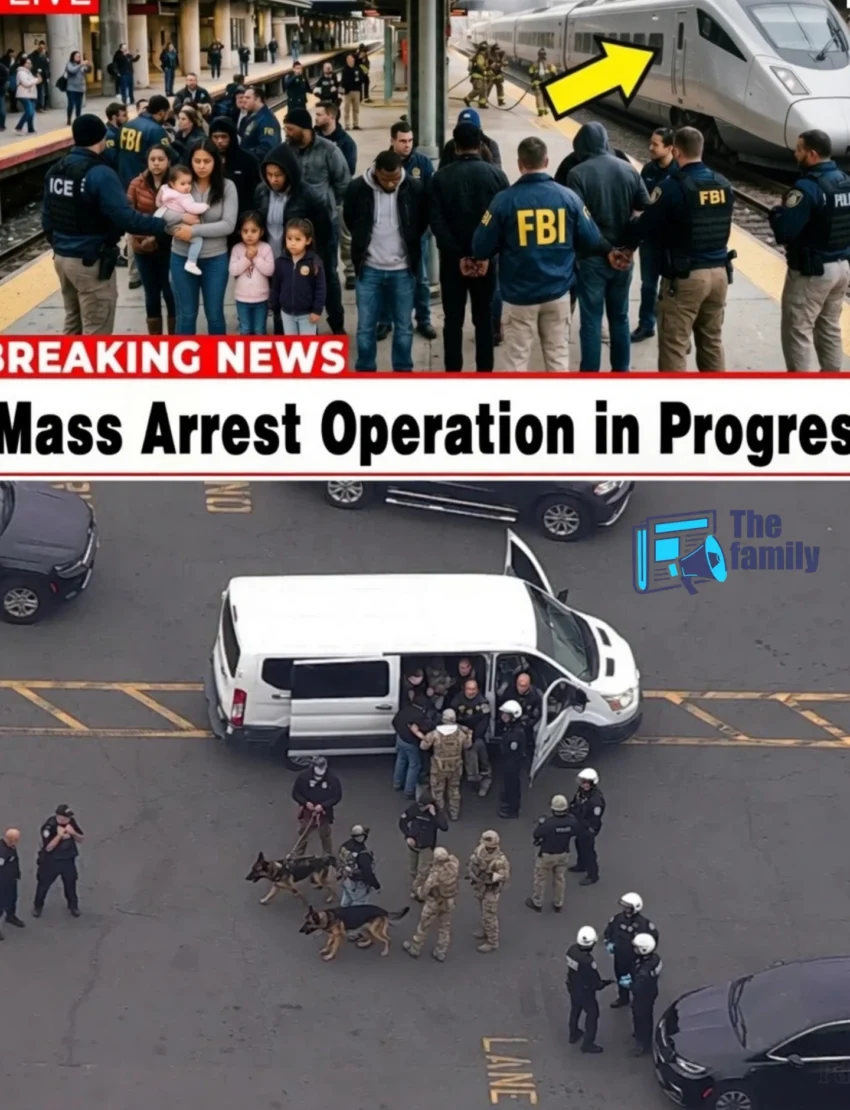
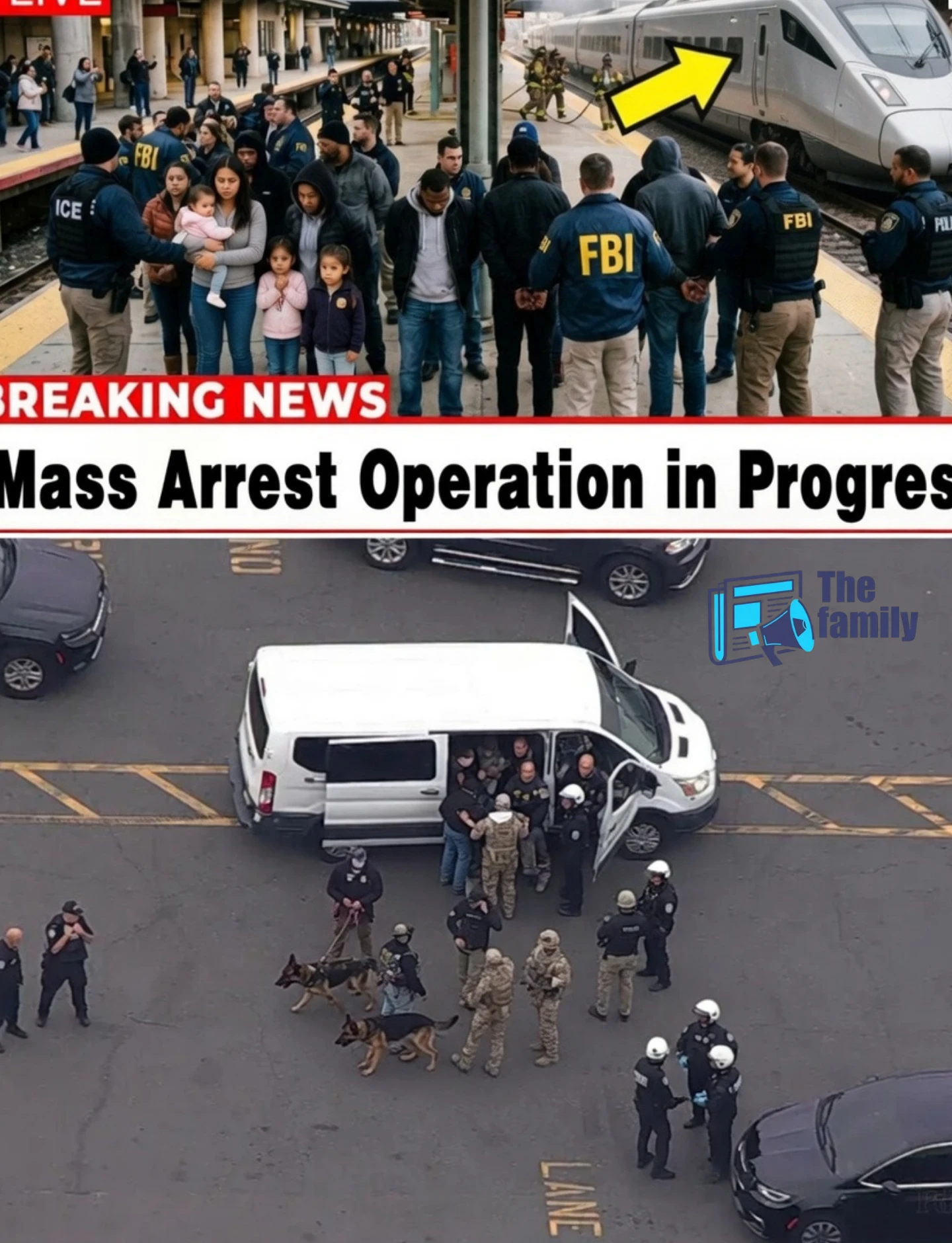
It begins, as many compelling narratives do, with something undeniably real and deeply human: a fatal crash.
In Morristown, New Jersey, the story opens with the death of a 68-year-old man in what is described as a hit-and-run incident. The emotional framing is immediate and deliberate. A life lost, a sudden घटना, a sense of injustice—these are elements that anchor attention and invite empathy before any broader claims are introduced.
But what follows is where the narrative becomes more complex.
Within a remarkably short span, the account transitions from a localized трагедия into a sweeping federal operation. According to the story, agencies such as the FBI and DHS rapidly mobilize, uncovering what is described as a multi-state network involving immigration violations, organized crime, and large-scale trafficking. The escalation is dramatic: hundreds of arrests, tons of seized contraband, and a hidden system allegedly operating beneath the surface of everyday life.
At first glance, the progression feels logical. A crime leads to an investigation, which leads to discovery, which leads to enforcement. This structure mirrors familiar patterns in both journalism and fiction.
Yet the speed and scale of the transformation raise important questions—not necessarily about whether such operations are possible, but about how narratives are constructed to make them feel immediate, inevitable, and interconnected.
One of the most striking features of the account is how quickly it expands.
In the span of what is presented as hours, a single incident reportedly triggers a coordinated, multi-agency response involving hundreds of personnel and advanced investigative techniques. While large-scale federal operations do occur, they are typically the result of prolonged intelligence gathering, surveillance, and legal preparation.
Search warrants, inter-agency coordination, and logistical planning rarely materialize instantaneously. Even in urgent cases, the infrastructure required for a multi-state raid suggests prior groundwork.
This raises a possibility: the narrative may be compressing time, blending pre-existing investigations with a triggering event to create a sense of immediacy. In storytelling terms, this technique is effective. It links cause and effect in a way that feels direct and emotionally satisfying.
But analytically, it introduces ambiguity. Did the crash initiate the operation, or did it simply intersect with something already in motion?
As the narrative unfolds, it repeatedly returns to a central theme: the existence of a concealed, highly organized network.
Patterns are emphasized—shared addresses, recurring identities, financial trails. Each detail is presented as part of a larger structure, reinforcing the impression of coordination and intent.
This technique is powerful because it taps into a familiar cognitive pattern: humans are predisposed to connect dots, especially when those dots are presented in sequence.
However, the strength of this impression depends heavily on the reliability of the underlying data. In the account, many of these connections are asserted rather than independently verified. Numbers are large—hundreds of individuals, millions in transactions, tons of material—but they are not consistently tied to identifiable sources, official statements, or publicly accessible records.
In investigative contexts, such details are typically accompanied by documentation. The absence of clear sourcing does not automatically invalidate the claims, but it does shift them into a category of information that invites further scrutiny.
Large numbers play a central role in shaping perception.
“200 arrests.”
“2 tons seized.”
“Multi-state network.”
These figures create scale. They suggest something expansive, systemic, and difficult to contain. Even without context, they carry emotional weight.
But numbers without context can also obscure as much as they reveal.
What does “200 arrests” represent? Are these individuals connected to a single coordinated network, or are they part of multiple unrelated enforcement actions aggregated into one figure? What constitutes “2 tons seized”? Is it a single category of material, or a combination of different substances or goods?
Without specificity, numbers function less as data points and more as narrative anchors—elements that stabilize the impression of magnitude without necessarily clarifying its meaning.
Another layer of the narrative involves the interpretation of policy—particularly around immigration enforcement.
The story suggests that gaps in enforcement, often described under the umbrella of “sanctuary policies,” allowed the alleged network to operate undetected. This framing introduces a causal relationship between policy decisions and criminal outcomes.
Policy debates of this kind are real and ongoing, involving complex trade-offs between enforcement, civil liberties, and community trust. However, establishing a direct causal link between a specific policy environment and a specific incident requires substantial evidence.
In the narrative, this connection is implied rather than demonstrated. The suggestion is that the system enabled the घटना, but the mechanisms of that enablement are not fully articulated.
This distinction matters because it separates interpretation from evidence. One can argue that certain policies may create vulnerabilities, but demonstrating that those vulnerabilities directly resulted in a particular outcome is a different level of analysis.
The structure of the account follows a familiar pattern: each revelation leads to a larger one.
First, there is a suspect.
Then, a network.
Then, financial operations.
Then, encrypted systems.
This layered escalation mirrors the architecture of a thriller. Each stage increases the stakes, encouraging the reader to continue, to see what comes next.
From a storytelling perspective, this is highly effective. It maintains engagement and creates a sense of progression.
From an analytical perspective, it raises a question: are these layers independent discoveries, or are they being assembled into a sequence that feels more cohesive than the underlying evidence might support?
In real-world investigations, discoveries often occur in parallel, not in neatly ordered stages. Information is fragmented, sometimes contradictory, and frequently incomplete. The clean progression seen in narratives may reflect editorial shaping rather than investigative reality.
Among the most striking elements of the story is the reference to encrypted data revealing a structured, multi-state system with internal codes and access layers.
If accurate, such a discovery would likely represent a significant development in national security or organized crime investigations. It would be expected to generate attention from multiple credible outlets, accompanied by official confirmation and detailed reporting.
The absence of such corroboration does not necessarily mean the claim is false. It may simply mean that information is incomplete, classified, or still under investigation.
However, it does place the claim in a category that requires caution. Extraordinary assertions typically require proportionate levels of verification, particularly when they involve complex systems and national-scale implications.
The emotional framing of the initial حادثة plays a crucial role in shaping the entire narrative.
By beginning with a tragic, relatable event, the story establishes a foundation of urgency and moral clarity. The loss of life is not abstract; it is immediate and personal.
This emotional anchor then supports the broader claims that follow. As the narrative expands, the initial empathy can make subsequent conclusions feel more plausible, even when they extend beyond the directly observable facts.
This does not diminish the seriousness of the original incident. A fatal crash is, in itself, significant and deserving of attention.
But it does highlight the importance of separating the emotional weight of an event from the analytical weight of the conclusions drawn from it.
Another subtle but powerful element is the framing of inevitability.
The narrative suggests that the crash was not an isolated घटना, but part of a larger, ongoing system. This framing transforms randomness into pattern, accident into outcome.
Humans are naturally inclined to prefer explanations that impose order on uncertainty. A single incident can feel unsettling in its randomness. A system, even a troubling one, offers a form of coherence.
But coherence is not the same as causation.
To demonstrate that an event is part of a system requires more than thematic alignment. It requires evidence of connection—clear, documented links between actors, actions, and outcomes.
Without that, the sense of inevitability remains a narrative construct rather than an established fact.
Large-scale federal investigations into organized networks do occur, and when they do, they typically share certain characteristics:
These elements provide a framework that allows claims to be examined, verified, and contextualized.
In contrast, narratives that present rapid, large-scale developments without corresponding documentation may reflect a different kind of storytelling—one that prioritizes immediacy and impact over procedural detail.
Perhaps the most revealing aspect of the account is not the specific claims it makes, but how those claims are constructed.
It demonstrates how a narrative can evolve:
Each step builds on the previous one, creating a structure that feels coherent and compelling.
But coherence in storytelling does not always equate to completeness in reality.
In the end, narratives like this place a certain responsibility on the reader.
Not to dismiss, but to question.
Not to assume, but to examine.
Key questions become essential:
These questions do not weaken the story. They strengthen understanding.
The issues touched upon in the narrative—crime, immigration enforcement, organized networks—are real and complex. They involve overlapping systems, competing priorities, and evolving strategies.
But complexity resists simplification.
When a story presents a single, unified explanation for multiple phenomena, it may be offering clarity at the expense of nuance.
The challenge is to hold both possibilities at once: that there may be underlying patterns worth investigating, and that not every pattern presented is fully substantiated.
What began as a tragic incident in New Jersey has, in this account, expanded into something much larger—a portrait of hidden systems, rapid enforcement, and systemic failure.
Whether that portrait reflects reality, interpretation, or a combination of both remains an open question.
What is clear is how effectively the narrative operates. It captures attention, builds tension, and offers a sense of unfolding revelation.
But in doing so, it also illustrates a broader truth: that in an era of rapid information flow, the distance between an event and its interpretation can collapse quickly.
And in that space—between what happened and what it is said to mean—stories gain their power.
Understanding that space may be just as important as understanding the события themselves.