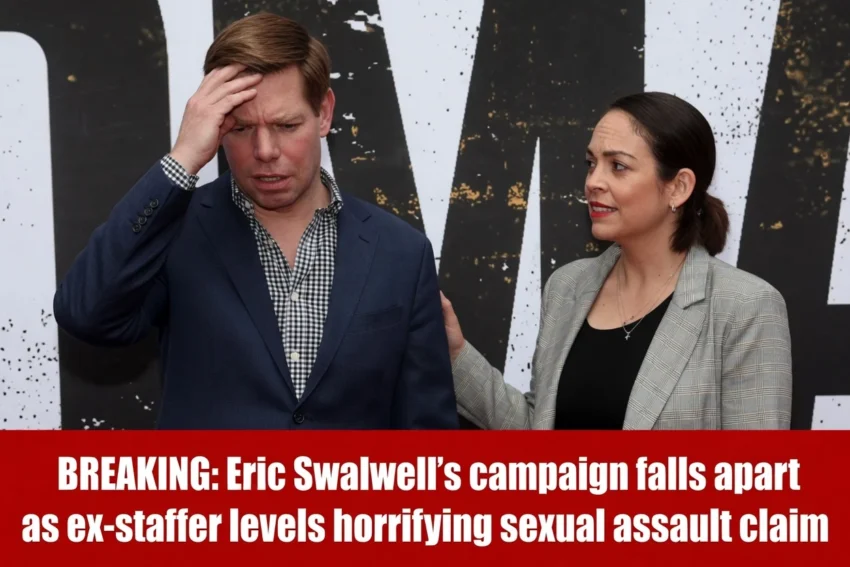
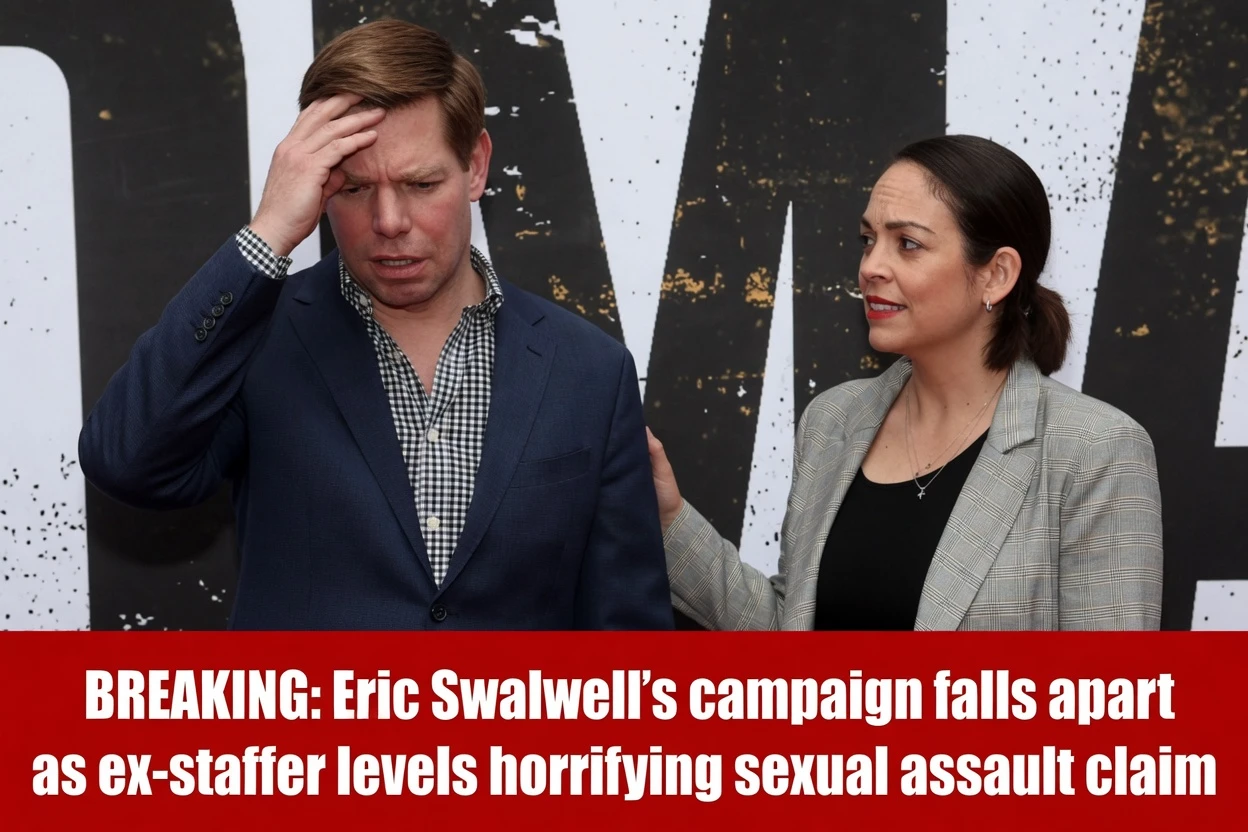
Just as momentum seemed to be building, a sudden wave of allegations has thrown one of California’s most closely watched political campaigns into uncertainty. But beyond the headlines lies a more complex story—one that raises difficult questions about power, accountability, timing, and truth.
In early 2026, Eric Swalwell appeared to be in a strong position.
A Democratic congressman from California’s East Bay, Swalwell had built a national profile through media appearances, congressional work, and previous presidential ambitions. In the race for California governor, he was widely viewed as a serious contender—backed by major unions, supported by prominent Democrats, and polling competitively against both intra-party rivals and Republican challengers.
But within days, that trajectory shifted dramatically.
A series of allegations—first circulating online, then reported by major outlets—introduced claims of sexual misconduct involving a former staff member. Almost immediately, the campaign entered a period of visible instability.
Staff departures followed. Public statements intensified. And a once-forward-moving campaign found itself on the defensive.
At the center of the controversy is an unnamed former staffer who worked in Swalwell’s district office beginning in 2019, when she was 21 years old.
According to reports, she has accused Eric Swalwell of engaging in nonconsensual sexual conduct on multiple occasions.
Among the most serious claims:
These allegations have been described as deeply serious by political observers and legal analysts alike.
At the same time, it is essential to emphasize: these claims have not been proven in court, and no criminal conviction has been established.
Eric Swalwell has forcefully denied the allegations.
In public remarks, he rejected claims of any sexual relationship with a staffer. His legal team has gone further, issuing cease-and-desist letters to individuals who have circulated or amplified the accusations online.
His attorney has characterized the claims as “baseless” and suggested that their timing—emerging during a competitive election—raises questions about motive.
This defense reflects a broader pattern often seen in high-profile cases: a combination of categorical denial, legal countermeasures, and an emphasis on due process.
While the legal and factual questions remain unresolved, the political impact has been immediate.
Reports indicate that multiple staffers resigned abruptly following the emergence of the allegations, including senior campaign figures. Such departures can signal internal concern—not necessarily about guilt, but about the viability of continuing under mounting pressure.
Campaigns rely heavily on perception. Even unproven allegations can disrupt fundraising, endorsements, and voter confidence.
For a candidate like Eric Swalwell, who was positioned as a frontrunner, the shift from momentum to crisis management could prove decisive.
The response from political figures has been swift—and varied.
Some opponents have called for accountability and even withdrawal from the race. Others have expressed support for the accuser, emphasizing the importance of taking such claims seriously.
Meanwhile, allies and observers have urged caution, stressing the need for full investigation before conclusions are drawn.
This split reflects a broader tension in modern politics:
One of the most debated aspects of the situation is timing.
The allegations surfaced at a moment when Eric Swalwell was gaining traction in the governor’s race. Polls suggested he was competitive with figures like Katie Porter and Tom Steyer within the Democratic field.
For supporters of Swalwell, this raises the possibility of politically motivated attacks.
For critics, the timing may reflect when the accuser felt able—or compelled—to come forward.
In reality, both dynamics can coexist. High-stakes elections often create conditions where personal, political, and legal narratives intersect in complex ways.
Beyond the specifics of this case, the allegations highlight a recurring issue in politics and professional environments: power imbalance.
A member of Congress holds significant authority—over staff, career opportunities, and access within political networks.
When allegations involve relationships between a senior official and a junior staffer, questions naturally arise:
These questions extend far beyond any single individual.
The progression of this story—from online rumors to formal reporting—illustrates how modern media ecosystems function.
Social media often acts as an early signal, amplifying claims before they are verified. Traditional outlets then investigate, contextualize, and publish more detailed accounts.
By the time a story reaches the broader public, it has already evolved—shaped by speculation, reaction, and interpretation.
This layered process can make it difficult for audiences to distinguish between:
Amid political strategy and media analysis, it is easy to lose sight of the individuals involved.
For the accuser, coming forward—whether her claims are ultimately proven or not—represents a deeply personal and potentially risky decision.
For Eric Swalwell, the allegations carry not only political consequences but also personal and reputational stakes.
And for campaign staff, colleagues, and voters, the situation creates uncertainty—forcing decisions in real time without complete information.
Several possible paths could shape the outcome of this situation:
Ultimately, this case is not just about one candidate.
It is a test of multiple systems:
At the center of everything remains a fundamental question:
How should society respond when serious allegations emerge against powerful figures—before the full truth is known?
There is no easy answer.
Act too quickly, and due process may be compromised.
Wait too long, and harm may go unaddressed.
For Eric Swalwell, the coming weeks may define not only his campaign but his broader political future.
For voters, the situation presents a difficult choice—one that requires weighing incomplete information against broader values and priorities.
And for the public at large, it serves as another reminder that behind every headline lies a complex intersection of truth, perception, and power.
Because in modern politics, the most decisive battles are not always fought at the ballot box—but in the uncertain space between allegation and proof, where reputations can rise or fall long before the final verdict is known.