Hudson Dick, a vibrant 9-year-old who loved school and soccer, seemed like any other energetic child. But in October 2023, his mother, Kristin, noticed something alarming when Hudson complained of an unusually severe headache.
During conversation, Hudson began showing stroke-like symptoms, including weakness on his left side, prompting Kristin to call 911 immediately. Hudson was rushed to the nearest hospital, where doctors delivered devastating news about his condition.
He was diagnosed with a rare brain arteriovenous malformation, or AVM, a tangled mass of abnormal blood vessels that had ruptured. Measuring five and a half centimeters, the AVM caused bleeding that pressed on his brain, leading to herniation, blown pupils, and a coma.
The medical team acted swiftly, performing a craniectomy to relieve pressure and stabilize Hudson’s condition. Despite the emergency surgery, he remained in a coma for two weeks, and his family knew specialized care was still essential.
After consulting with friends and experts, Hudson was transferred to Holtz Children’s Hospital, one of the few centers in South Florida with extensive AVM expertise. The multidisciplinary team offered surgery, embolization, and focused radiation to treat both adults and children with AVMs.
“At first, Hudson couldn’t speak or move the left side of his face and body,” said Dr. Robert M. Starke, co-director of endovascular neurosurgery. Given the AVM’s location in critical brain areas, embolization was used to block its feeders before completely removing the lesion, achieving remarkable success.
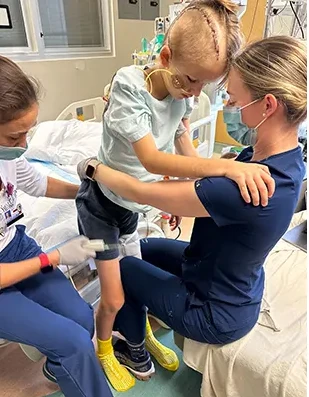
Post-surgery, Hudson’s brain swelling remained significant, delaying bone flap replacement until March. During this time, he wore a protective helmet and began the challenging process of relearning basic movements and skills.
Hudson spent a month in the pediatric intensive care unit at Holtz Children’s, where he worked on mobility and motor function with physical therapist Kyle Zreibe. Their initial sessions focused on simply sitting at the edge of the bed, requiring significant assistance to move even minimally.
Through consistent therapy at the Christine E. Lynn Rehabilitation Center, Hudson progressed from needing full support to walking with the Zero G Gait Trainer. This device supported his weight while allowing him to practice walking independently and safely.
“Walking was really hard for me at first,” Hudson said, recalling his early struggles with balance and strength. Gradually, his left leg adapted, and standing and walking became increasingly manageable with repetitive practice.
By December, Hudson was walking independently without any assistance, a milestone celebrated by his therapy team. Soccer became a motivating factor, with Hudson inspired by Lionel Messi and Zreibe framing therapy like training camp for Inter Miami to make rehabilitation engaging.
After four weeks of intensive therapy, Hudson was discharged just in time for the holidays. By January, he returned to school and, despite missing ten weeks, excelled academically, making the Honor Roll by the end of the year.
Looking forward, Hudson aims to run and train for his school soccer team with continued guidance from his therapist. His motivation and resilience highlight the powerful combination of expert care and personal determination in recovery.
Kristin describes Hudson as a “miracle kid,” attributing his survival to the alignment of exceptional medical care and timing. She emphasized that the family could not have reached this outcome without the dedicated Holtz Children’s team and their multidisciplinary approach.
Hudson reflects on his journey with gratitude and purpose, believing that he was kept alive for a meaningful reason. “One day, I’ll do something great,” he said, embodying hope and determination beyond his years.
His story illustrates the life-saving impact of early recognition, rapid intervention, and the expertise of a multidisciplinary medical team. Hudson’s recovery showcases how specialized neurosurgical procedures, rehabilitation, and family support can restore both function and quality of life in children facing critical conditions.
From emergency craniectomy to progressive rehabilitation, every step of Hudson’s journey underscores the resilience of a young patient and the skill of his medical team. His ability to walk, return to school, and pursue his passion for soccer demonstrates the transformative power of comprehensive care.
The collaborative approach at Holtz Children’s Hospital, combining neurosurgery, endovascular therapy, and rehabilitation, ensured Hudson not only survived but thrived. His progress inspires families and healthcare providers alike, showing that even life-threatening brain conditions can be overcome with expertise and perseverance.
Hudson’s journey is a testament to hope, courage, and the extraordinary dedication of medical professionals who treat both patients and families with compassion. His story emphasizes that early intervention, innovative procedures, and persistent therapy can produce outcomes once thought impossible.
Today, Hudson continues to recover, building strength and coordination while embracing school, sports, and social activities. His story serves as a beacon of hope for children and families facing similar medical crises, illustrating the remarkable possibilities of modern pediatric care.
From sudden stroke-like symptoms to walking independently and excelling academically, Hudson Dick’s journey embodies courage, resilience, and the miraculous impact of multidisciplinary pediatric care. His recovery is a powerful reminder of the difference that specialized treatment, determination, and supportive care can make in a young life.