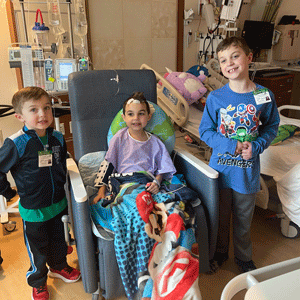
Shortly before Beckett turned six, his parents noticed unusual symptoms that didn’t seem significant at first. He would become dizzy when spun around and was frequently sick with stomach flu-like symptoms, which they initially dismissed as minor childhood ailments.
When his teacher expressed concern about Beckett’s changing personality in school, Nora and Pat realized something deeper was happening. Their instinct led them to further medical evaluation to uncover the root of his discomfort and behavioral changes.
In early 2023, Beckett was initially diagnosed with chronic constipation, a seemingly benign condition. However, over the next few months, his gait worsened, nausea persisted, and he began experiencing hip pain, prompting more extensive testing.
The family was referred to Lurie Children’s Orthopedics team, where an MRI revealed a shocking diagnosis unrelated to bones or joints. Beckett was suffering from hydrocephalus, a buildup of fluid in the brain, caused by a brain tumor.
“We never expected that news – his bloodwork was normal, so we thought tumors and cancer had been ruled out,” Nora said. Beckett was immediately rushed into surgery to relieve the fluid buildup and had a permanent shunt placed to manage the hydrocephalus.
During his two-week hospital stay, a biopsy confirmed that Beckett had a low-grade glioma, a slow-growing, cancerous tumor located in the central part of his brain. Surgery to remove the tumor was not an option due to its critical location, and Beckett began an intensive chemotherapy regimen immediately.
The initial phase of chemotherapy proved challenging, with side effects impacting his daily life and progress. At his 12-week check-in, Beckett’s family learned that the tumor had grown and spread, requiring a revised chemotherapy strategy, carefully guided by Lurie Children’s Center for Cancer and Blood Disorders and Brain Tumor Program.
Despite the difficult news, Beckett showed remarkable resilience. By November 2023, his MRI scans were stable, and by February 2024, the tumor had even begun shrinking, a promising sign that the new treatment plan was effective.
Throughout chemotherapy, Beckett continued physical and occupational therapy to regain strength and mobility. These therapies helped him restore energy and return to activities he loved, including wrestling with his brothers, playing outside, and engaging in sports safely.
His parents describe the current chemotherapy as a blessing, allowing Beckett to live a more typical childhood. With side effects from the first round now largely resolved, he has resumed his playful personality and normal daily routines.
Dr. Angela Waanders, Beckett’s neuro-oncologist, monitors his tumor with the goal of keeping it in “sleep mode,” where cancerous cells stop dividing indefinitely. Low-grade gliomas like Beckett’s are chronic conditions that may require ongoing treatment and careful observation over many years.
Dr. Waanders’ research focuses on genomic alterations in childhood low-grade gliomas, developing alternative strategies for tumors that cannot be surgically removed. Beckett’s progress demonstrates that targeted therapy can control tumor growth while preserving quality of life.
Even during hospital stays, Beckett’s spirit shines with the help of Lurie Children’s Child Life specialists. Marlee Speak, a Child Life Specialist, supports Beckett through procedures, providing comfort, distraction, and encouragement that turns treatment sessions into manageable experiences.
“Marlee is his best friend,” Nora said. “He loves having her there. Chemo is almost fun and easy for him now, thanks to her.” The Child Life team’s support has helped Beckett approach each treatment with confidence and positivity.
Beckett’s family recognizes that his journey will continue throughout his life. The tumor will need lifelong monitoring, but the present moment is filled with relief and gratitude. Seeing him energetic, playful, and engaged in normal childhood activities is a victory after months of fear and uncertainty.
His parents describe small sighs of relief as Beckett regains his old self. They see his energy, his playfulness, and his personality returning, providing a light at the end of a very dark tunnel.
Outside hospital walls, Beckett thrives in physical activity, sports, and recreation. He participates in baseball, soccer, basketball, and swimming, reclaiming the active childhood that the tumor and its treatment had temporarily interrupted.
Beckett’s story exemplifies the power of specialized pediatric care, multidisciplinary teamwork, and resilience in the face of life-threatening illness. Every milestone, from physical recovery to social engagement, reflects the effectiveness of expert treatment combined with family support.
His progress also highlights the significance of Child Life services in pediatric oncology care. Emotional and psychological support during invasive procedures is vital to ensuring that children not only survive but thrive through treatment.
Lurie Children’s Brain Tumor Program offers advanced care and research for children with brain tumors. Their multidisciplinary team of physician-scientists works to develop innovative therapies that improve outcomes and quality of life for patients like Beckett.
The program’s research also informs the broader medical community about pediatric brain tumors, ensuring that future patients benefit from new treatments and evidence-based care. Beckett’s experience shows that even tumors that cannot be surgically removed can be managed successfully.
For Beckett’s family, every step forward is a cause for celebration. Each day that he can play, laugh, and enjoy life is a tangible reminder that hope, expertise, and determination can overcome extraordinary challenges.
Through perseverance, expert care, and a supportive hospital environment, Beckett has regained his shine. His journey demonstrates that even children facing serious, chronic conditions can live full, happy, and active lives when treatment and care are personalized and compassionate.