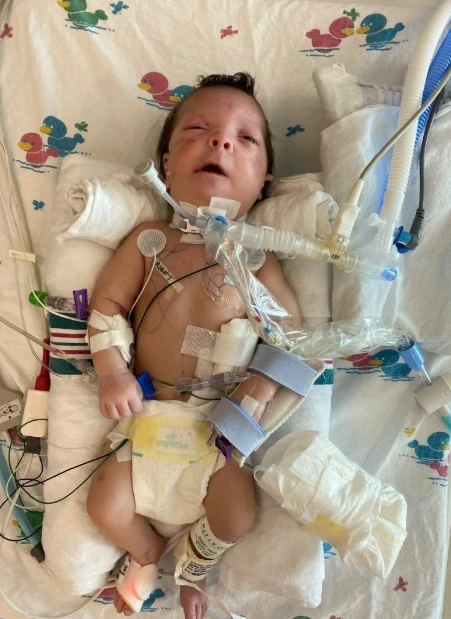
For most families, a fourth birthday is filled with joy, laughter, and celebration. But for Devin and Adriana Stallard, the days leading up to their daughter Abigail’s fourth birthday were filled with fear, uncertainty, and the weight of an unimaginable decision.
Just three days before the life-changing surgery, a single number loomed over them: fifty percent. It wasn’t just a statistic; it was the line between life and loss.
Abigail’s journey had never been simple. Born prematurely at 35 weeks, she entered the world smaller and quieter than expected. Immediately, doctors began to suspect something wasn’t right.
The diagnosis would forever shape Abigail’s life: 22Q Duplication, a rare genetic condition that affects development in unpredictable and complex ways. For Abigail, it meant facing challenges in every aspect of her body—her appearance, communication, and, most critically, her ability to breathe.
From the start, her airway was fragile. A condition called suprastomal collapse made each breath a struggle. Something as basic as breathing became a daily fight, one that required strength far beyond her years.
But that was just the beginning. Abigail was also born with hemifacial microsomia, affecting the structure of her face and jaw. The lack of ear canals made hearing and speech development incredibly difficult for her.
Still, she adapted. She learned to communicate through sign language. She found a way to express herself in a world that wasn’t prepared for her.
Her quiet determination spoke volumes. Though her progress may have seemed small to outsiders, each milestone was monumental to her parents. Every sign she learned, every connection she made, every breath she took without struggle—these were victories fought for with relentless effort.
But despite her progress, her airway remained at risk. Doctors had monitored her closely, knowing that one day, intervention might become necessary. And eventually, that day arrived.
The recommendation was clear, though terrifying: Abigail needed a highly complex surgery to reconstruct and stabilize her airway. It was a procedure so delicate that even the most experienced specialists approached it with caution.
Leading the operation would be Dr. Reza Rahbar, a world-renowned expert in pediatric airway surgery. For many parents, his involvement would bring comfort, but for Devin and Adriana, it came with the sobering reality of just how serious the situation was.
Even Dr. Rahbar acknowledged the gravity of Abigail’s case. This was one of the most complicated surgeries he had ever encountered. And no matter his expertise, the risks were undeniable.
As surgery day approached, time seemed to slow. The final days before the procedure were filled with tension. Three days, two days, one—each moment felt heavier than the last.
Nights became restless, filled with sleepless hours and silent prayers. Every glance at their daughter felt more meaningful, more fragile.
Abigail, unaware of what lay ahead, continued to live in the simplicity of childhood. She smiled, she signed, and she reached for her parents with unshakable trust.
She didn’t understand the risks. She didn’t know what fifty percent meant. All she knew was that she was loved, and her parents were there, and that trust became both a comfort and a heartbreak.
Because this time, protecting her meant letting go. It meant placing her life in the hands of surgeons who would take on the responsibility of her survival.
It meant stepping back and believing in something beyond certainty. It was a faith that Devin and Adriana held onto with everything they had.
In the quiet moments, they prayed. They held each other when fear felt overwhelming. They imagined a future where Abigail could breathe freely, where her body no longer had to fight so hard for something so essential.
But fear never fully disappeared. It lingered in every “what if,” in every possibility beyond their control.
Still, they showed up for their daughter with unwavering love. To the outside world, it might have looked like waiting. But for them, it was endurance. It was strength that came not from knowing the outcome but from choosing hope anyway.
As the final hours drew near, Abigail remained exactly who she had always been: resilient, present, full of quiet courage. She continued to connect, to express, and to live fully in each moment—unaware that her story had already inspired everyone around her.
And maybe that was the most powerful part of all. Because even in the face of uncertainty, life was still unfolding.
Devin and Adriana didn’t know what the outcome would be. They didn’t know which side of that fifty percent their daughter would land on. But they knew this: Abigail had already shown extraordinary strength.
In just four years, she had faced more than most do in a lifetime. And still, she kept going.
So they held onto that truth—not as a guarantee, but as a reason to believe. Because sometimes, hope doesn’t come from knowing what will happen. Sometimes, it comes from everything you’ve already seen.
And in Abigail, that strength was undeniable.