At 1:15 PM on March 26, my brother George, known to friends as Ujo, texted his friend that his job interview went great.
By 1:22 PM, less than ten minutes later, he was unresponsive.
By 2:00 PM, paramedics were telling me that he might not survive the drive to the hospital — a Code Blue situation none of us had ever imagined.
My name is Gerald. I’m George’s younger brother.
This is what happened.
George was 27 years old — young, healthy, strong, and with no prior medical history, no medications, no warnings.
He had just finished an interview for a job he was truly excited about.
He even video‑called a friend to celebrate the moment — ready to share his good news.
Mid‑FaceTime, everything changed.
He suddenly grabbed the left side of his head and exclaimed, “Is this an aneurysm?” — a thunderclap headache that came without any obvious cause.
He even tried to Google his symptoms on the call.
Then he went pale, started sweating, and stopped responding entirely.
Within five minutes, a friend had arrived at his apartment and found George barely conscious — eyes rolled back, drenched in cold sweat.
911 was called, and then I was called.
I arrived at the scene just three minutes after the paramedics.
I watched four emergency workers carry my brother to the ambulance, powerless, unable to walk, unable to speak.
A paramedic made a call that changed everything.
“This is very serious,” he said.
“Head to the ER now. He doesn’t look like he’s going to make it.”
At the emergency room, the gravity of the situation became clear.
I was asked to give consent to operate on his brain — to put him under anesthesia, to open his skull, to do whatever it would take to keep him alive.
That’s when our family heard a reality no one wants to hear.
Doctors told us that he was unlikely to survive — that we should get our parents there before it was too late.
That’s when my father, a man who I have never heard cry in my entire life, called me in tears.
He asked if I could fly our mother from Las Vegas to Los Angeles so she could be with her son in his final moments.
The next six hours became the longest of my life.
George went into emergency brain surgery at 4:30 PM — a procedure that lasted over six hours.
For hours we sat in a waiting room, staring at a monitor showing names and statuses.
While other patients’ procedures turned into “Post‑Op Recovery,” George’s name remained under “OR / Procedure” — unmoving, unchanging, until it suddenly vanished from the screen.
For a moment, we didn’t know if he was alive.
Five minutes later, a hospital supervisor informed us that George had survived surgery and was now in the Neuro‑ICU.
For the first time in six hours, we exhaled.
What the doctors discovered during surgery was something that had likely been present since birth — a silent threat that had never given a hint until that moment.
George suffered a ruptured arteriovenous malformation (AVM) — an abnormal tangle of blood vessels in the brain that had gone undetected for 27 years.
In a normal brain’s circulation, arteries carry oxygen‑rich blood to tissues and veins carry oxygen‑depleted blood back to the heart via tiny capillaries. In an AVM, arteries connect directly to veins without that capillary bed, disrupting normal blood flow and increasing pressure on the vessel walls.
Most AVMs cause no symptoms until they rupture, which often comes as a complete shock — just like it did with George.
When an AVM ruptures, it can cause a hemorrhagic stroke, bleeding directly into the brain and surrounding tissue.
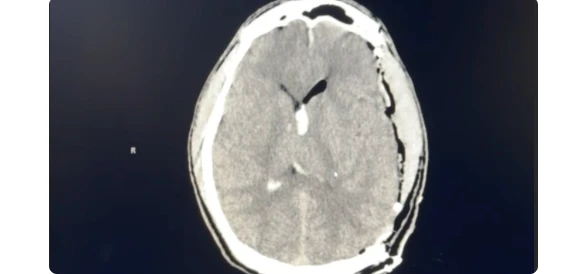
In George’s case, the AVM ruptured suddenly, flooding the left side of his brain with blood — the region responsible for language, memory, and motor function.
During the emergency surgery, neurosurgeons performed a craniotomy — they removed part of his skull to give his swelling brain room to survive.
They evacuated as much of the hemorrhage as possible and placed a drain to relieve lethal pressure.
The operation saved his life.
But it didn’t end the battle.
The AVM itself — the root cause — could not be treated at that moment because removing it would have likely caused further brain damage.
Now, doctors say that two more surgeries are necessary — one to fully remove the AVM itself, and another to reconstruct his skull with a custom prosthetic plate once his brain has had time to heal.
Additional complex surgeries are not new when dealing with AVMs, but timing and care must be precise to avoid further hemorrhage or neurological damage.
Right now, George is in stable condition, and follow‑up scans show significant improvement, which has doctors cautiously optimistic.
Yet he faces a long road of recovery — rehabilitation that will span months.
Weeks of speech therapy, physical therapy, and occupational therapy lie ahead as George works to regain the motor function, verbal ability, memory, and cognitive skills that the hemorrhage affected.
Doctors have warned that another stroke is a real possibility, meaning constant monitoring and 24/7 attentive care may be necessary for quite some time.
It will be at least six months before he can think about returning to any form of work.
And all of this is unfolding without an income.
George was on involuntary unpaid leave when this happened — the reason he was interviewing in the first place — and now he has zero income as he fights to survive and reclaim his life.
This was not George’s fault.
He did not cause this AVM, did not trigger its growth, and did not know it was there — a congenital condition that remained silent his entire life.
He lived 27 healthy years — no medications, no warning signs — until the day a thunderclap headache changed everything.
Thunderclap headaches — sudden, severe pain often described as the worst of one’s life — are exactly the type of symptom AVMs can produce right before a rupture.
Now, as George lies in a hospital bed connected to monitors, tubes, and specialists who know his brain better than he does right now, his family stands by him — exhausted, emotionally drained, but unwavering.
The next phase involves not just surgeries, but a comprehensive rehabilitation plan designed to rewire his brain and help him rebuild the functions that were lost.
Recovery from a ruptured AVM is highly individual, but experts say that physical, occupational, and speech therapies can leverage the brain’s neuroplasticity — its ability to adapt and form new connections.
Young brains like George’s often have greater potential to heal and rewire than older adults’, which has given his doctors a measure of genuine hope.
Yet, the financial reality remains daunting — surgeries, ICU stays, months of therapy, and living expenses with no income can overwhelm even the strongest families.
This isn’t just a story about medical crisis — it’s a story about how quickly life can change in a single moment.
One second you’re planning your future after an exciting job interview.
The next you’re in an ambulance, fighting for your life.
And the world as you knew it no longer exists.
But even in the midst of this overwhelming burden, there is a thread of hope — a reminder that despite the odds, with modern medical care and rehabilitation, a future still remains possible.