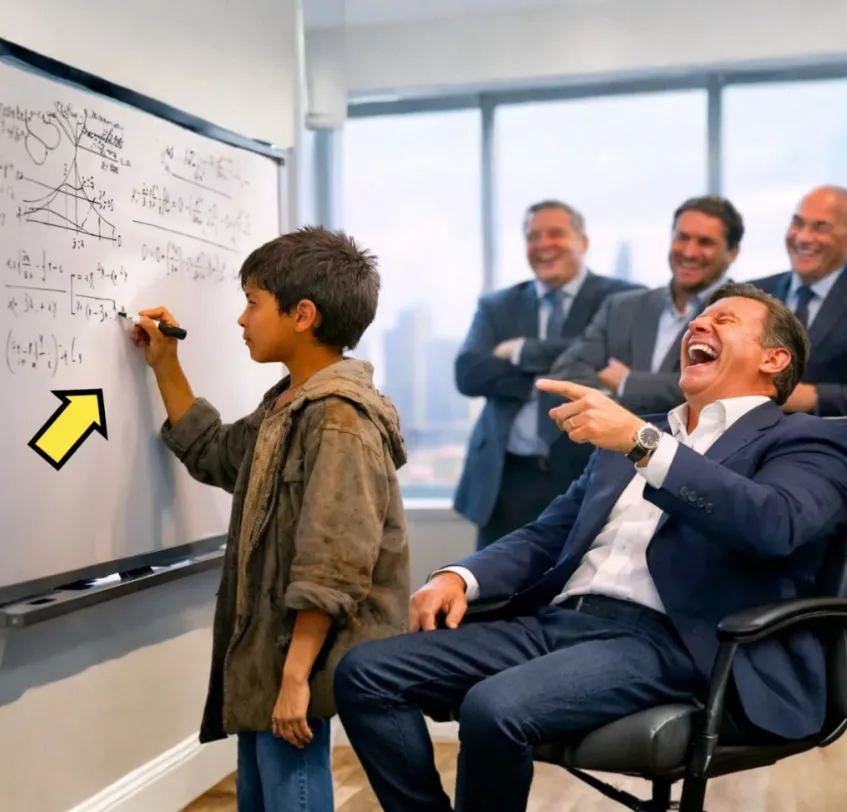
“Your calculations are wrong…” said the poor boy… The millionaire laughed… but he was also shocked.
“Numbers don’t lie.”
Roberto Santillán adjusted his Italian silk tie and looked again at the whiteboard as if it were a mirror that always proved him right. There they were: perfect columns, clean arrows, percentages underlined in blue marker. He had rehearsed that presentation for a week, and that morning—inside the boardroom on the 23rd floor of a Santa Fe skyscraper—he was ready to crown the biggest deal of his career.
“With this expansion,” he said, pointing to the total, “we’re talking about fifty million pesos in initial investment and a projected return of seventeen percent.”
To his right, his assistants nodded with tense smiles. In front of him, three Japanese investors watched in silence—impeccable, attentive. The eldest, Mr. Takeshi Yamamoto, held a small notebook and a pen that kept spinning between his fingers. The youngest, Kenji Sato, was all eyes.
Roberto took a deep breath. It was time to close, to sell the dream: shopping centers, residential complexes, a brand multiplying across the country. His company, Grupo Santillán Desarrollos, had been born in a tiny room with a borrowed desk. Now, the numbers on the board promised the next leap.
And then, a child’s voice—soft but firm—cut through the air.
“Your calculations are wrong.”
Silence fell like a door slamming shut.
Roberto blinked, incredulous. He slowly turned around, looking for a joke, a hidden camera, a reckless employee. But it wasn’t a joke.
At the entrance of the room stood a boy of about twelve. He had messy brown hair, worn-out sneakers, and a backpack that looked bigger than him. He held an old notebook with folded pages and a chewed blue pen.
The Japanese investors glanced at each other. Yamamoto murmured something in Japanese. Roberto felt the heat rise up his neck.
“Who are you?” he asked, trying to keep his voice calm, though irritation had already sharpened it.
“My name is Mateo Hernández, sir,” the boy replied without lowering his gaze. “I’m the son of Doña Celia, the woman who cleans here. And… those numbers are going to make you lose a lot of money.”
A loud laugh escaped Roberto—more reflex than humor. His assistants laughed too, nervously, like clapping to cover thunder.
“Listen, kid,” Roberto said. “Do you have any idea how much a meeting like this costs? These gentlemen came all the way from Japan to evaluate my project. We don’t have time for… nonsense.”
“It’s not nonsense, sir,” Mateo insisted, stepping forward. “You multiplied 127,000 by 394, but you wrote 50,038,000. It should be 50,138,000. That’s a difference of one hundred thousand pesos.”
The laughter died halfway in Roberto’s chest.
He froze. He turned back to the whiteboard, searching for the error like someone hunting for their own lie.
“Impossible,” he thought. His team had checked everything.
Mateo opened his notebook like it was a file.
“And on the third line,” he continued, “when you added operating costs, you forgot the 2.3% administrative rate you had on the previous sheet. I saw that rate on a paper you printed yesterday.”
Roberto felt a chill in his stomach. How could that boy know about internal sheets, previous versions, rates that didn’t even appear in the final presentation?
“Can we verify?” Yamamoto asked in slow, clear Spanish.
Roberto swallowed. He couldn’t hesitate.
“Of course we can verify,” he said, walking to the desk. “But my calculations are correct. Surely the boy saw loose numbers and—”
He typed into the calculator on the computer. The silence in the room became heavy, almost physical.
One second.
Another.
Roberto went pale.
“No…” he murmured, redoing the calculation. “That can’t be.”
Mateo looked at him without mockery.
“It’s wrong, right?”
Roberto looked up and met the investors’ eyes. There was no anger—just a quiet warning: the kind of look that measures risk without raising its voice.
“It was… a typing error,” Roberto stammered. “We’ll correct it and move on.”
Mateo tilted his head, as if asking something obvious.
“Do you want me to show you the other mistakes too? I found five more.”
This time, no one laughed.
Roberto felt the reputation he had built over twenty years begin to crack because of a gap the size of a boy with a backpack.
“What other mistakes?” Roberto asked, forcing composure.
Mateo walked to the whiteboard and pointed to the upper right corner.
“Here you calculated fifteen percent annual growth for five years, but you used simple interest, not compound. With compound interest, the result changes… it’s more than two hundred thousand pesos difference.”
Roberto checked. Correct.
Mateo pointed to another line.
“And here you added import costs twice: once on line seven and again on line twelve. That’s eight hundred ninety thousand counted twice.”
Sweat ran down Roberto’s back. His accountants, his engineers, his CFO… how had they missed this? How could a child see it at a glance?
“How did you learn this?” Roberto asked, no longer scolding—genuinely surprised.
Mateo shrugged.
“I like math. I wait for my mom here when she works… and across the street there’s a private school. From the yard you can see the math classroom board through a window. I stand behind a tree and… listen.”
The image struck Roberto in a way he hadn’t expected: a child learning from outside, stealing knowledge from the world through a crack.
Yamamoto stood up, walked to the board, reviewed it in silence. Then he asked for Mateo’s notebook. The boy hesitated for a second, looking at Roberto. Roberto nodded.
Yamamoto flipped through the pages. His expression slowly changed from caution to astonishment.
“These calculations… are correct,” he finally said. “And very well organized. Where did you learn financial projections?”
“I don’t know what ‘projections’ are,” Mateo answered honestly. “I just know that if money comes in and money goes out… you have to add it right, or in the end it’s not enough.”
The simplicity left everyone silent.
Roberto felt a strange humiliation—not the kind that angers, but the kind that cleans.
“Mateo,” he said, taking a deep breath, “can you help us correct the board?”
The boy took the marker and erased numbers with confidence. His handwriting was surprisingly clear and aligned. When he finished, he stepped back as if nothing special had happened.
“Done.”
Yamamoto checked line by line. He nodded.
“Perfect. This way, the project makes sense.”
Roberto should have felt relieved, but he could only think of one thing: if a child had saved his presentation today, how many times had his company walked toward a cliff without realizing it?
“Where’s your mother?” Roberto asked.
“On the eighteenth floor, sir.”
Roberto asked for her to be called. Minutes later, Doña Celia Hernández entered—about forty years old, impeccable blue uniform, hair neatly tied. When she saw her son there with men in suits, her face tightened.
“You sent for me, sir?” she asked nervously.
“Your son helped us today,” Roberto explained. “He has an… impressive talent.”
Doña Celia looked at Mateo with pride mixed with fear.
“I hope he didn’t cause trouble, sir. I tell him to stay still…”
“On the contrary,” Yamamoto interrupted. “He did us a great service.”
Roberto observed mother and son: the affection in a glance, the dignity in their posture, and the weariness of a life of effort.
“Where does Mateo study?” Roberto asked.
“At the public middle school nearby,” Doña Celia replied. “He’s very dedicated, but… the school doesn’t have resources to teach him more advanced things. He looks on his own.”
Roberto walked to the window. From there, he could indeed see the private school across the avenue—children in expensive uniforms, new backpacks. And behind a tree, he imagined Mateo, still, learning from the edge.
He turned back.
“Mateo,” he said, “would you like to study mathematics seriously, with teachers who can take you further?”
The boy’s eyes lit up, but he looked first at his mother.
“Yes, sir… but my mom can’t afford it.”
Roberto heard himself before thinking too much.
“I can.”
Doña Celia stiffened, alert.
“In exchange for what, sir?”
The question hurt because it was fair. Roberto had lived in a world where nothing was free.
“In exchange for your son not having to learn in hiding,” he replied. “And… yes, I’d also like him to come some afternoons to review numbers. Not as an employee. As support, with supervision. Without taking away his school. I’ll pay for the private school and a tutor.”
Yamamoto took out a card.
“Doña Celia, our group also has scholarships for talented youth. Please consider that option too. Talent like this… is rare.”
Roberto felt, for a second, an absurd pang of competition. Then he felt ashamed. This wasn’t a contract; it was a child.
As they left, Mateo turned at the door.
“Mr. Roberto… can I tell you something?”
“Go ahead.”
“You should also review the big shopping center project. Yesterday I saw a paper on the secretary’s desk… and the numbers didn’t match the size of the land on the map.”
The blood drained from Roberto’s feet.
That shopping center was worth over one hundred million pesos.
That night, Roberto barely slept. He summoned the CFO, engineering, everyone. And at nine the next morning, when Yamamoto returned with his team, Roberto already had the report in hand… and an expression he hadn’t worn in years: real concern.
“We found inconsistencies,” Roberto admitted. “And Mateo was right.”
Mateo opened his notebook.
“The paper said fifteen thousand square meters… but on the map scale it looks smaller. I calculated around twelve thousand five hundred.”
The CFO, a man with two master’s degrees, fell silent.
“How did you calculate that?” he asked, incredulous.
“With the map scale,” Mateo replied. “And a ruler.”
Yamamoto tilted his head, interested.
“Can we go to the site?”
Roberto hesitated. It wasn’t protocol. But it also wasn’t protocol for a child to save his company twice.
“If Doña Celia agrees… let’s go.”
An hour later, they were on the outskirts. Developing land, “Future Value” signs, dust and sun. Mateo got out first, counting steps, observing angles. He took out a small measuring tape.
“My mom gave it to me,” he said. “She said a man should know how to measure well.”
For an hour he measured the boundaries patiently. The adults followed in silence, like students.
“Done,” he said finally. “It’s 12,430 square meters, not fifteen thousand.”
The silence was brutal. If the land was smaller, the design wouldn’t fit, costs would explode, viability would collapse. And worst of all: someone had inflated data. Mistake? Or something else?
Back at the building, Roberto locked himself in with his team.
“Starting today,” he said, “no project is approved without independent verification. No more ‘trusting because the paper says so.’ And we start by investigating who gave us false measurements.”
Far from pulling out, the Japanese investors surprised him.
“In Japan,” Yamamoto said, “we value humility and improvement. Today you accepted corrections and changed the process. That… gives us confidence.”
Then came the second surprise.
“We want Mateo to participate in verification,” Yamamoto added. “Not as a worker, but as a young consultant, with supervision. His perspective has been… extraordinary.”
Doña Celia squeezed her son’s hand.
“He must not lose school,” she said firmly. “That comes first.”
“That comes first,” Roberto repeated, looking at her with respect. “I swear it on my name.”
The following weeks changed everything. Mateo attended his public school in the mornings. In the afternoons, he took advanced math lessons with a tutor: Professor Miguel Salgado, a retired engineer who said on the third day:
“This kid doesn’t just solve—he understands. As if numbers speak to him.”
At the company, Mateo reviewed calculations in a small office, always supervised. At first some engineers resisted. Then, when Mateo saved millions by correcting an impossible design, resistance turned into respect.
One day, Roberto found him looking out the window.
“What are you thinking?” he asked.
Mateo shrugged.
“That it’s strange. Before, I watched classes from outside. Now I’m inside… but I feel like there are many kids still out there, behind the tree.”
That sentence stuck with Roberto.
Little by little, what started as an “arrangement” became something bigger. Roberto created a program with public schools to identify talent: math, technical drawing, logic. He called it Open Windows Foundation, after the boy who learned by looking through one.
Mateo was the first to help select scholarship students. He didn’t do it as a “genius,” but as a peer. He told them:
“It’s not magic. It’s practice. And asking without shame.”
The day the first eight children arrived at the new educational workshop in the building—a room full of whiteboards, books, and rulers—Doña Celia cried silently. Roberto, who had only cried over stock failures, felt a strange knot: pride in something that couldn’t be bought.
Months later, at a simple ceremony, Mateo handed Roberto a folded paper.
It was a handmade “certificate,” with numbers drawn around the edges.
“To the best boss and mentor. Thank you for listening to me when I was just a child.”
Roberto found no words. He only hugged him—an awkward hug, from a man used to shaking hands, not holding stories.
“You know what’s the strangest thing, sir?” Mateo whispered. “That day I thought you were going to throw me out.”
Roberto swallowed.
“And I thought you came to humiliate me,” he confessed. “Turns out you came to save me.”
The happy ending didn’t come with applause in a boardroom, but with something quieter: a change of direction.
Two years later, Grupo Santillán Desarrollos kept growing—but with real audits, site visits, and teams no longer offended when someone pointed out a mistake. Yamamoto’s group expanded their investment, not just for profitability, but for the educational model the company promoted.
Mateo, now fourteen, sometimes traveled to Guadalajara or Monterrey to open new program locations. And every time an adult called him a “genius,” he answered the same way:
“No. I just had a mom who taught me not to give up… and a man who decided to listen.”
As for Roberto, he understood something that was never written on the whiteboard: true prestige isn’t “never being wrong,” but correcting in time, with humility, and opening the door so others can come in.
And one afternoon, watching the program’s children leave with books under their arms—without hiding behind any tree—Roberto knew that for the first time in his life, he had built something more important than buildings:
Years later, when Roberto Santillán was asked what the wisest decision of his career had been, he never mentioned the multimillion-dollar projects or the high-profile deals. He simply smiled and spoke of a morning on the twenty-third floor, when a poor boy with a worn-out backpack dared to say, “These numbers are wrong.” Because of that boy, Roberto not only saved his company, but also learned how to listen, how to bow to the truth, and how to open doors for talents that had long been overlooked. From that day on, success for Roberto was no longer measured in profit, but in the lives that were changed.
Charlie Kirk, the 31-year-old founder of Turning Point USA, was fatally shot during a Q\&A session at Utah Valley University.
The attack unfolded as he responded to a question on mass shootings, his final words cut short by a gunshot that struck him in the neck.
Witnesses described chaos as students screamed, ducked for cover, and scrambled for exits.
Video captured Kirk collapsing mid-sentence beneath a tent reading “The American Comeback.”
Blood pooled on the ground as security rushed forward, unable to prevent the tragedy.
Initial confusion followed when police detained an elderly man shouting about his rights,
but authorities later confirmed he was not the shooter. Investigators believe the fatal shot
came from the Losee Center building nearly 200 yards away, sparking an ongoing manhunt.
Attendees questioned the lack of security measures at the event, with some noting no bag checks or entry screening.
Officials admitted that vulnerabilities existed and acknowledged the failure to prevent such a deliberate act.
Utah Governor Spencer Cox condemned the killing, vowing full accountability for those responsible.
Former President Donald Trump paid tribute on Truth Social, calling Kirk “Great, and even Legendary,”
while California Governor Gavin Newsom denounced the attack as “disgusting, vile, and reprehensible.”
Kirk is survived by his wife, Erika Frantzve, and their two young children.
Married in 2021, the couple had recently marked their fourth anniversary.
Friends and colleagues remembered him as a passionate activist who built a national movement from his teenage years.
Law enforcement officials emphasized the gravity of the security breach, with UVU’s police chief expressing heartbreak over the incident. The university community, meanwhile, struggled to process the shocking violence.
Life has a way of surprising us in the most unexpected moments. For one man, what began as a simple stretch while relaxing in his living room turned into an unusual experience that quickly drew both curiosity and concern. What he thought was just another normal day would end up revealing something strange about his body—something that raised questions, drew laughter online, but also served as a reminder of how delicate our health can be.