So, no one from her school or family ever thought to check on her in Mobile, Alabama? That question lingers heavily over a heartbreaking case that has shocked the public and exposed deep failures in parental responsibility and community awareness. A 14-year-old girl in Mobile County had been living completely alone with seven dogs since February 2025, abandoned in a trailer and left to survive on her own. The last time she saw her mother was on Halloween. For months afterward, no adult was physically present to care for her, protect her, or even ask if she was okay.
At just 14 years old, a child should be focused on school, friendships, and personal growth—not on basic survival. Yet this girl was forced into an adult role far too early, navigating hunger, illness, and isolation without parental support. Her mother, 43-year-old Marchelle Pertilla, and her stepfather, 52-year-old Eugene Medrano, had relocated to Pensacola, where they were living and working, according to the girl. Instead of bringing her with them or arranging a safe alternative living situation, they left her behind.
Their idea of caregiving was sending food through DoorDash or Walmart deliveries. While food deliveries may have kept her from starving, they did nothing to meet her emotional needs or ensure her safety. A child cannot be raised by delivery drivers and phone notifications. There was no adult present to notice changes in her health, her mental state, or her well-being. There was no one to comfort her when she was scared, sick, or lonely.
The situation came to light only because of a chance encounter. On January 4, deputies were called to a Dollar General store on Jarrett Road after a store employee noticed a young girl stumbling down the road. She appeared dizzy and complained of stomach pain. The sight of a child in such distress, alone and visibly unwell, raised immediate concern. That moment of awareness by a stranger may very well have saved her life.
When law enforcement arrived at the trailer where the girl had been living, the reality of her living conditions became clear. The inside of the trailer was unsuitable for a child, let alone a child living alone for months. It was cluttered, unsanitary, and unsafe. She shared this space with seven dogs, adding another layer of neglect—not only toward the child but also toward the animals. The environment reflected long-term abandonment, not a temporary lapse in judgment.
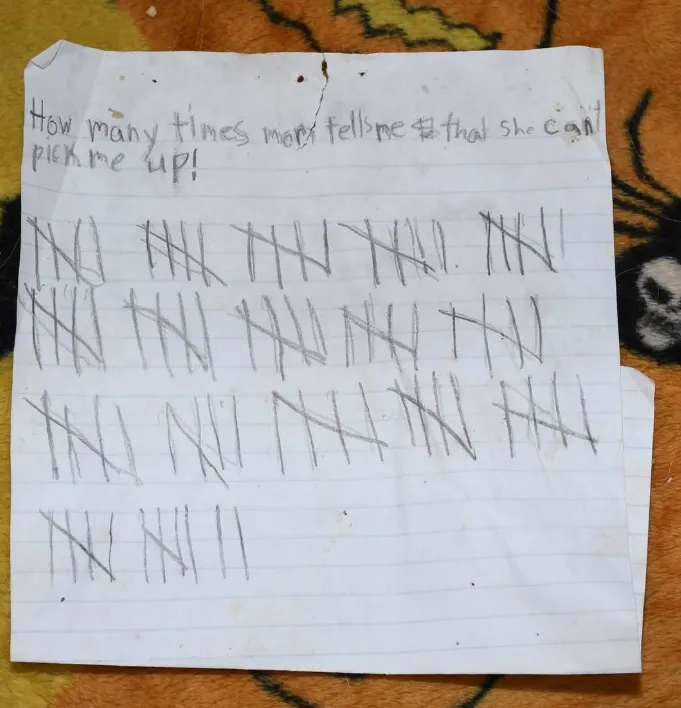
One of the most haunting discoveries was a handwritten letter found in the area where the girl slept. The letter was titled, “How many times mom tells me that she can’t pick me up.” On the page were 87 dash marks. Each mark represented a broken promise, a moment when the girl hoped her mother would come back for her, only to be disappointed again. Eighty-seven times she waited. Eighty-seven times she was told “not today.” The letter stands as silent testimony to her emotional suffering and longing for parental love.
This single piece of paper reveals more about the damage done than any photograph or police report ever could. It shows a child who did not stop hoping, even after being repeatedly let down. It shows resilience, but also deep emotional pain. Being physically alone is devastating enough; being emotionally abandoned by the people meant to protect you is far worse.
Following the investigation, the girl’s mother and stepfather were taken into custody and charged with child abuse and animal cruelty. While legal accountability is necessary, it does not undo the harm already done. Months of neglect can leave lasting psychological scars, especially during such a critical stage of development. Trust, attachment, and a sense of safety may take years to rebuild.
However, this case raises broader and more troubling questions. Where was the school system? Where were extended family members? Where were neighbors or community members? A 14-year-old child living alone for months should not go unnoticed. If she was enrolled in school, her absence should have triggered concern. If she was seen regularly in the neighborhood, someone should have asked questions. This was not a hidden crime—it was a neglected one.
The failure here is not limited to two adults. It reflects cracks in a system meant to protect vulnerable children. When communities become disconnected and individuals assume someone else will intervene, children fall through the gaps. This girl’s suffering continued not just because she was abandoned, but because she was overlooked.
Her story is a painful reminder that child neglect does not always look dramatic from the outside. Sometimes it is quiet. Sometimes it is a child eating delivered food alone in a dark trailer, counting the number of times her mother didn’t come back. And sometimes, it only comes to light when a child is sick, dizzy, and collapsing on the side of the road.
Now, the focus must shift to healing. This girl deserves safety, stability, and professional support to help her recover from what she endured. She deserves adults who will show up, not just promise to. And she deserves a future not defined by abandonment.
Above all, this case should serve as a wake-up call. Children depend on adults—not only parents, but teachers, neighbors, and communities—to notice when something is wrong. When we fail to look, to ask, or to care, tragedies like this happen. No child should ever have to grow up alone, waiting for a parent who never comes home.