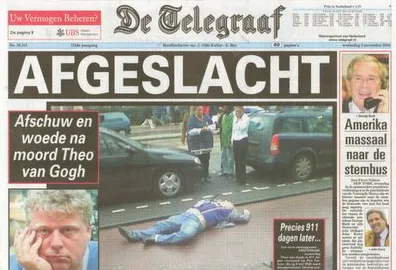
Theo van Gogh – The Dutch Filmmaker Murdered For Criticizing Islam
Never Miss a Word Again
These discrete, rechargeable hearing aids deliver crystal-clear sound and advanced noise cancellation. Perfect for watching the news, busy restaurants, or family gatherings.
Secure transaction via Amazon.com
On the morning of November 2, 2004, what began as an ordinary day in Amsterdam quickly turned into one of the most shocking acts of violence in modern European history.
A man was riding his bicycle to work.
Never Miss a Word Again
These discrete, rechargeable hearing aids deliver crystal-clear sound and advanced noise cancellation. Perfect for watching the news, busy restaurants, or family gatherings.
Secure transaction via Amazon.com
Moments later, he lay motionless in the street — the victim of an attack that no one around him had anticipated.
That man was Theo van Gogh, a filmmaker known as much for his provocative voice as for his work.
His death was not just a murder.
Never Miss a Word Again
These discrete, rechargeable hearing aids deliver crystal-clear sound and advanced noise cancellation. Perfect for watching the news, busy restaurants, or family gatherings.
Secure transaction via Amazon.com
It became a defining moment in an ongoing global conversation about free speech, religion, and the limits of tolerance.
Born on July 23, 1957, in The Hague, Theo van Gogh was the great-grandnephew of the legendary painter Vincent van Gogh.
But unlike his famous relative, Theo chose not paint but film and commentary as his medium.
Never Miss a Word Again
These discrete, rechargeable hearing aids deliver crystal-clear sound and advanced noise cancellation. Perfect for watching the news, busy restaurants, or family gatherings.
Secure transaction via Amazon.com
Over time, he built a reputation in the Netherlands as a relentless provocateur.
He openly criticized Islam, Christianity, and Judaism alike.
He described himself as a “village idiot,” someone who could say what others would not dare.
For Theo, free speech was not just a right — it was a principle worth defending at all costs.
He once famously said, “No one kills the village idiot.”
That belief would ultimately prove tragically misplaced.
The turning point came in 2004, when Theo collaborated with Ayaan Hirsi Ali, a Somali-born Dutch politician and outspoken critic of certain practices within Islam.
Hirsi Ali had fled Somalia to escape an arranged marriage and later renounced her faith.
Her personal experiences shaped the script of a short film that would ignite fierce controversy.
The film, titled Submission (Part I), was a 10-minute television production that depicted Muslim women praying to Allah to be freed from lives marked by physical and sexual abuse.
One of its most controversial elements was the visual portrayal of Quranic verses written across women’s bodies — a symbolic protest against the suffering they endured.
Theo van Gogh argued that, in his interpretation, certain readings of Islamic teachings placed women in a position of absolute submission within marriage.
He insisted the film was meant to spark debate, particularly about the plight of women in conservative religious contexts.
“It’s directed at the fanatics, the fundamentalists,” he said.
But that distinction was not accepted by everyone.
When the film aired in September 2004, it provoked intense backlash.
Many in conservative Muslim communities saw it as deeply offensive.
Others argued that it contributed to growing anti-Muslim sentiment in the West following the September 11 attacks.
Amid rising tensions, threats began to emerge.
Hirsi Ali was placed under heavy police protection.
Theo van Gogh refused.
He believed that accepting protection would undermine the very freedom he defended.
He continued his daily routines, cycling through Amsterdam without security.
He remained convinced that he would not be targeted.
At the same time, another man had already made his decision.
Mohammed Bouyeri, a 26-year-old Dutch-Moroccan, had become increasingly radicalized in the years following his mother’s death from cancer.
Raised in the Netherlands in what was described as a quiet environment, Bouyeri’s path changed as he embraced extremist ideology.
The film Submission enraged him.
Though his anger was primarily directed at Hirsi Ali — whom he viewed as a traitor — her police protection made her inaccessible.
Theo van Gogh, unprotected and highly visible, became the alternative target.
On that November morning, Bouyeri approached van Gogh on the street.
There was no warning.
No chance for escape.
The attack unfolded in broad daylight.
Witnesses would later describe a scene of shock and horror.
After the shooting, Bouyeri carried out a brutal act that symbolically silenced the filmmaker’s voice.
Before leaving, he pinned a letter to van Gogh’s body with a knife.
The message contained threats and ideological statements, directed not only at Hirsi Ali but at Western society more broadly.
Within hours, Bouyeri was apprehended after a confrontation with police.
During interrogation, he showed no remorse.
He openly admitted to the killing and declared that he would do it again if given the chance.
In 2005, he was sentenced to life imprisonment without the possibility of parole.
The murder of Theo van Gogh sent shockwaves through the Netherlands.
Thousands gathered in Amsterdam to mourn.
Flowers, candles, and bicycles were placed at the site where he died.
But beyond grief, there was a deeper unease.
The Netherlands, long known for its liberal values and multicultural tolerance, was forced to confront difficult questions.
Some politicians began calling for stricter immigration policies.
Debates around integration and identity intensified.
At the same time, many innocent Muslims found themselves under suspicion, despite having no connection to extremism.
A teenager named Samir, raised Muslim in the Netherlands, expressed a painful reality: “We are hated now. Whatever we do will be wrong.”
The consequences of the murder extended far beyond one act of violence.
They reshaped public discourse, strained social cohesion, and exposed underlying tensions that had long existed beneath the surface.
In the years that followed, another phenomenon emerged — silence.
Many public figures became hesitant to discuss the assassination openly.
Some feared fueling anti-Muslim sentiment.
Others worried that criticizing van Gogh’s work might be interpreted as supporting his killer.
Journalist Theodor Holman, one of van Gogh’s closest friends, criticized this growing reluctance, stating: “Tolerance has been transformed into cowardice.”
It was a controversial statement.
But it reflected a broader concern — that fear had begun to shape the boundaries of public expression.
More than two decades later, the murder of Theo van Gogh remains a defining moment in modern European history.
It is remembered not only for its brutality, but for the complex questions it raised.
About freedom and responsibility.
About belief and criticism.
About how societies navigate the fragile balance between protecting expression and preserving respect.
Theo van Gogh believed that speech should remain free, even when it provokes discomfort.
Mohammed Bouyeri believed that faith must be defended at any cost.
Between those two convictions, a life was lost — and a nation was forced to confront a reality it could no longer ignore.
And even today, one question still lingers.
In a world where cultures and beliefs increasingly intersect, where does the line truly lie between freedom of expression and the boundaries of respect?