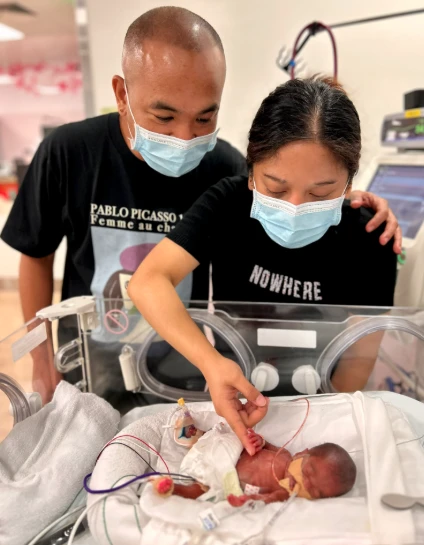
For the first time since she was born, our daughter is sleeping in her own crib rather than a hospital incubator.
After spending half a year fighting for her life inside the NICU, our brave little Chelsea Unica was finally discharged on December 30, 2025.
That night was not just a discharge.
It was the realization of a dream we had prayed for every single night for six long months.
We were blessed to welcome the New Year at home as a family, something we once only imagined during the long days and long nights in the hospital.
Bringing her home was the miracle we had hoped for.
But walking through those hospital doors did not mean Chelsea’s journey was done.
Far from it.
While she is finally home with us, she is not yet safe from the complications of her extreme prematurity.
Chelsea still requires intensive therapies, specialist consultations, and ongoing medications just to have a chance at developing like a normal child.
This is her story — not just of survival, but of struggle, endurance, hope, and the long road still ahead.
Chelsea’s journey began long before she ever took her first breath.
My husband Ehrol and I had dreamed of having a child for years.
We endured sacrifices — time apart, long work hours, and the challenge of maintaining our careers in healthcare while keeping hope alive for a family of our own.
I worked in Qatar while Ehrol served as a nurse in Singapore.
After years of waiting, Chelsea was our answered prayer — a hope finally becoming a reality.
But at just 25 weeks pregnant, everything changed in an instant.
I began bleeding heavily due to placental abruption and maternal preeclampsia — a terrifying combination that thrust us into an emergency scenario we were never truly prepared for.
On June 26, 2025, doctors rushed me into an emergency delivery.
Chelsea arrived, but she was unlike any baby most of us know.
She was tiny, translucent, and completely unprepared for the world beyond the womb.
Instead of cradling her in my arms, her first breaths were supported by machines.
She weighed only 365 grams — lighter than a stick of butter.
Her lungs were not developed enough for her to breathe on her own.
And she was immediately diagnosed with pulmonary hypertension, respiratory distress, and a host of other critical complications.
We watched her small frame trembling under the weight of tubes and wires.
Every moment felt fragile, as if the slightest disturbance might take her from us.
The Neonatal Intensive Care Unit — the NICU — quickly became her world.
And ours.
We spent every day and night in and out of that ward.
Chelsea’s life in the NICU was not simple.
Over six months, she endured countless battles no baby should ever face.
She lived on mechanical ventilation.
She received steroid treatments that made her fight even harder for every breath.
She grew from a delicate 365 grams to a stronger baby nearing 2 kilograms within those walls.
That journey was marked by victories both big and small — the first time she breathed without a machine, the first time she drank a little milk, the moments her lungs grew stronger.
These were victories that gave us hope when hope felt faint.
During that time, we saw other stories of extraordinary NICU journeys — babies born even earlier, babies who fought for every ounce and every breath just like Chelsea.
A baby named Arya, born at just 24 weeks, spent 236 days in the NICU before she finally went home with her family after a long battle for growth and health.
Another baby, born at 23 weeks in South Korea, toughed through four major surgeries and required six months of intensive care before discharge.
These stories, and the many others shared by families around the world, remind us that preterm survival is possible — but it is never easy.
After six long months, on December 30, 2025, our little warrior finally came home.
But arriving home did not mean her struggles were over.
At 8 months old (4 months adjusted), Chelsea still faces feeding difficulties and growth delay.
Her tiny body cannot yet eat normally, and she requires a nasogastric tube (NGT) to support her nutrition.
Every feed, every attempt at turning her head, every minute of rest poses a new challenge.
To help her catch up, she needs rigorous care and therapies.
Physiotherapy is essential for her to gain motor skills like rolling over.
Speech therapy is needed to help her with swallowing challenges.
She requires the expertise of specialists to monitor her thyroid function and prevent regression in her eyesight.
Her right eye, in particular, still needs constant vigilance to ensure it continues to develop.
Each day brings new appointments, new therapies, and new challenges.
Even though we are home, our lives still revolve largely around Chelsea’s medical care and needs.
It’s overwhelming, exhausting, and without a clear finish line.
Born Too Soon
Our journey began not with excitement at an impending birth, but with fear and uncertainty.
We had dreamed of this child for years — prayed for this moment — yet the moment she arrived, it was not like we expected.
Instead of the joy of a peaceful delivery, we were confronted with the harsh reality of extreme prematurity.
Instead of warm embraces and happy photos, we saw wires, screens, and alarms.
Chelsea’s first breaths were not cradled in love but supported by machines.
Yet in that sterile environment, life fought back.
Chelsea grew — not just in weight, but in resilience.
She moved from being a fragile, tiny bundle of uncertainty to a strong, determined baby ready for the next phase of life.
But the word “home” does not represent the end of struggle — it represents the beginning of another chapter.
The world outside the NICU walls is not a hospital, but it is filled with its own set of challenges.
Caring for a premature child at home means constant vigilance.
It means managing feeding issues daily and staying alert to every tiny sign of distress.
It means adapting therapies into everyday routines, always seeking progress, however small.
And it means facing fears — fears that never fully disappear — about what lies ahead for a child who started life so early and so vulnerable.
This is the reality for many preterm infants and their families — a journey marked by persistence, sacrifices, love, and resilience.
These stories shared by other parents and caregivers remind us that we are not alone — there are countless families who walk similar paths and who celebrate similar milestones, even after the darkest days.