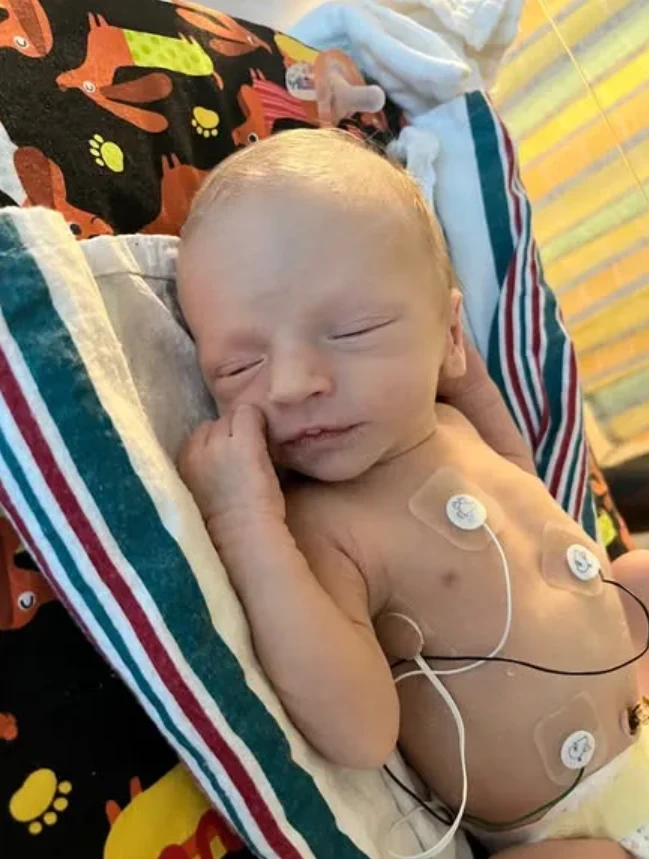
The day Beckett Williams was born was meant to be calm, filled with quiet joy and the promise of a new beginning. Weighing just over six pounds, he seemed small but strong, a baby ready to be welcomed into a life his parents had imagined for months.
But within hours, something shifted. His tiny body began to struggle in ways no one expected, and the calm was quickly replaced by urgency.
His blood sugar spiked to dangerous levels. At the same time, his body temperature dropped, creating a situation that demanded immediate intervention.
Doctors acted fast. Beckett was rushed to the NICU, where machines replaced the warmth of his mother’s arms.
Instead of soft voices and lullabies, there were alarms and constant monitoring. Instead of celebration, there was fear.
For his mother, Morgan, the transition was overwhelming. One moment she was holding her newborn son, and the next, she was watching him fight for stability from a distance.
The hardest part was not just his condition. It was the lack of answers.
Doctors ran tests, monitored every detail, and searched for explanations. But nothing immediately explained why his body was failing to regulate itself.
Time passed without clarity. And with every hour, the fear grew heavier.
When answers don’t come, uncertainty takes over. Every possibility begins to feel like a threat.
That’s when the medical team made a critical decision. They chose to go deeper than standard testing.
They turned to rapid genome sequencing. A method designed to uncover hidden genetic causes that traditional tests might miss.
It became a race against time. Because without a diagnosis, there could be no targeted treatment.
Days later, the results came back. And everything changed.
Beckett was diagnosed with neonatal diabetes caused by a rare mutation in the KCNJ11 gene. A condition so uncommon that only a small number of cases had ever been documented worldwide.
For Morgan, the diagnosis brought mixed emotions. Fear remained, but now it had a name.
And more importantly, it brought a direction. A way forward.
At just eight days old, Beckett was started on the correct medication. That moment became the turning point in his life.
It didn’t fix everything overnight. But it gave him a chance.
Still, the future remained uncertain. Doctors warned that developmental delays were likely.
He might never walk. He might never speak.
Those words settled heavily on his family. Because every parent carries a vision of their child’s future, and suddenly, that vision felt fragile.
But instead of giving in to fear, his family made a choice. They chose to focus on possibility.
Progress didn’t arrive all at once. It never does in stories like this.
It came quietly. In small, almost invisible changes.
A slight movement. A brief response. A moment of awareness.
Each one became a victory. Each one carried meaning beyond what others could see.
Day by day, Beckett began to grow stronger. His presence became more noticeable, more engaged.
Then came a moment that once felt impossible. He took his first steps.
They were small and unsteady. But they were real.
And they changed everything.
Soon after, his voice began to emerge. First sounds, then words.
Now, more than twenty-five words form the beginnings of communication. Each one a quiet challenge to the predictions that once defined him.
Today, Beckett is a thriving toddler. He walks, he speaks, and he explores the world around him with curiosity.
To an outsider, his journey may not be visible at first glance. But behind every step is a story that almost went differently.
His progress is more than a medical outcome. It is the result of timing, precision, and persistence.
Rapid genome sequencing did more than provide a diagnosis. It gave him access to the right treatment when it mattered most.
Looking back, Morgan sees those early days differently now. The fear, the waiting, the uncertainty—they were part of a larger story still unfolding.
Beckett is not defined by the condition he was born with. He is defined by how he continues to move beyond it.
Because sometimes, the future we fear is not the one that arrives. Sometimes, it changes in ways no one expects.
With the right care, the right timing, and unwavering support, something fragile can become strong.
And Beckett Williams is living proof of that. One step, one word, one moment at a time.