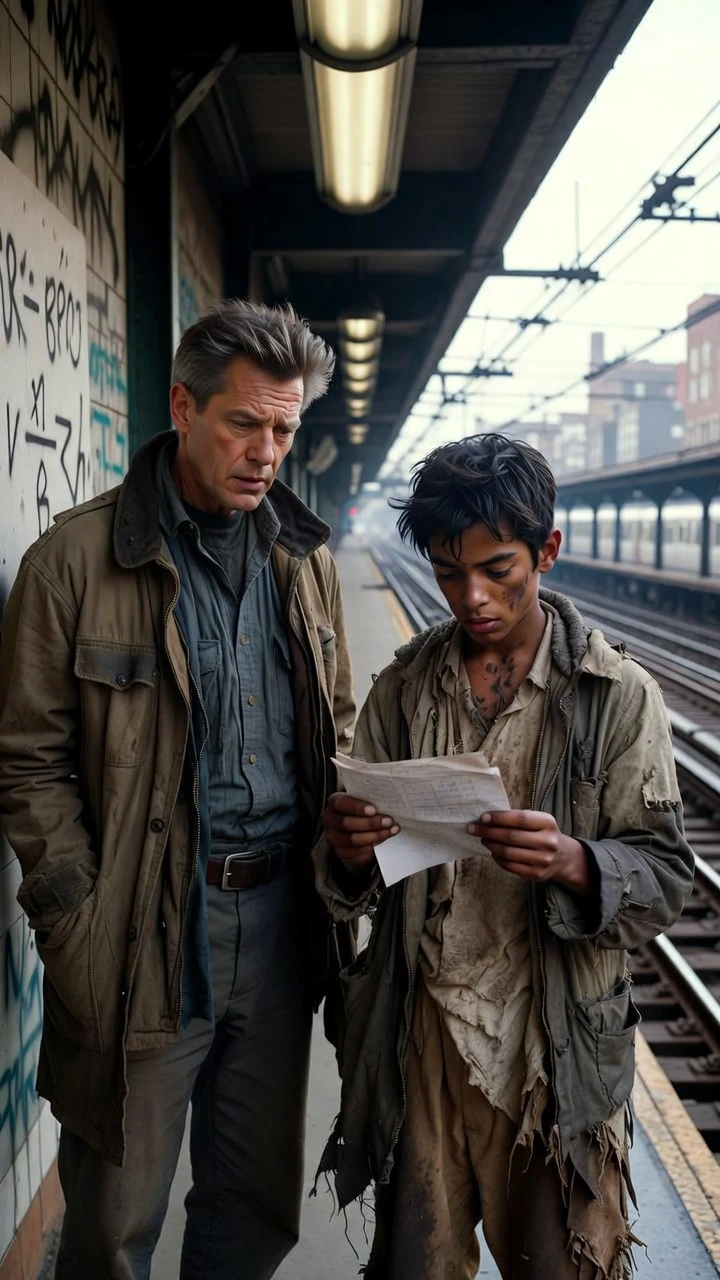
In Samuel’s world in 2026 Boston, intelligence was a privilege packaged in expensive suits and sterile laboratories. He viewed those without academic titles as absolute zeroes, outcasts from human evolution, until a streak of white chalk on a public bulletin board at Kendall Square station shattered his entire faith.
The screech of subway wheels echoed against the steel tracks.
Professor Samuel Thorne stepped off the train.
Cold.
His polished leather shoes struck the dusty tiles of Kendall Square station.
He stopped before the public bulletin board – the spot where he had scrawled a complex challenge regarding the Riemann Hypothesis three days ago just to humiliate a rival colleague.
Samuel’s eyes narrowed.
Beneath his problem, a new sequence of characters had appeared.
Scrawled.
In cheap chalk.
But brutally accurate.
It wasn’t just a solution; it was a shortcut that no academic mind at MIT had ever conceived.
“Who did this?”
Samuel muttered.
He looked around. Tired faces heading home. Drunks. No one looked like a mathematician.
“Someone is playing games with me.”
The following night.
Samuel hid behind a rusted steel pillar.
The clock struck 2 AM.
A figure emerged from the darkness of the Red Line tunnel.
Jaxson “Jax” Miller.
Eighteen. Tattered jacket. Hair matted with grime.
He didn’t carry the latest tablet. He held an old, tattered math textbook rescued from a library dumpster.
Jax approached the board.
He began to write.
The sound of chalk against wood was like the scream of a soul desperate to be heard.
“Stop!”
Samuel stepped out.
Jax flinched. His eyes held the terror of a cornered animal.
“Where did you get that solution?”
Samuel barked.
“In my head,”
Jax whispered. He turned to run.
“Wait!”
Samuel grabbed his shoulder.
His hand touched the cold, ripped fabric.
“You have no degree. You aren’t on any student list. How does a boy living under a bridge understand Knot theory?”
Jax turned back.
His eyes suddenly flared, sharp as a blade.
“Mathematics doesn’t need an address, Professor.”
“It only needs a brain that isn’t buried in arrogance.”
Samuel didn’t believe it.
He led Jax to a stone bench dampened by the night mist.
He pulled out a sheet of paper and a gold-encrusted pen.
“This is a problem on Navier-Stokes equations. Solve it. Do it, and I’ll buy you a hot meal.”
Jax looked at the paper.
He didn’t take the pen.
He picked up a piece of peat from the ground.
Jax began to draw directly onto the stone surface of the bench.
Numbers.
Overlapping integrals.
Shifting physical constants.
Samuel froze.
Every line Jax wrote was like a hammer blow to the Field Medalist’s pride.
Ten minutes.
Jax stood up.
The bench was now a masterpiece of human intellect.
“Done,”
Jax whispered, his stomach growling with hunger.
Samuel looked at the solution.
It wasn’t just correct.
It was beautiful.
The beauty of absolute equity that math provides: 1+1 always equals 2, whether you’re a billionaire or a beggar.
The next morning.
The MIT Boardroom.
Samuel Thorne stood in the luxurious room, Jax beside him in old but washed clothes.
“I demand a full scholarship for this boy.”
Samuel said.
“Thorne, have you lost your mind?”
The Dean growled.
“Where is his transcript? SAT scores? Letters of recommendation?”
“His transcript is on a stone bench at Kendall Station!”
Samuel slammed the table.
“We talk about equity, about finding genius. Yet when a real genius stands before us, you only see his rags?”
“He’s a vagrant, Samuel. It will ruin the Institute’s image.”
Samuel unclipped the Fields Medal from his lapel.
“If Jaxson Miller is not admitted, I resign. And I will take his brain to Harvard.”
Silence filled the room.
The Board realized Samuel wasn’t joking. They didn’t fear losing Samuel; they feared the glory Jax was about to create elsewhere.
November 2026.
The International Mathematics Olympiad in Zurich.
Jax stepped onto the stage.
Surrounded by geniuses raised in luxury, those with private tutors and supercomputers.
Jax had only a pencil stub and memories of the cold beneath the bridge.
The final problem: Decoding an unprecedented quantum encryption system.
The hall held its breath.
The scratch of Jax’s pencil filled the silence.
He didn’t look at the computer screen. He closed his eyes.
He saw numbers like subway trains running through the tunnels of his mind.
“DONE!”
Jax set the pencil down.
Five minutes left on the clock.
The result flashed on the giant screen.
100% Accuracy.
The hall erupted in a standing ovation.
Jax looked at the stands. Samuel Thorne was there.
The once-arrogant professor was weeping.
He wept because he realized he had spent ten years in a glass cage of self-complacency, while the truth had been lying in the places he never deigned to look.
Six months later.
The MIT campus glowed in the spring sun.
Jax Miller was now the most brilliant student in the university’s history.
But he wasn’t in a million-dollar lab.
He was at Kendall Square station.
He was teaching math to a group of homeless children on the very same bulletin board.
Samuel Thorne walked up.
He wasn’t wearing a suit. He wore a simple sweater, carrying a bag of warm bread.
“Any new problems today, Jax?”
Jax smiled.
“There’s an equation I’m still solving, Professor.”
“Which one?”
“How to make sure all these kids have a safe bench to sleep on, not just to solve math.”
Samuel was silenced.
He sat down next to Jax.
Beneath the dark, noisy bridge.
He realized that genius doesn’t need a prestigious address to shine.
But society needs a heart wide enough to receive that light.
Genius has no address, only aspiration.
And true equity begins when we stop looking at the clothes and start looking at the eyes.
Boston is beautiful tonight.
And mathematics, for the first time in 2026 years, finally brought warmth to humanity.