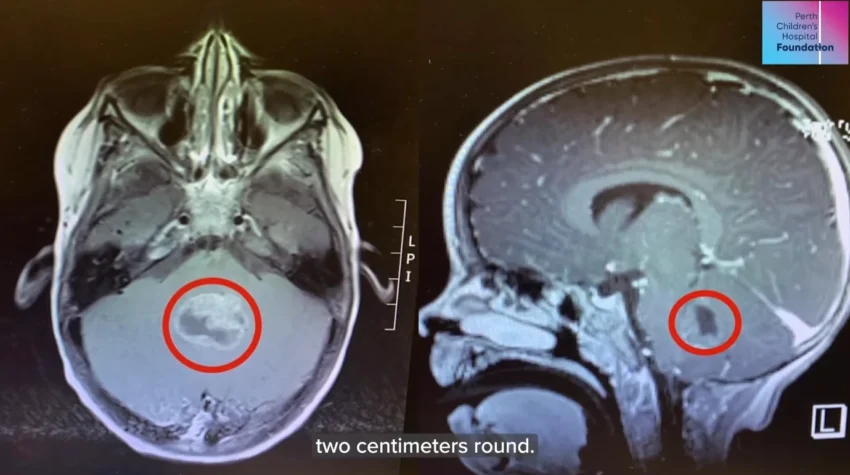
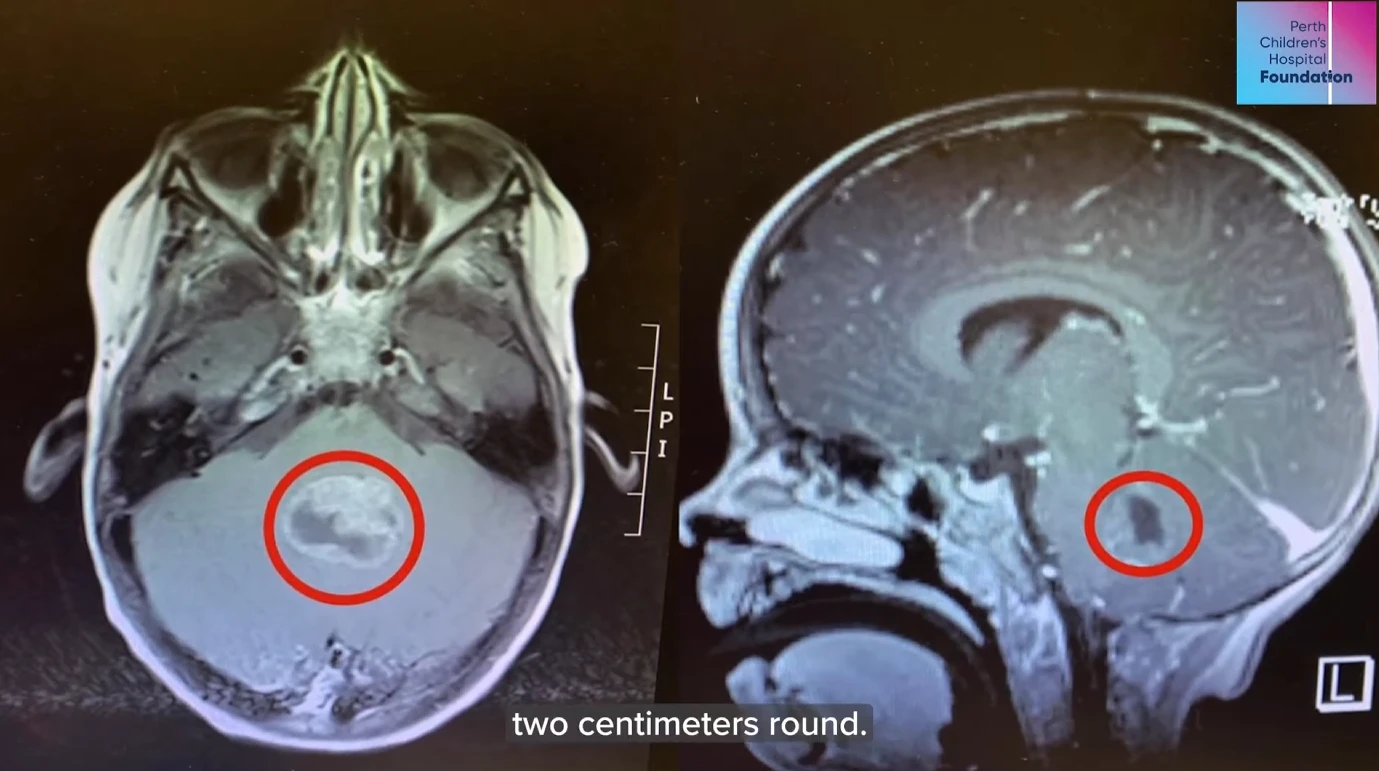
A routine scan became a nightmare for mum Brooke when an MRI revealed her three‑year‑old daughter, Luca, was hiding a tumour at the base of her cerebellum — right next to her brainstem.
That tumour measured two centimetres — small in size but massive in consequence, nestled in one of the most critical parts of the brain.
The cerebellum, located at the back of the brain, helps control movement and balance — but beside it lies the brainstem, the part that regulates breathing, heart function, and life itself.
Doctors looked at that scan and delivered words no parent wants to hear.
They told Brooke that her little girl’s chances were tiny — shockingly tiny — and that even experts didn’t know if she would live.
The room went silent for a moment that felt like forever as those words echoed.
Luca had been acting mostly normal until recently — energetic play, giggles, little legs running around — until one day things changed, and things didn’t make sense.
Her parents noticed something odd.
She complained of hurting her head after bumps that any child might shake off.
They thought it was normal — fall, cry, then go back to playing.
But something in Brooke’s intuition told her to take Luca to the hospital.
Doctors began a series of tests and eventually ordered an MRI.
The machine clanked and whirred around her tiny head, and within minutes a life was changed.
The scan lit up with shadows that should never have been there.
A tumour — and one right next to the brainstem.
Doctors explained that tumours this close to the brainstem are among the most delicate — and dangerous — kinds.
They are buried deep where surgeons have to tread with the precision of a feather and the confidence of a surgeon’s lifetime of experience.
Despite a long list of possible diagnoses, on this scan the word “tumour” stood clear against the grey background of brain tissue.
And that word carried with it a shock no parent ever prepares for.
To see your child’s future blur is a pain words can’t describe.
Brooke remembers just how calm her little girl had seemed before — watching cartoons, choosing snacks, playing with toys as though nothing was wrong.
But inside, something was growing.
Something that had no place in her small body.
Specialists explained that tumours near the brainstem are especially challenging.
They control vital functions — breathing, heartbeat, balance — all without a child ever knowing they are even happening.
And in that place, there’s almost no room for error.
Doctors told her that even with treatment, survival isn’t guaranteed.
Sometimes, they said, simply reaching the tumour with surgical tools risks the very functions that keep a child alive.
This is why tumours in the cerebellum or adjacent brainstem are among the most complex paediatric medical cases.
For hours after the diagnosis, Brooke sat with Luca in silence, watching her daughter’s small chest rise and fall with each innocent breath.
That simple rhythm — in, out — was suddenly the thing she feared losing most.
Doctors explained that even if Luca survived surgery, the road ahead would be long and uncertain.
Side effects from aggressive treatments could leave long‑term impacts.
They explained that chemotherapy and radiation, while powerful, are also harsh on young bodies.
Some children endure months of hospital stays, weakened immunity, and side effects that can include loss of vision or hearing.
Parents in similar situations have spoken of the brutality of these side effects and the constant fear that the cure might be worse than the disease itself.
But families also cling to stories of hope.
Across the world, there are rare but inspiring cases where children with once‑inoperable brain tumours have survived against expectations.
One such story involved another young boy whose innovative treatment led to complete remission of an aggressive brainstem cancer — something doctors once thought impossible.
His case became a beacon of hope in the medical world.
Yet every story, every family, knows that for every victory, there are heartbreaks we never hear about.
For Luca’s mum, every moment brought a new wave of emotion.
Fear washed over her, followed by determination.
How could the future of the child she had held since birth be uncertain in a single scan?
How could a two‑centimetre shadow become the most feared word in her vocabulary?
With every beat of Luca’s heart, she felt both relief and terror.
Doctors began explaining the options — what could be done now and what might come later.
Would surgery be possible?
How much does the tumour press against the brainstem?
Would it spread?
Even in these discussions, no one could give certainty.
Instead, they spoke in probabilities and percentages — a language that meant little to parents watching their child’s eyes drift closed with fatigue.
Hours passed in discussions about treatment plans, risks, and second opinions.
Brooke found her thoughts drifting between hope and dread.
She replayed Luca’s laughter in her mind and tried to imagine the future — birthdays, school days, sunsets and bedtime songs.
And yet, there was this tumour — uninvited and threatening everything.
Doctors warned that even answering simple questions like “Is this treatable?” took time because tumours near the brainstem require a personalised and targeted approach.
Each tumour can behave differently depending on its location, size, and genetic characteristics.
In some rare treatments for other children, scientists have begun tailoring therapies to the genetic profile of a tumour, allowing doctors to attack cancer cells more precisely while sparing healthy tissue.
That kind of precision medicine is still emerging and not yet widely available everywhere.
But it has given hope to some families when it might not have existed before.
In the waiting room, Brooke watched other families — some with older children, some with adults — but all with the same look of fear or hope in their eyes.
A community of strangers bound by similar battles.
During moments of exhaustion, she wondered if it was all a cruel twist of fate.
But during moments of clarity, she saw that hope still lived in Luca’s smile, in the way her daughter reached for her hand, or the way she nuzzled into her shoulder for comfort.
That child, so small, yet so brave.
There were times when doctors spoke of the harsh realities — survival rates, clinical trial outcomes, possible complications.
And there were times when stories of hope peaked through — triumphs that kept parents believing in the impossible.
One doctor spoke of the need for further research and how, in some truly rare cases, new targeted therapies have drastically changed outcomes for children with tumours that once seemed futile.
Researchers are now studying why some children respond miraculously to targeted treatments while others do not, hoping to unlock answers that might lead to better outcomes for all.
But right now, for Brooke and Luca, it was about the next step — one day at a time.
Some nights, Brooke stayed awake in Luca’s hospital room, watching her chest rise and fall.
Each breath was a reminder that life was still here, still fighting.
There was fear that every sound — a cough, a shift in bed — might herald something dreadful.
And there was the stubborn flicker of hope that every sunrise brought.
In moments alone, Brooke replayed that MRI scan in her mind — the cold images, the stark words of doctors.
She wondered how so much can change in an instant.
Yet she also felt something stronger than despair.
She felt love — a force that pushed her beyond fear.
That love became her anchor.
In the days that followed, surgeons and specialists consulted, reviewed scans, and proposed a tailored plan for Luca’s tumour.
They discussed delicate surgery to reduce the tumour burden and limit pressure on the brainstem.
They explained possible adjuvant treatments — therapies given after surgery to target any remaining tumour cells.
Though the options were complex, and outcomes uncertain, each step was a chance — a chance to tilt the odds back toward life.
Friends and family gathered around, offering support in whispered conversations and shared prayers.
But for Brooke, solace was slow in coming.
Her fear did not disappear, but she learned to compartmentalise it — holding it at bay while focusing on Luca’s needs.
She learned to breathe one breath at a time — a lesson she wished no parent ever had to learn.
When Luca held her hand and asked for her favourite story, she read it with a trembling voice, not knowing if tomorrow would be the same.
Yet she read it, because in that moment, life was still ongoing.
In the coming weeks, further specialists reviewed Luca’s case, each offering perspectives but no guarantees.
Some recommended aggressive intervention.
Some encouraged caution.
But all agreed that early action — informed by careful planning — offered the best chance.
Meanwhile, the tumour remained a silent threat — growing perhaps, or waiting — no one could say for certain without more scans.
It was this uncertainty that haunted every quiet hour.
Yet it was also this uncertainty that forced Brooke to cling to hope even more fiercely.
Family members who once joked about everyday things now talked about prognosis, treatment pathways, and possibilities they never thought they’d have to understand.
Yet through it all, Luca remained just a kid — curious, innocent, and unaware of the gravity of her diagnosis.
She asked for snacks, wanted her favourite cartoons, and sometimes giggled at her own jokes.
Her spirit — unaffected by fear — became the strongest force in that hospital room.
For her mum, it was a bittersweet reminder that children carry joy even when life turns hard.
When doctors repeated that surgery was risky due to proximity to the brainstem, Brooke felt despair.
But when they also said there was a chance, however small, for years of life if successful, her heart caught in her chest.
She realized that hope is not a simple thing — it’s a tapestry woven from fear, courage, and stubborn belief that life is worth fighting for.
In the end, there were no easy answers.
There were only choices — each one daunting, each one heavy with consequence.
And there was Luca — unaware that her future was a puzzle to be solved, just wanting her mum to stay close.
Days turned into weeks, and though the tumour had not yet been removed, plans were in motion.
Plans that involved specialists, genetic analyses, and targeted approaches that might spare her more harm.
And though no doctor could promise survival, no matter how advanced the science becomes, there was something in the air — a sense that even in the darkest corridors of medicine, light can return.
Because every tumour, every diagnosis, every child brings a new story.
And sometimes in those stories, courage becomes a force that changes everything.
And in others, hope becomes a weapon stronger than fear itself.