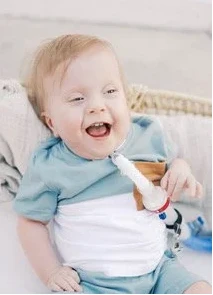
Everett’s story is one of resilience, hope, and the power of a family’s determination to never give up. It all began in June 2023, when his parents received the news that they were expecting twins.
The joy of expecting two babies soon turned to worry and fear after a routine scan revealed something alarming: Everett, their baby boy, had been diagnosed with a severe form of Congenital Diaphragmatic Hernia (CDH), a condition in which a hole in the diaphragm allows organs to migrate into the chest cavity, restricting lung development. Everett’s liver, stomach, intestines, colon, and spleen were all displaced into his chest, leaving minimal space for his lungs to grow.
What followed was a whirlwind of emotions and decisions that would change the course of their family’s journey forever. At 31 weeks, Everett’s family transferred his care to Dr. David Kays and the CDH team at Johns Hopkins All Children’s Hospital in St. Petersburg, Florida.
Just days before his birth, his parents were informed that, in addition to left-sided CDH, Everett had a rare complication called bilateral CDH, where the hernia affected both sides of his diaphragm. This diagnosis was extremely rare, and the survival rate was heartbreakingly low. But despite the odds stacked against him, Everett’s parents remained hopeful and prepared for whatever challenges lay ahead.
On December 19, 2023, Everett was born via C-section at just 33 weeks. The moment he entered the world, he was intubated and rushed to the CDH unit, where his condition was carefully monitored.
The doctors’ immediate concern was his need for ECMO, a life-saving support system to temporarily take over the functions of his heart and lungs. At only 2.5 hours old and weighing just 3 pounds, 12 ounces, Everett was placed on life support in a desperate bid to keep him alive. His parents, overwhelmed and filled with anxiety, held onto the hope that their little warrior would survive.
The following day, Everett underwent a complex eight-hour surgery to repair his left-sided hernia, and the team found that his left lung had only 10% of its required volume.
Additionally, 45% of his liver had been up in his chest, complicating his already fragile condition. Despite these critical conditions, Everett’s strength and the incredible efforts of the medical team allowed him to survive the surgery.
But as the days went by, the challenges continued. An X-ray revealed that the fluid previously thought to be part of his liver was actually due to his right-sided hernia, making Everett’s case even more complicated. The chances of survival were slim, but Everett proved to everyone that he wasn’t ready to give up.
At just 15 days old, Everett underwent a second repair surgery for his right-side hernia. The surgery was successful, but soon after, the pressure in his abdomen became too great, and he had to be rushed back to the operating room for yet another procedure.
This time, his kidneys were affected, but, like everything else in his journey, they eventually recovered. Over the next several weeks, Everett faced more setbacks, including dangerously high bilirubin levels that required eight exchange transfusions while he was still on ECMO.
But through every trial, Everett fought back with the same courage and strength his parents had seen since his birth.
On day 44, after another attempt to come off ECMO, Everett’s body wasn’t ready, and he was put back on life support. It was one of the most difficult moments of their journey, but Everett’s parents never lost hope.
Finally, on day 64, he was taken off ECMO again—and this time, he stayed off. By day 85, he had his breathing tube removed and was able to start taking bottles, a small but meaningful milestone.
However, feeding difficulties arose due to reflux, and at four months old, he underwent a Nissen Fundoplication and G-tube surgery to help him eat and thrive.
After more than seven months in the hospital, Everett was finally discharged and able to return home. But the challenges didn’t end there. Over the next few months, he faced several readmissions due to feeding intolerance and desaturations.
Despite trying various treatments and adjustments, Everett’s struggles persisted. Then, at ten and a half months old, doctors suggested a GJ tube to help bypass his stomach and ease the pressure on his lungs. But just when it seemed like there was light at the end of the tunnel, Everett suffered a severe aspiration episode, which led to respiratory failure.
At this point, his parents were faced with an impossible decision. After many tearful discussions, they decided to move forward with a tracheostomy to provide Everett with a stable airway and help him grow without struggling to breathe. The procedure was performed one week before his first birthday, and it was the best decision they could have made. For the first time in a long while, Everett began to thrive.
Fourteen long months after arriving in Florida for his treatment, Everett’s family finally returned home to Iowa in March 2025. Since then, Everett has continued to surprise his medical team, and he has been making steady progress.
He now trialing off his ventilator twice a day, gaining strength, and hitting new developmental milestones. He’s sitting up, working on crawling and standing, and adores his siblings, especially when they bring him toys or play trucks together. His progress has been nothing short of miraculous, and his parents are filled with gratitude and joy as they watch their son flourish.
Everett’s story is a testament to the power of perseverance, love, and faith. It’s also a reminder of the incredible advances in medical technology and the tireless dedication of the doctors, nurses, and therapists who worked around the clock to give him a fighting chance. His family’s journey has been filled with challenges, but it is also one of hope and inspiration for anyone facing seemingly insurmountable odds. Everett has truly become the warrior his parents always believed he was—and his story will continue to inspire families everywhere.