We went for our 20‑week scan on the 8th of August 2024, excited and thinking about our upcoming babymoon.
It should have been a joyful moment — seeing our first baby, imagining his tiny fingers and kicking feet.
But when the sonographer became silent and rushed for help, everything changed.
They were looking at his tiny heart — still no bigger than an acorn — and something didn’t seem right.
The left side looked smaller than the right, unclear, and the specialists said they needed to be sure.
Only then did it hit me.
Our perfect little boy had something serious going on, and our plans for a relaxing holiday dissolved.
The next day, we were at a fetal cardiology unit, scared and uncertain, facing a world of terminology and tests we had never imagined.
The first question the doctor asked was a simple one — had we Googled it?
When we admitted we had, she gently told us not to — the results were much better than we feared.
Our baby was diagnosed with Coarctation of the Aorta (CoA), a congenital heart defect where a section of the main artery — the aorta — is narrower than it should be.
The aorta is the vessel that carries oxygen‑rich blood from the heart to the rest of the body, and when it is constricted, every part of the heart has to work much harder just to keep blood flowing.
As I sat in that room, everything felt unreal.
We were no longer planning a beach holiday.
We were planning to meet our son at a specialist hospital, where he would likely need surgery soon after birth, and where we would spend weeks over Christmas far from home.
That news felt unnatural — almost unfair.
I remember the consultant saying CoA happens by bad luck, that about 1 in every 100 babies is born with congenital heart disease, and about 1 in 25 of those have coarctation of the aorta.
But knowing the odds didn’t diminish the weight in my chest.
After that first meeting, our world became a whirlwind — ultrasounds, blood tests, visits to different hospitals, and scans that felt endless.
I lost count, but I think I had at least 15 scans before his birth.
My mental health declined — each appointment brought anxiety and fear I struggled to quiet.
I convinced myself he might not survive, and even had to be signed off work because the stress became overwhelming.
One day, a family member told me about Tiny Tickers, a charity that supports families facing congenital heart conditions before birth.
They sent us a support pack filled with information and comforting keepsakes, and connected us to virtual peer support sessions.
For the first time in weeks, I began to feel a glimmer of hope.
I read stories of other babies with CHD and saw pictures of children smiling and thriving.
It made me realise that this wasn’t a journey we had to walk alone.
Finally, it was time.
I was admitted early November, packed for the unknown, carrying emotions heavier than my suitcase.
But after five days of induction and little progress, an emergency caesarean section became necessary.
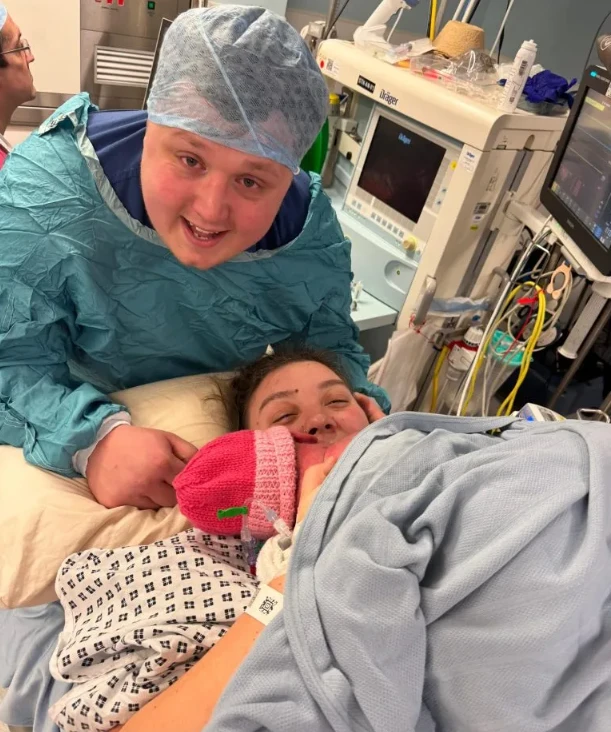
At 36 weeks, our son was born on the 26th of December, a day full of emotion and meaning — not only the day after Christmas, but also the birthday of my great aunt and my grandma in heaven.
As our baby was handed to me, weighty yet small and healthy, relief washed over me.
He looked peaceful — there was no sign of all the battles we knew lay ahead.
Soon, he was taken to the NICU, where he began his fight the moment he arrived.
A nurse later told us something unexpected — he was doing so well that he was being moved from NICU to the cardiac ward instead.
But three days after birth, his aortic arch began to close, and he needed surgery.
We walked him into the operating theatre at 8 a.m., holding hope tight as we kissed his tiny body goodbye.
Those hours felt endless, the hours where time and fear blur into one long stretch.
Finally, at 2:30 p.m., the surgeon called — the operation had succeeded.
He had made it through.
And in that moment, our tears were not just tears — they were relief, gratitude, disbelief, and love all mixed together.
When we saw him again in recovery, he looked so different.
Swollen and yellow, with stitches, wires, and tubes everywhere, he looked fragile — but he was alive.
The nurses and doctors were our anchors through it all, helping us face each new day with strength we didn’t know we had.
That Christmas was unlike any other — we shared it with other families who were also in hospital, with children fighting their own battles.
At Ronald McDonald House, we found a community of people who understood this version of family life — where hospital walls become part of your story.
On Christmas morning, the greatest gift arrived — our baby no longer needed a ventilator.
We held him, breathing beside him, and in that moment I knew he wasn’t just surviving — he was fighting.
Days passed, and Hudson’s strength grew.
We learned how to care for him, how to change dressings and read monitors, how to support him without fear controlling us.
Each day brought tiny victories — less equipment, steadier breathing, a quiet recognition that he could get better.
About eight days after his open‑heart surgery, we were told something incredible — he was ready to go home.
It was New Year’s Eve when the ambulance carried us back to our local hospital, and the next day we walked through our own front door as a family.
Those first weeks home were filled with awe.
Our son, who had once needed major heart surgery, was now thriving, laughing, and growing into the cheeky, joyful boy we had dreamed of.
At seven months old, Hudson is continuing to flourish.
Every milestone — every smile, every sound, every stretch of his body — feels like a testament to the fight he won and the care that stood beside him.
He doesn’t look like a baby who survived something overwhelming.
He looks like a boy with energy and spirit, ready to explore the world.
Even though he had surgery early in life, and even though coarctation of the aorta is a serious congenital heart defect that requires intervention and long‑term cardiology monitoring, most children who undergo repair go on to live active lives.
The narrowing of the aorta — the main artery that carries oxygen‑rich blood from the heart — can be successfully treated, allowing blood flow to improve and relieving the heart from an excessive workload.
Recovery can take time and care, but many children live normal lives after surgery.
For us, Hudson’s story will always be one of fear and hope intertwined, the kind of story that changes everything you once took for granted.
The journey has reminded us that early diagnosis, specialized care, and compassion — both medical and human — are powerful forces in the fight for life.
And more than anything, it’s proven that even the smallest hearts can stand strong against the greatest challenges.