My pregnancy had started as a dream. From the very first heartbeat heard on the early scans to Alfie’s tiny kicks that danced against my belly, every moment was filled with joy, anticipation, and wonder.
I felt healthy, strong, and calm — no nausea, no unexpected pains, just a steady rhythm of life growing within me. At the 12-week scan, the sonographer smiled as she pointed to the fluttering tiny heart, and for a fleeting moment, I believed that this journey would remain uninterrupted, smooth and joyful.
The 20-week scan arrived with promise and excitement. We couldn’t wait to see our little boy again, to watch him wiggle and grow in the womb, to confirm that everything was developing as it should.
But joy turned abruptly to fear. After examining Alfie’s heart for several long minutes, the sonographer’s tone shifted. Her words were gentle, yet heavy: “I’m not seeing a normal shape,” she said. “We need to refer you to a fetal cardiologist for an echocardiograph.”
In that instant, my world shattered. “Normal” and “abnormal” were words that suddenly carried weight I was unprepared to bear. My mind raced, questions piling on top of each other, fears of the unknown settling like a stone in my chest.
Hours later, we met with the fetal cardiologist, and the diagnosis was delivered: Alfie had truncus arteriosus, a rare congenital heart defect. The aorta and pulmonary artery had failed to separate, leaving a single “trunk” and a hole between his left and right ventricles.
The valve at the base of this trunk was malformed, allowing blood to flow backward, mixing oxygenated and deoxygenated blood. This meant his lungs and vital organs were under threat from the very first moments of life.
Survival without surgery was impossible; even with intervention, the road ahead would be long and uncertain.
Living in the United Arab Emirates, far from family and without public healthcare, added another layer of anxiety.
We were alone, navigating an unfamiliar system with specialists, hospitals, and procedures we had never encountered.
The cardiologist explained that truncus arteriosus could sometimes be linked to DiGeorge syndrome, a chromosomal condition that could present lifelong challenges.
A prenatal amniocentesis was recommended. The wait for the results was agonizing, but when we learned Alfie’s chromosomes were normal, a flicker of relief pierced the cloud of fear.
From that moment, every day became about preparation. We assembled a multidisciplinary medical team, researched hospitals, arranged insurance, and planned for the inevitable surgeries.
We scheduled a C-section, ensuring that 18 doctors and nurses would be ready at birth. I knew, heartbreakingly, that I would not experience the first magical hour of skin-to-skin contact.
I would leave the hospital without my son. The thought was unbearable, yet unavoidable. As first-time parents, no amount of preparation could truly prepare us for the depth of this emotional trial.
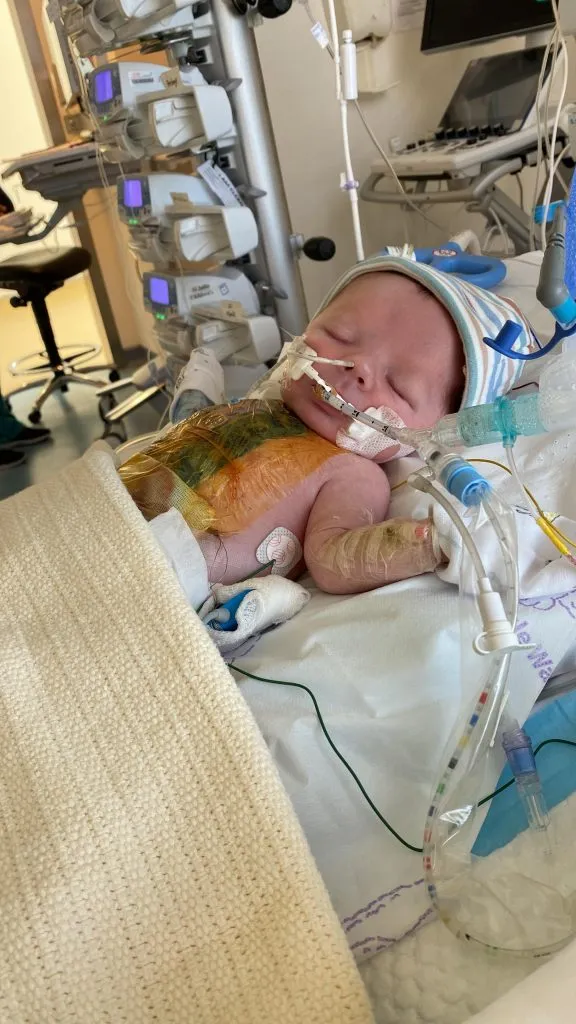
Alfie was born at 39 weeks, weighing 8lb 2oz, his cries weak but full of life. He was whisked immediately to the NICU, intubated and surrounded by tubes, monitors, and wires.
The first 24 hours of his life were a blur of medical intervention, fear, and silent prayers.
On that very first day, Alfie underwent a septostomy, a critical procedure to create a small hole between the atria, allowing his blood to circulate. I watched, heart in my throat, as my tiny baby underwent surgery before I could even cradle him.
When we finally met him, sedated and fragile, my heart ached with love and fear intertwined. Yet, as the hours passed, Alfie began to show signs of strength. Within five days, he was breathing on his own, off oxygen support, and awake enough to cuddle.
His beautiful eyes — wide, alert, and curious — were finally visible to us. We introduced him to his sisters, Scarlett, five, and Aria, just 1.5 years old. The joy of these first family moments was immense, yet we knew that the greatest battles were still ahead.
At just eight days old, Alfie underwent his first open-heart surgery: the Norwood procedure, the most critical of the three required surgeries for his condition.
Walking him into the operating theatre, hand on his tiny chest, I felt a surge of anger, fear, and helplessness — why him? The warning from the surgeons lingered in our minds: a 5–10% chance he might not survive.
Eleven hours later, we saw him again — his tiny body swollen and grey, chest open, connected to machines that kept him alive. Nothing could have prepared us for the sight.
The next days were a delicate dance between hope and despair. Three days after the Norwood, Alfie needed to return to surgery for a blood clot.
The words of the doctors, “We need to get to theatre now or he will die,” made my knees buckle. Yet, once again, the skill, dedication, and unwavering focus of the medical team saved him.
Two days later, his chest was finally closed. Within a week, he was transferred to the children’s cardiac ward, where we learned to care for him at home: tube feeding, weighing, administering medication, recognizing signs of distress, and even baby CPR. Every day was a lesson in vigilance and love.
At five weeks old, Alfie came home for the first time. The joy was profound, yet two days later, he could not retain his feeds and was rushed back to the hospital. His second open-heart surgery, the Glenn procedure, occurred at four months old.
The four-hour operation initially went well, but complications soon arose: Chylothorax, where lymphatic fluid leaks into the chest cavity, and sepsis, slowed recovery. For eight long weeks, we remained on the cardiac ward, witnessing every struggle, every challenge, and celebrating every small triumph.
Finally, just before six months, Alfie came home permanently — right in the midst of the coronavirus pandemic, adding fear and logistical challenges to an already exhausting journey.
Yet, the joy of having our family together outweighed every worry. Now, at nine months old, Alfie thrives. Every smile, every giggle, every small achievement is a testament to his resilience, courage, and indomitable spirit.
The future holds more challenges. Alfie will eventually need the Fontan procedure, typically between ages three and five, and may require further interventions throughout childhood.
Yet, as we watch him grow, healthy and happy, we are reminded daily of the miracles wrought by expert medical care, unwavering love, and relentless hope.
Every nurse, surgeon, and doctor at Southampton Hospital is a hero in our story. They have saved Alfie countless times, yet it is his tiny, unyielding spirit that inspires us most.
He has taught us about patience, resilience, and the power of hope — lessons far beyond his nine months.
Alfie’s journey has not only transformed our lives but has also touched the hearts of those around us. Family, friends, and even strangers have followed his story, inspired by his courage and the meticulous care of the medical teams.
Social media and community support have provided lifelines, advice, and encouragement, reminding us that we were never alone, even in the darkest moments.
As his parents, we have learned to celebrate every milestone, no matter how small. His first smile, the tiny grasp of our fingers, the soft coos that signal contentment — all of these are monumental.
Alfie’s life, once threatened before he even left the womb, is now a story of triumph over rare adversity, proof that miracles can and do happen when love, preparation, and human skill converge.
Alfie’s courage reminds us that life is fragile yet resilient. His tiny heart has faced unimaginable challenges, yet his spirit has never faltered. He is our tiny warrior, our beacon of hope, and our daily inspiration.
Each day with Alfie is a gift, a chance to witness bravery in its purest form — a lesson in compassion, perseverance, and the enduring power of love.
And though his journey is far from over, every heartbeat, every breath, every smile is a victory. Alfie is living proof that even in the face of the most daunting medical odds, hope, courage, and care can turn fear into life, and uncertainty into joy.