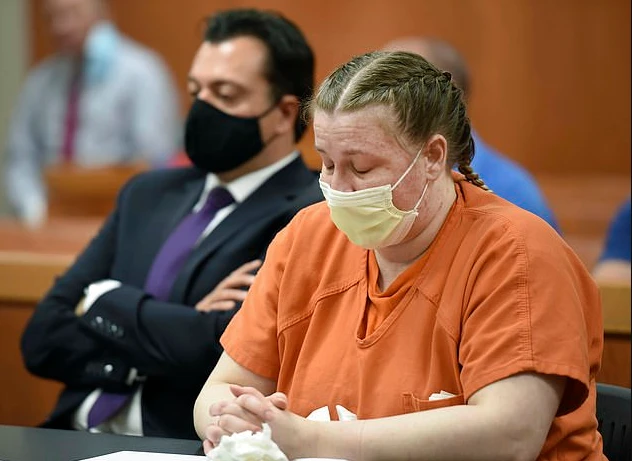
A mother has been sentenced to 35 years in prison for the shocking and inhumane murder of her five-year-old son, AJ Freund.
JoAnn Cunningham, 37, pleaded guilty to the brutal killing of her son, who was tortured before being buried in a shallow grave.
AJ Freund, who was just five years old, endured severe abuse at the hands of his mother before his tragic death in April 2019.
Cunningham was spared the maximum sentence of 60 years and sentenced to 35 years for the torturous murder of her son.
The court heard details of the horrific circumstances surrounding AJ’s death.
His body was found buried in a shallow grave in the woods near Woodstock, Illinois, after a six-day search.
AJ had been killed by his mother, who subjected him to intense physical and emotional abuse before his life was tragically taken.
The story of AJ’s death shocked the local community and became emblematic of the systemic failures in child protection services.
JoAnn Cunningham had a history of drug abuse and significant personality dysfunction.
Her long history of mental health issues and neglectful behavior was known to authorities.
Cunningham had been investigated by the Illinois Department of Children and Family Services (DCFS) multiple times before AJ’s death.
Despite multiple warnings, AJ remained in her care, which ultimately led to his untimely and brutal death.
In a statement, Cunningham’s husband, Drew Freund, explained how Cunningham had forced AJ into a cold shower to “admit the truth” about hiding his soiled underwear.
He described how Cunningham “hitting” AJ in the shower escalated into a violent confrontation.
Drew Freund also recounted how Cunningham used the shower spray nozzle on AJ’s face.
According to Freund, AJ would lose his balance and fall in the tub during the abusive ordeal.
The tragic incident culminated in AJ’s death on April 15, 2019.
Cunningham woke Freund at 3 a.m. to inform him that AJ was not breathing.
The couple searched for child CPR information on Freund’s phone, but by the time they realized AJ was dead, it was too late.
Freund, in his grief and confusion, told Cunningham he would “handle it.”
He placed AJ’s lifeless body into a plastic tote in the basement, where it remained for several days before being buried in the woods.
After the six-day search, AJ’s body was found in the shallow grave by investigators.
Cunningham pleaded for help in finding AJ, while the couple had already buried his body.
She later became a key suspect in the murder investigation.
Drew Freund, AJ’s father, was also charged with first-degree murder in connection with his son’s death.
Freund has pleaded not guilty to the charges and is awaiting trial.
During Cunningham’s sentencing hearing, Judge Robert Wilbrandt described her actions as “inhumane, repulsive, and frankly, shocking.”
He stated that Cunningham had “lied, cheated, and manipulated” her way through life while terrorizing her small son.
A forensic pathologist who conducted AJ’s autopsy testified that AJ had suffered fatal head injuries, along with cuts and bruises across his entire body and limbs.
Dr. Mark Witeck, the forensic pathologist, described the case as “bad, but not the worst” he had seen in his career.
AJ’s cause of death was listed as inhalation of his own blood.
The child also had small, circular marks on his forehead, which were consistent with the pattern of a detachable shower head.
Cunningham’s previous history with the Illinois Department of Children and Family Services was troubling.
The department had received numerous reports of her neglectful behavior and abuse, some even before AJ was born.
A 2019 review revealed that there had been ten hotline calls about Cunningham’s treatment of children, including her firstborn son and a foster son she briefly cared for.
The calls came from police, hospital staff, neighbors, and even her own mother.
Judge Wilbrandt noted that Cunningham was responsible for the life of AJ, and now she must be responsible for his death.
He expressed that the murder had been “horrible” and that Cunningham had failed to provide the basic love and care that every child deserves.
The judge noted that while the court could not undo the harm Cunningham had caused, it could ensure that she would face some measure of justice.
However, the family of AJ Freund expressed disappointment at the sentencing.
They had hoped Cunningham would receive the maximum 60-year sentence.
In a statement, AJ’s family said, “We know that whatever the punishment, it will not ease the loss and pain we feel.”
“AJ was an innocent, precious little boy whose life was taken from him after he endured, what we now know, was much pain and suffering.”
The family continued, expressing their wish that Cunningham would spend the rest of her life in prison for what she had done to their son.
Cunningham, who had two other sons and a daughter, tried to explain her actions.
She tearfully told the judge that she had always felt abandoned, unloved, insignificant, and rejected.
“I’ve been mentally and physically abused, all without a single moment of encouragement, which slowly drained my heart of joy and peace,” Cunningham said.
She described herself as someone who had been “mentally unavailable” even to herself.
Cunningham admitted that she had been using drugs to cope with her anxiety, depression, and pain.
Her addiction was a key factor in her inability to care for her son.
Despite the circumstances, Cunningham did not fully apologize for AJ’s death.
“I love and miss him,” she said, stopping short of offering a full apology for her actions.
She added, “I want my children to be proud of me.”
The tragedy of AJ’s death is a heartbreaking reminder of the importance of child protection.
AJ’s life was taken by the very person who should have been his protector.
The systemic failures of child services in this case are a sobering reflection on how vulnerable children can be in abusive environments.
The case has sparked national outrage and calls for stronger regulations and reforms in child welfare systems.
In Cunningham’s case, it was too late for AJ, and her actions will haunt her family forever.
While the sentence has been handed down, the damage caused by Cunningham’s cruelty is irreversible.
AJ’s memory will live on through his family’s fight for justice, and their call for accountability in the case.
As Cunningham begins her 35-year sentence, the memory of AJ will continue to inspire those who advocate for stronger protections for children.
The pain of losing AJ will never fade, but his family remains determined to ensure that his death was not in vain.
Through their pain, they continue to fight for justice for the little boy whose life was stolen too soon.
While nothing can bring AJ back, his family hopes that their efforts will make a difference for other children who are at risk of being hurt by neglect and abuse.
The fight for justice continues, and AJ’s family will never stop advocating for what is right.
As AJ’s family mourns his loss, they are committed to ensuring that his memory will live on and that the system will be held accountable.
AJ’s story serves as a stark reminder of the need to protect vulnerable children and prevent similar tragedies from occurring in the future.