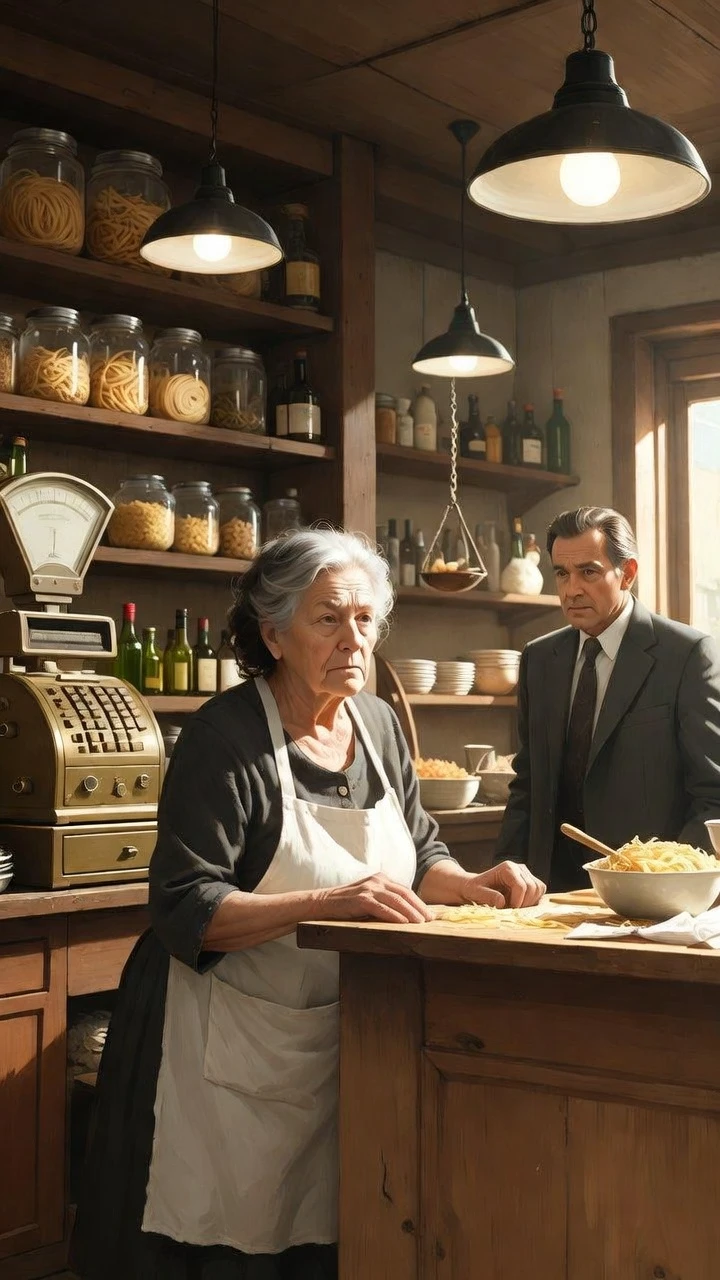
Noah Bennett didn’t taste food; he calculated the ROI per calorie. In the neon-lit NYC of 2026, Noah was a money-printing machine, turning small eateries into global franchises standardized by AI. To Noah, tradition was an obstacle to growth, and his next target was “La Lanterna” – the oldest pasta shop in Rome, which held a secret tomato sauce recipe the whole world craved.
Scratch.
Noah Bennett slammed his leather briefcase onto his mahogany desk in Manhattan.
Cold.
The “Global Pasta” plan was ready to swallow the European market.
Alistair Vance, the board chairman with ruthless ash-gray eyes, entered the office. He set a glass of hard liquor on the desk.
“Finish this, Noah. If the old hag won’t sign, use the media to crush that tattered shop. We need that recipe to standardize global flavor.”
Noah took the blank check. He flew to Rome, leaving the glass skyscrapers for the worn cobblestone alleys of Trastevere, where the breath of history still clung to every corner.
La Lanterna rose in Trastevere like a dissonant note in the digital age.
Peeling brick walls. The scent of garlic and basil.
Elena Rossi stood behind the counter. Her hands were white with flour, her face etched with wrinkles, but her eyes burned like the embers in the oven.
“Ten million dollars.”
Noah placed the check down next to a basket of ripe tomatoes.
“You can retire on an island in Greece. My company will take your flavor to every corner of the Earth.”
Elena didn’t look at the check. She kept kneading.
Thud. Thud. Thud.
“Mr. Bennett,” she whispered. “What you want to buy isn’t a recipe. You want to buy my family’s soul.”
“Billions will know your food!” Noah barked.
“My food will die once it’s cooked by machines.”
Elena pointed to the old apron.
“If you want the ‘secret,’ stay here for a month. Work as my prep cook. If you still want to buy it after that, I’ll sign.”
The first ten days were torture for Noah.
No more tailored Dior suits. Noah wore a worn undershirt, waking up at 3 AM while Rome still slept.
The pain didn’t come from open wounds, but from utter physical exhaustion.
Noah had to haul 50kg sacks of flour on shoulders that had never known manual labor. The weight made his spine creak.
The intense heat from the wood-fire oven made sweat pour, stinging his eyes. The soot clung to his lungs, making him cough fitfully every night. He spent hours peeling thousands of tomatoes by hand, his fingertips numb and burning from the acidic juice seeping into his cuticles.
“You’re cooking with your head, Noah. Cook with your hands,” Elena reminded him as he tried to use a micro-scale to measure salt.
“I’m trying to create perfection!” Noah roared in frustration.
“Perfection has no taste,” Elena smiled sadly. “It only has precision. This pasta is delicious because it carries the longing for my late husband.”
Noah froze. He looked at his own trembling, exhausted hands. For the first time, he felt the connection between food and human emotion.
On the fifteenth night, Alistair Vance called via satellite.
“Noah, the excavators are ready. I’ve bought all the bad debt in the neighborhood. Tomorrow, La Lanterna will be leveled for a mall.”
Noah was silenced. His breath caught.
“Stop it, Alistair. This place… it’s Rome’s heritage.”
“Heritage doesn’t make money, Noah. Profit does. Sign the demolition order, or I’ll throw you onto the streets with nothing.”
Noah looked at the plate of pasta Elena had just set before him. A simple dish, but its scent reminded him of his mother – who had died in the loneliness of an industrial world.
Rage flared. Noah realized Alistair didn’t just want to demolish a shop; he wanted to erase humanity and replace it with numbers.
The next morning, the roar of excavator engines filled Trastevere.
Alistair Vance stood there, his face upturned in a triumphant sneer.
“Level it!”
The giant mechanical arm reached out. But it stopped.
Noah Bennett stepped out of the shop, still wearing Elena’s flour-stained apron, drenched in sweat. He didn’t hold a check; he held a legal file.
“If you want to destroy this shop, go through me!”
“You’re insane, Noah!” Alistair roared. “You’ll lose your entire career!”
“I’ve found something more important than a career.”
Noah smiled. A free smile.
“I’ve used my entire stock portfolio as collateral for the Central Bank of Italy. La Lanterna now belongs to the ‘Rome Culinary Arts Heritage Fund.’ You can’t touch it.”
Alistair turned pale. He realized he had lost to a man he once considered his most loyal pawn.
Six months later.
Rome was still golden and bright. La Lanterna was no longer dilapidated. It had been restored, yet it kept the scent of old wood and ginger tea.
Noah was no longer the “Franchise King.” He sat behind the counter, slowly kneading a new block of dough. His shoulders were firmer, his eyes more alive.
He didn’t sell millions of meals. He only sold 50 plates a day.
And every plate told a story.
Elena walked over, placing a glass of wine on the table.
“Does the dough ‘soften’ today, Noah?”
Noah looked down at his rough hands. They weren’t polished, but they were creating life.
“It’s very happy, Elena.”
True happiness isn’t in fast growth. It lies in daring to preserve a soul in a standardized world.
Noah looked at the steaming plate of pasta.
The taste of home. He was finally home.