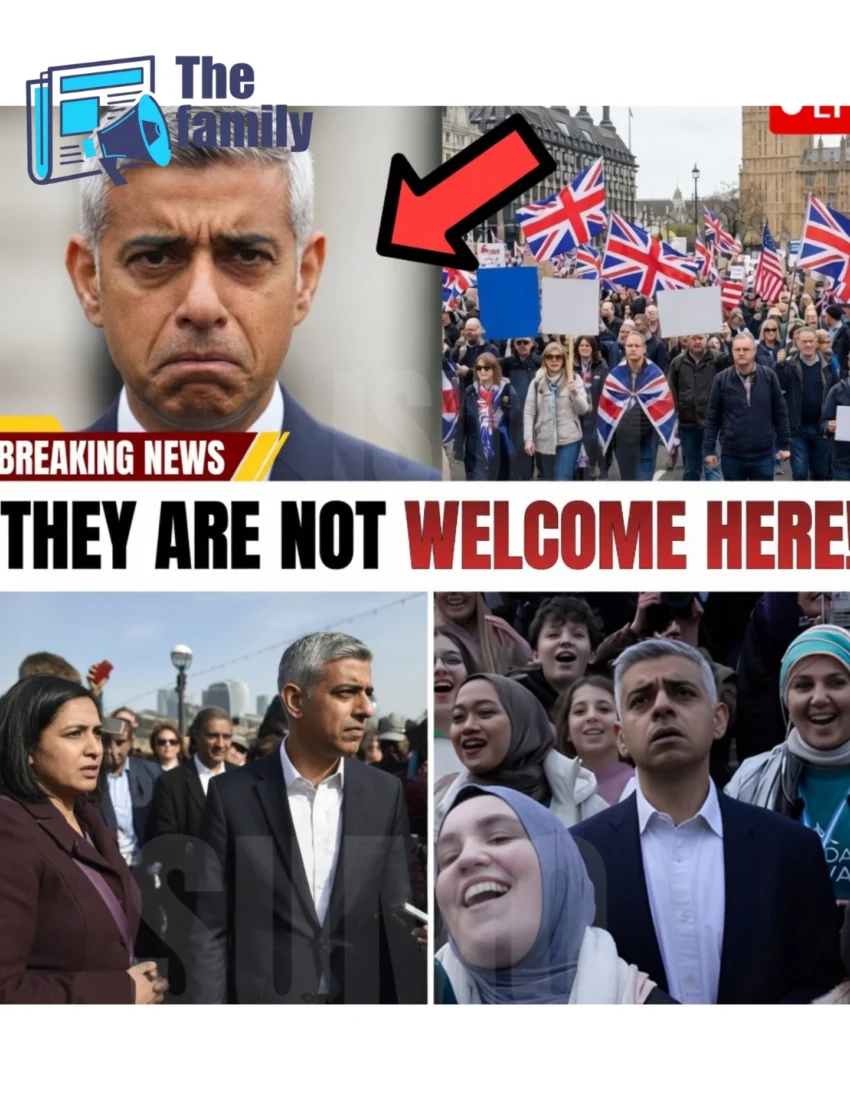
Is London באמת on the brink of a political uprising—or are millions of people being pulled into a carefully constructed narrative that feels larger, louder, and more unified than reality? As viral content floods the internet, the line between public concern and amplified perception becomes harder to see.
In April 2026, a wave of highly charged online content began circulating with a striking claim: that “patriots” were flooding into the UK to remove Sadiq Khan from power.
The framing was dramatic. Urgent. Almost cinematic.
It painted a picture of a city on edge—a population united in frustration, rising against leadership that had, according to the narrative, failed across nearly every front.
But beneath the intensity of the language lies a more complicated question:
Is this a reflection of reality—or an example of how modern political storytelling shapes perception?
At the heart of the viral material is a simple but powerful idea: that Londoners, after years of dissatisfaction, are collectively turning against their mayor.
The argument is built on several key pillars:
Taken individually, each of these issues exists within public discourse. But when combined—and framed without nuance—they create a much more sweeping conclusion: that London is experiencing a unified political “revolt.”
That’s where the narrative becomes more complex.
Crime is one of the most emotionally charged aspects of the discussion.
The material highlights:
These are real concerns, frequently debated in UK politics and covered in media reporting.
However, crime data is rarely simple.
Some categories may increase while others decrease. For example, long-term trends in homicide rates have, at times, shown decline—even as other offenses rise.
When selective statistics are presented without broader context, they can create a perception of total collapse—even if the full data tells a more mixed story.
This doesn’t mean concerns are invalid.
It means how they are presented matters just as much as the numbers themselves.
Another major focal point is the Ultra Low Emission Zone (ULEZ), a policy strongly associated with Sadiq Khan.
The criticism is clear: that ULEZ places financial strain on working-class residents, particularly in outer London.
And to some extent, that criticism reflects a genuine political divide.
Environmental policies often create tension between:
Supporters argue ULEZ improves air quality and reduces pollution-related illness.
Critics argue it disproportionately affects those who can least afford to upgrade vehicles.
The viral narrative leans heavily toward the latter—portraying the policy as punitive rather than preventative.
But again, the reality is more balanced—and more contested.
One of the most serious elements of the narrative involves claims about organized child exploitation, often referred to as “grooming gangs.”
This is an extremely sensitive and real issue that has been investigated in various parts of the UK.
However, the viral content makes a critical leap: implying widespread awareness or responsibility at the level of city leadership.
That leap is not clearly supported by verified evidence in the material itself.
Cases of exploitation are complex, involving multiple agencies, legal thresholds, and investigative challenges. Assigning direct accountability requires careful, case-by-case verification—not broad generalization.
When such topics are used in emotionally charged narratives, they can shift from awareness to weaponization—intentionally or not.
Perhaps the most powerful—and potentially misleading—aspect of the narrative is the idea of unity.
It suggests that “ordinary Londoners” are collectively rising up, forming a near-universal opposition.
But London is one of the most diverse cities in the world:
Public opinion is rarely unified.
While dissatisfaction certainly exists—and opposition parties like Reform UK may be gaining traction in some areas—it does not necessarily translate into a citywide consensus.
The concept of a “revolt” is compelling.
But it may also be a simplification of a far more fragmented reality.
The tone of the material is not neutral.
It relies heavily on words like:
These are not just descriptions—they are framing devices.
They create urgency. They evoke emotion. They encourage a particular interpretation before the audience has time to analyze.
This is a common feature of viral political content.
Strong language increases engagement—but often reduces nuance.
Equally important is what the narrative leaves out.
London’s performance as a city can be measured across many dimensions:
These factors are largely absent from the material.
By focusing exclusively on negative indicators, the narrative creates a one-sided portrayal—one that may feel comprehensive, but is actually selective.
In today’s digital environment, content like this doesn’t just spread—it accelerates.
Algorithms tend to prioritize:
This creates a feedback loop:
Over time, a narrative can begin to feel like reality—not because it is fully accurate, but because it is constantly reinforced.
Criticism of political leaders is not unusual.
In fact, it is a fundamental part of democratic systems.
Every mayor, prime minister, or president faces:
What makes this situation different is the intensity and framing.
Instead of presenting criticism as part of ongoing political debate, the narrative frames it as:
a breaking point. a collapse. a revolt.
That shift—from criticism to crisis—is where interpretation becomes storytelling.
There is a reason this kind of content resonates.
It taps into real emotions:
When people feel unheard or uncertain, narratives that offer clear explanations—even simplified ones—become more appealing.
They provide:
But clarity is not always the same as accuracy.
The reality likely sits somewhere between extremes:
Instead, what we are seeing is:
a complex political environment being distilled into a powerful—but simplified—story.
Ultimately, this is not just about Sadiq Khan.
It is about how modern audiences interpret information.
In an era where narratives spread faster than verification, the challenge is not just to consume content—but to analyze it.
To ask:
London is not collapsing.
Nor is it free of problems.
It is, like any major city, navigating competing pressures—economic, social, and political.
The viral narrative captures part of that reality.
But it also reshapes it.
Because in today’s world, the most powerful force in politics is not always policy or performance—but the story people believe about them.