The Great Dollar Shift: Inside the Quiet Financial Revolution Reshaping Global Power
For decades, the global financial system has revolved around one central pillar: the dominance of the U.S. dollar. From international trade to sovereign debt, from central bank reserves to development financing, the “greenback” has functioned not just as a currency, but as a symbol of stability, influence, and geopolitical power.
But in 2026, that foundation appears to be undergoing a subtle yet profound transformation—one driven not by dramatic confrontation, but by gradual, calculated change.
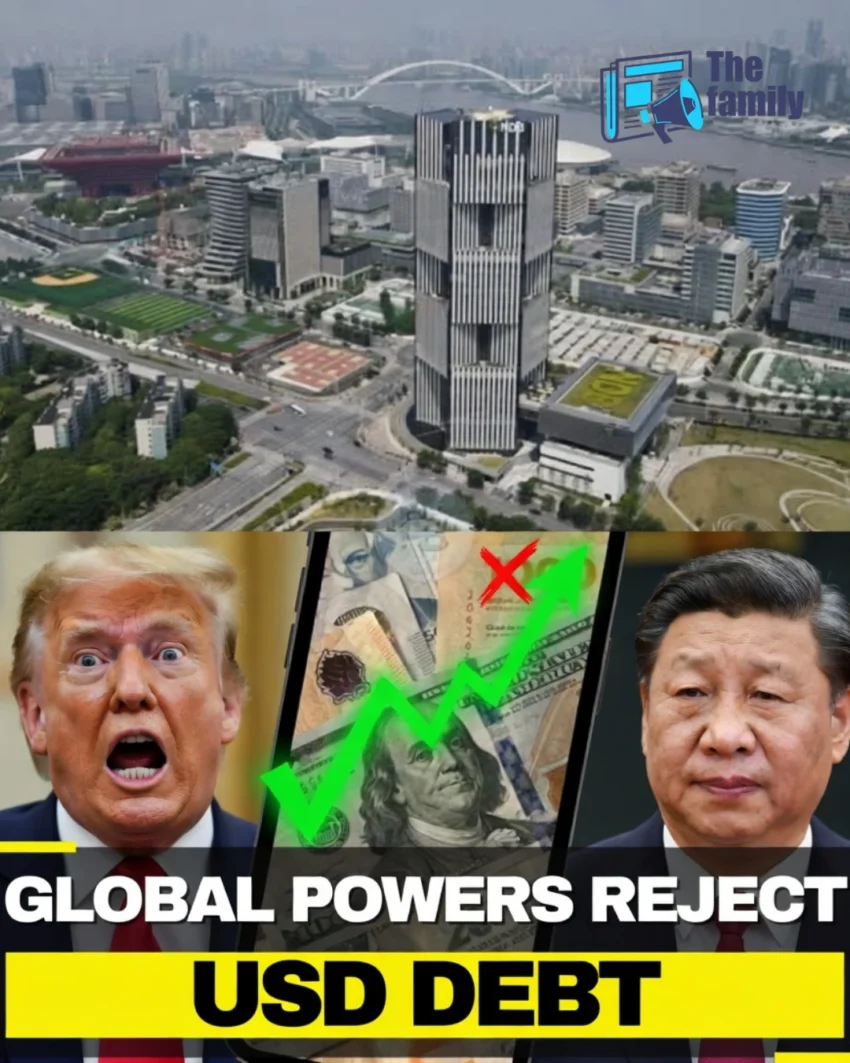
At the center of this shift is the New Development Bank (NDB), the financial institution established by BRICS nations—Brazil, Russia, India, China, and South Africa—as an alternative to Western-led lenders. Its latest move has sent ripples across global markets: a strategic pivot away from U.S. dollar-denominated loans toward financing in Chinese yuan.
This decision is not being framed as ideological. Instead, it is being presented as practical—driven by numbers, risk calculations, and long-term economic strategy.
To understand the significance of this shift, it is important to grasp just how deeply the dollar has been embedded in global finance.
Since the end of World War II, the United States has maintained a unique position. The Bretton Woods system, followed by decades of economic expansion and financial integration, cemented the dollar as the world’s primary reserve currency. Central banks across the globe accumulated dollar reserves. International institutions issued loans in dollars. Commodities—from oil to metals—were priced in dollars.
Even countries with little direct connection to the U.S. economy found themselves tied to its currency.
For emerging markets, this often meant borrowing in dollars to fund infrastructure, development, and social programs. On paper, it provided access to deep capital markets and relatively stable financing. In practice, it introduced vulnerabilities that would become more apparent over time.
The NDB’s pivot toward yuan lending is rooted in what its officials describe as a “brutal” financial reality: borrowing in dollars has become significantly more expensive.
As of 2026, U.S. Treasury yields remain elevated, reflecting persistent deficits and a national debt that has climbed into the tens of trillions. Meanwhile, Chinese government bond yields are considerably lower.
The difference may appear modest in percentage terms—but over time and at scale, it becomes enormous.
Consider a hypothetical $1 billion infrastructure project financed over ten years. At interest rates above 4%, a dollar-denominated loan can generate hundreds of millions in interest costs. A comparable yuan-denominated loan, with rates closer to 2%, cuts that burden dramatically.
For developing nations operating within tight fiscal constraints, the implications are immediate and tangible. Savings from lower interest payments can be redirected into healthcare, education, or additional infrastructure.
In this context, the decision to move away from dollar loans is less about politics and more about arithmetic.
Beyond interest rates, there is another factor quietly influencing the shift: currency mismatch.
Many large-scale infrastructure projects in emerging markets rely heavily on Chinese suppliers—machinery, materials, and labor that are priced in yuan. When countries borrow in dollars but spend in yuan, they expose themselves to exchange rate fluctuations.
If the dollar strengthens, the cost of servicing that debt rises—even if the project itself remains unchanged.
This mismatch has caused significant financial strain in the past. Projects that once appeared viable can suddenly become unsustainable, forcing governments to cut spending, renegotiate terms, or in extreme cases, default.
By borrowing directly in yuan, countries align their financing with their spending. The result is greater stability and predictability—two qualities that are often in short supply in emerging markets.
While economics plays a central role, geopolitics cannot be ignored.
The freezing of Russian foreign reserves in 2022 marked a turning point in how many countries perceive the dollar-based system. For the first time, a major economy saw hundreds of billions in assets effectively immobilized through coordinated Western action.
The message was clear: access to the global financial system could be influenced by political considerations.
For some nations, this realization has prompted a reassessment of risk. Holding reserves in dollars—or relying on dollar-based financing—now carries not just economic implications, but geopolitical ones as well.
In contrast, yuan-denominated assets are seen by some as less exposed to Western sanctions. China has also expanded its network of currency swap agreements, providing liquidity support to partner countries without requiring access to U.S.-aligned institutions.
This evolving landscape is contributing to a gradual diversification of financial strategies.
Perhaps the most significant aspect of this transition is the way it reinforces itself.
As institutions like the NDB increase their use of local currencies, demand for dollars in development finance declines. Reduced demand for dollar assets can contribute to higher borrowing costs in the U.S., which in turn makes dollar loans even less attractive.
This creates a feedback loop:
At the same time, trade patterns are evolving. A growing share of transactions between BRICS nations is now conducted in local currencies. China, in particular, has expanded the international use of the yuan in cross-border payments.
Individually, these changes may seem incremental. Collectively, they point toward a broader rebalancing.
Despite these developments, it would be premature to declare the end of the dollar’s global role.
The U.S. still possesses the world’s largest economy, the deepest financial markets, and a level of institutional stability that remains difficult to replicate. The dollar continues to account for a significant portion of global reserves and international transactions.
What appears to be changing is not dominance itself, but exclusivity.
For decades, the dollar was not just the primary option—it was often the only viable one. Today, alternatives are emerging, offering countries greater flexibility in how they manage their finances.
This does not necessarily signal a sudden collapse, but rather a gradual shift toward a more multipolar financial system.
One of the most striking features of this transition is its quiet nature.
There are no dramatic announcements declaring the end of dollar dominance. No single event that marks a definitive turning point. Instead, change is occurring through a series of small, deliberate decisions—each one rational on its own, but collectively transformative.
Countries are not abandoning the dollar outright. They are simply choosing, in certain cases, not to use it.
Loans are being issued in yuan. Trade is being settled in local currencies. Reserves are being diversified.
Each step reduces reliance on the dollar, not through confrontation, but through substitution.
Looking forward, several questions remain unanswered.
Will the yuan continue to gain traction as an international currency? Can China provide the level of transparency and institutional trust required for broader adoption? How will the United States respond to a gradual erosion of its financial influence?
Equally important is the question of balance.
A more diversified financial system could reduce systemic risk, offering countries alternatives during times of crisis. At the same time, fragmentation could introduce new complexities, making coordination more difficult in moments of global instability.
For now, the trajectory appears clear: the global financial system is evolving.
The story unfolding in 2026 is not one of sudden upheaval, but of quiet transformation.
The decision by the New Development Bank to pivot away from dollar loans reflects a broader trend—one driven by cost efficiency, risk management, and changing geopolitical realities.
It is a reminder that power in the modern world is not only exercised through force or policy, but through the structures that underpin everyday economic activity.
And as those structures begin to shift, even gradually, the implications can be far-reaching.
The dollar is not disappearing. But for the first time in decades, it is no longer unchallenged.
In a world increasingly defined by multiple centers of influence, that distinction may prove more important than any headline declaration of victory or decline.