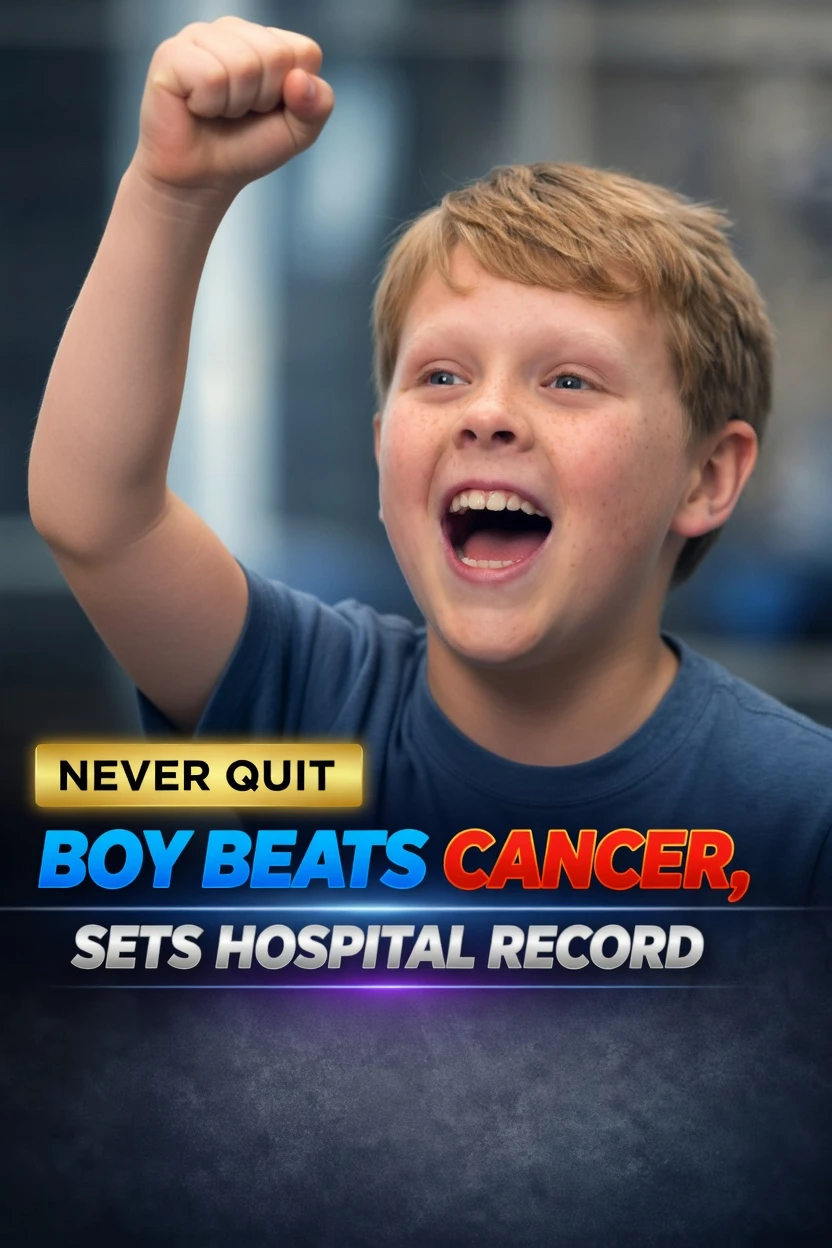
At Cook Children’s Medical Center in Fort Worth, recovery is not always measured only in test results or charts. Sometimes, it is measured in motion—in the quiet, determined rhythm of a child refusing to stand still in the face of something overwhelming.
For one nine-year-old boy named George, movement became more than therapy. It became a statement.
Inside the hospital, young patients are encouraged to stay active through a simple but symbolic activity: riding laps on a roller bike through the halls. Nurses keep track of the miles, turning each small effort into a visible sign of progress.
For many children, it is a way to pass time or regain strength. For George, it became something else entirely.
Day after day, even as cancer treatment drained his energy, he kept riding. There were moments when his body resisted—when fatigue made even standing difficult. His mother would later recall watching him lean against the wall just to keep going, inching forward when stopping would have been easier.
What began as a recommendation slowly transformed into a mission.
Over the course of five and a half months, George’s effort accumulated into something extraordinary. Mile after mile, he continued—long after most would have stopped counting.
Eventually, the number exceeded 100 miles.
At that point, the staff stopped tracking. Not because it no longer mattered, but because the meaning had shifted. The miles were no longer just a number. They had become a reflection of something deeper: resilience in its purest form.
George was not riding because it was easy. He was riding because he had made a quiet decision—not to give in to what was happening to him.
In many cancer treatment centers, there is a tradition: when a patient completes treatment, they ring a bell.
It is a simple act, but one filled with emotion. It marks the end of a difficult chapter—a moment of relief, hope, and transition.
When George rang that bell, it was more than a signal that treatment was over. It was a recognition of everything that had come before it: the long days, the physical pain, the emotional weight, and the countless moments where he chose to keep going.
Today, George is in remission.
But his story did not end there.
For many, finishing treatment is the end of the journey. For George, it became the beginning of something new.
Instead of turning away from the experience, he chose to face it differently—by helping others who are still in the middle of their own battles.
Each year, Cook Children’s hosts an event known as “The Blast,” a large-scale fundraiser that includes a two-and-a-half-mile walk. The goal is simple: raise money and awareness for children fighting cancer.
Even before he was healthy enough to attend in person, George found a way to participate.
Last year, while still quarantined and unable to join physically, George built a fundraising team that quickly grew beyond expectations. More than 130 people joined him, forming the largest group in the event.
Together, they raised nearly $14,000.
It was not just a number. It was a reflection of how one child’s story had already begun to influence others—how his determination inside hospital walls had reached far beyond them.
This year, with his health restored, George was finally able to take part in person. And in a way that now feels characteristic of him, he did not simply show up.
He showed up ready to move forward again.
What makes George’s story resonate is not only the fact that he survived cancer. It is the way he chose to respond to it.
There is a kind of strength that comes from endurance—the ability to withstand pain, to persist through difficulty. But there is another kind of strength, quieter and perhaps even more powerful: the ability to remain open, compassionate, and outward-looking after hardship.
George embodies both.
He understands, in a way few children do, how difficult cancer treatment can be. And his motivation to help others comes from that understanding. He does not want other children to experience what he went through—or at least, he wants to make that experience a little less lonely.
For George’s mother, watching this transformation has been both emotional and humbling.
She has seen firsthand the moments that others might not—the exhaustion, the struggle, the quiet determination that defined his days during treatment. And now, she sees the continuation of that same spirit, directed outward.
Her sense of awe is not just about what he endured, but about who he has become through it.
In many stories, victory is defined by a clear outcome: the illness is gone, the treatment is complete, the patient recovers.
But George’s journey suggests a broader definition.
Winning, in his case, was not just about reaching remission. It was about how he chose to move through the process—and what he chose to do afterward.
It was in the decision to keep riding, even when it hurt.
It was in the willingness to inspire others, even while he was still struggling.
And now, it is in his commitment to helping those who are still in the middle of their fight.
George has a message for other children at the hospital: try to beat his record.
On the surface, it sounds like a simple challenge—something playful, even competitive. But beneath it lies something more meaningful.
It is an invitation to keep going.
To push forward, even when progress feels slow.
To believe that effort matters, even when the outcome is uncertain.
In many ways, it is a philosophy shaped not by theory, but by experience.
Stories like George’s resonate because they reveal something fundamental about human resilience. They show that strength is not always loud or dramatic. Sometimes, it is found in small, repeated actions—in choosing to move forward one step at a time.
They also challenge assumptions about age and capability. At nine years old, George has already faced a level of adversity that many adults never encounter. Yet his response has been marked not by withdrawal, but by engagement.
He did not let suffering close him off.
He allowed it to expand his sense of purpose.
As George continues his life beyond treatment, his story remains in motion—much like those miles he once rode through hospital corridors.
It is not a finished narrative, but an evolving one.
There will be new challenges, new milestones, and new opportunities to make an impact. But the foundation has already been set: resilience paired with compassion, determination paired with purpose.
At its core, George’s story can be distilled into a simple idea—one that he has already lived through experience rather than words:
Keep going.
Not because it is easy.
Not because the outcome is guaranteed.
But because movement itself can become a form of hope.
For a child who once leaned against hospital walls just to take another step, that message carries a weight far beyond its simplicity.
It is not just encouragement.
It is truth, earned the hard way—and now shared so that others might find their own way forward.