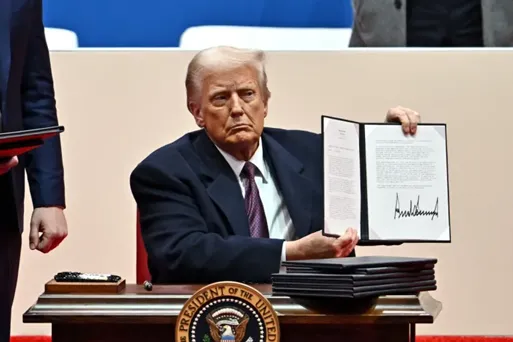
WASHINGTON, D.C. — In a decisive move to rescue America’s cities from the grip of squalor and decay, President Donald Trump has signed a landmark Executive Order, officially bringing an end to the era of “permissive neglect” regarding homelessness and public drug use.
The order, titled “Ending Crime and Disorder on America’s Streets,” signals a massive paradigm shift in federal policy. It dismantles the failed “Housing First” model championed by the Left and replaces it with a
“Treatment First” strategy rooted in accountability, public safety, and genuine rehabilitation.
Speaking from the Oval Office, President Trump declared that the American people have lost patience with seeing their parks, sidewalks, and public spaces transformed into open-air drug dens filled with needles and refuse.
“Compassion does not mean letting people die slowly on the sidewalk,” the President stated. “True compassion is getting them off the streets, getting them the help they desperately need, and returning safety to law-abiding families.”
The Executive Order outlines a rigorous new approach:
Ban on Urban Camping: Directs federal agencies to prioritize funding for states and cities that strictly enforce bans on unauthorized camping and public drug consumption.
Mandatory Treatment: Instructs Attorney General Pam Bondi to challenge legal precedents that currently hinder authorities from institutionalizing the severely mentally ill. The goal is to facilitate involuntary commitment for those who are a danger to themselves or others due to severe addiction or psychosis.
Defunding Failure: Halts the flow of federal dollars to “Housing First” programs that provide free apartments without requiring sobriety or mental health treatment. Funds will instead be redirected to outcome-based recovery models.
Controlled Safe Zones: Supports the creation of temporary, designated areas where medical and psychiatric services are available on-site, moving the homeless out of residential neighborhoods and into environments where they can be triaged and treated.
The move has been hailed by conservative organizations like the Heritage Foundation and the Cicero Institute as a return to “common sense.” Supporters argue that after decades of throwing billions at “harm reduction” programs that only increased homelessness, the administration is finally addressing the root causes: mental illness and addiction.
Louisiana Governor Jeff Landry, a close ally of the administration, praised the federal intervention as a “lifeline” for cities under siege by crime and disorder.
Predictably, the order has triggered outrage among liberal leaders in “sanctuary cities.” California Governor Gavin Newsom and various activist groups have accused the administration of “criminalizing poverty” and have vowed legal challenges.
However, the White House remains undeterred, viewing the outcry as proof that they are disrupting the “Homeless Industrial Complex” that has profited from the chaos.
This Executive Order sends an unmistakable message: The right to camp on a sidewalk or inject drugs in public does not supersede the right of American families to live in safe, clean communities.
By forcing a choice between accepted treatment or facing law enforcement, the Trump administration is placing a bet on tough love. For the millions of voters who demanded a cleanup of American cities in 2024, this is a promise kept: The United States will no longer tolerate chaos disguised as compassion
There are few stories as peculiarly morbid as the case of Larry Ely Murillo-Moncada, the man discovered trapped behind a set of store shelves some 10 years after he disappeared.
According to reports from the time, Larry was declared missing on November 28, 2009, when his parents had grown concerned after he fled his home in a distressed state, barefoot during a blizzard without his keys and car, and failed to return.
Larry was 25 years old at the time, employed at the No Frills supermarket in Council Bluffs, Iowa.
Though a search soon got underway, no trace of the missing man was found. His family had little to console them following his vanishing. Indeed, it simply seemed as though he had disappeared into thin air one day.
According to the BBC, relatives of Larry had revealed that he was suffering from hallucinations at the time of his disappearance.
“He was hearing voices that said ‘eat sugar’,” his mother said, via a translator.
“He felt his heart was beating too hard and thought if he ate sugar, his heart would not beat so hard.”
According to Council Bluffs Police Captain Todd Weddum, Larry’s parents believed he was possibly acting strangely due to the medication he was taking.
Then, a decade later, in 2019, a tragic discovery changed everything.
The store worker’s remains were found at the local supermarket in Council Bluffs where he had worked. His body was discovered wedged in an 18-inch gap between the cooler and a wall.
As per reports, Larry’s corpse was found by a group of workers who had been ordered to remove shelves and coolers. The store had been shut for three years at this point and the premises were being cleared.
Using DNA collected from his parents, the Iowa Division of Criminal Investigation were able to identify Larry. The clothing on his body also matched what he was said to have been wearing at the time of his disappearance.
According to the Des Moines Register, Larry’s death was ruled accidental.
Investigators looking into the accident concluded that Larry had gone into the supermarket after leaving his family home, thereafter climbing atop the store’s coolers. There, he must have fallen into the gap between the units and the wall, tragically becoming trapped in the process.
Sergeant Brandon Danielson said it would have been a 12-foot fall, while the noise of the freezer units would have been ‘so loud’ there was ‘probably no way anyone heard him.’
“Our heads are spinning, finding this out after so many years, and it is distressing, it makes us feel a lot of pain,” said Larry’s father, Victor Murillo, after the discovery of his son in 2019.
“They closed the building. The freezers weren’t working anymore. So how can a body just be there?”
Hauntingly, former staff members claimed they had reported a terrible smell coming from the freezer units, though their complaints were repeatedly dismissed.