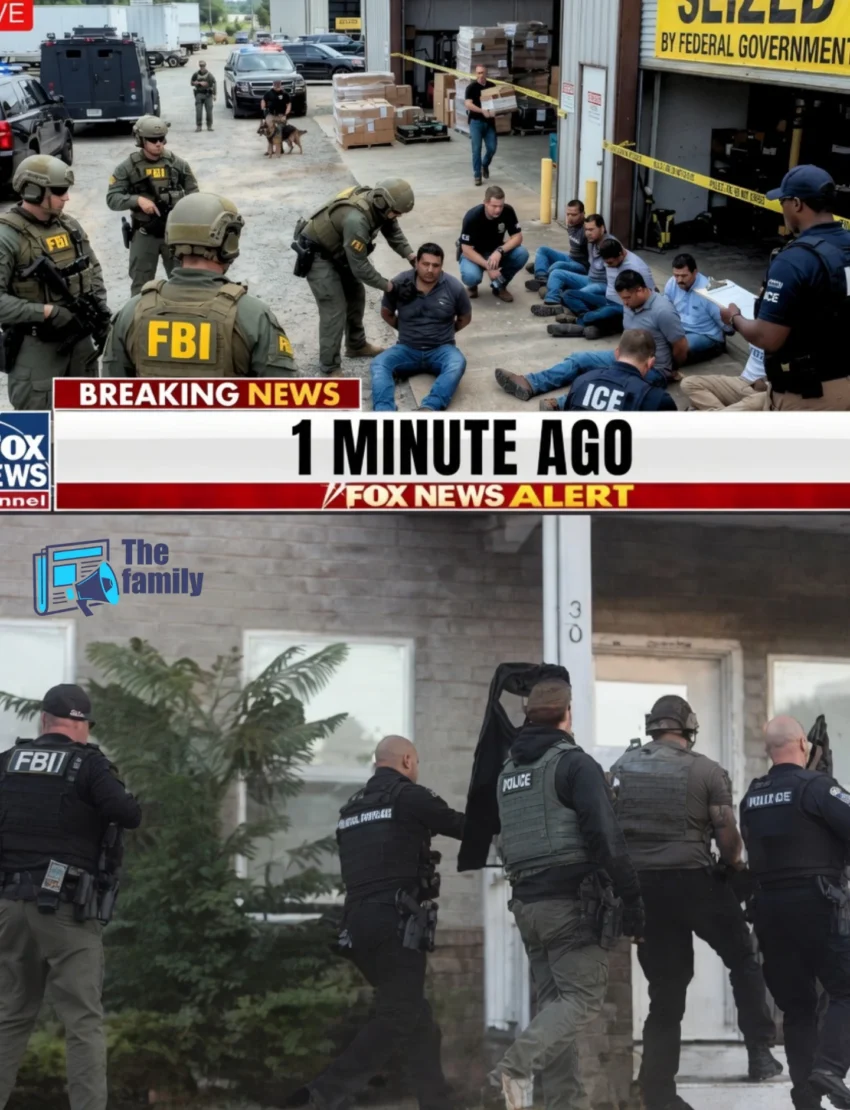

What initially appeared to be a standard enforcement action has since been described by officials as something far more consequential: a coordinated effort targeting what may have functioned as a centralized logistics hub for transnational cartel activity in the southeastern United States.
Yet beyond the immediate headlines—raids, seizures, arrests—there are deeper questions worth examining. Why Alabama? Why now? And what does this operation suggest about how organized criminal networks may be adapting within the United States?
For decades, public understanding of cartel activity in the U.S. has been shaped by a relatively simple mental map: the border states serve as entry points, and major metropolitan areas act as distribution centers. But the Alabama raids hint at a possible shift away from that traditional model.
According to officials involved in the operation, the targeted properties were not random stash houses scattered across the state. Instead, they may have functioned as part of a coordinated infrastructure—one that prioritized discretion over proximity to the border.
Alabama, in this interpretation, becomes strategically interesting not despite its lower profile, but because of it.
The state sits within reach of several major interstate systems, including the I-20 corridor, which connects key southeastern markets. At the same time, it lacks the intense scrutiny typically associated with border regions or known trafficking hubs. This combination—connectivity without constant attention—may create conditions that certain networks find advantageous.
If that assessment holds, it suggests a broader pattern: criminal logistics evolving in ways that mirror legitimate supply chains, seeking efficiency while minimizing visibility.
What federal agents reportedly discovered inside the seized warehouses complicates the idea that these were merely storage sites.
Descriptions from the investigation point to structural modifications—hidden compartments embedded within machinery, false flooring systems, and other engineered concealment methods. These features imply planning, investment, and a level of operational permanence that goes beyond temporary use.
Alongside these modifications, authorities reported the seizure of:
Taken together, these elements suggest a system designed not just for storage, but for processing, staging, and redistribution.
In other words, the warehouses may have functioned less like endpoints and more like nodes—points within a larger network where goods are received, repackaged, and sent onward.
That distinction matters. A node implies coordination. Coordination implies hierarchy. And hierarchy raises questions about how deeply embedded such systems might be beyond what any single operation can reveal.
One of the more notable aspects of the Alabama operation is not what was seized, but how.
Rather than focusing solely on arrests or contraband, federal authorities moved to take control of the properties themselves—14 in total, with an estimated value in the tens of millions of dollars. This approach reflects the use of civil asset forfeiture, a legal mechanism that allows the government to seize assets believed to be connected to criminal activity, even in the absence of a criminal conviction for the property owner.
From an enforcement perspective, the logic is straightforward: removing the physical infrastructure of a network may disrupt operations more effectively than targeting individuals alone.
However, the use of forfeiture laws has long been debated. Supporters argue that it weakens criminal organizations at their foundation, stripping away the tools and spaces necessary for operation. Critics, on the other hand, question the standards of proof required and the potential for overreach, particularly when properties are held through layers of shell companies or indirect ownership structures.
In the Alabama case, authorities indicated that many of the seized properties were tied to entities designed to obscure ownership. If accurate, this would align with known practices in both legal and illicit business environments, where corporate structures are used to manage liability—or, in some cases, conceal it.
While the operation centered on infrastructure, it also resulted in the arrest of 19 individuals. Among them were figures described as “logistics managers”—a term that stands out for its almost corporate tone.
Rather than focusing solely on traditional criminal roles, the language used suggests an organizational framework that resembles legitimate business operations. Logistics managers oversee movement, coordinate schedules, and ensure that supply chains function smoothly. Applied to illicit networks, the same principles appear to hold.
This framing raises an important question: to what extent do modern criminal organizations mirror the structures of the global economy they operate within?
If supply chains in the legal world have become increasingly optimized, digitized, and decentralized, it would not be surprising for parallel systems to emerge in illicit contexts. The distinction, in such cases, lies less in structure and more in purpose.
For residents living near the targeted warehouses, the revelations came as a surprise.
Industrial zones, by their nature, are designed for activity that is not always visible or easily interpreted from the outside. Trucks come and go. Goods are loaded and unloaded. Buildings remain largely closed to the public. In such environments, distinguishing between legitimate and illicit operations may be difficult without inside knowledge.
This raises a broader issue: the invisibility of certain forms of organized activity. When operations are embedded within ordinary-looking infrastructure, detection often depends on intelligence rather than observation.
In the Alabama case, the investigation reportedly unfolded over several months, suggesting that the operation was the result of sustained surveillance and analysis rather than a single breakthrough moment.
Perhaps the most consequential phase of the operation is not the raids themselves, but what follows.
Federal teams are now examining digital evidence, financial records, and physical documents recovered from the sites. These materials may provide insight into:
If the warehouses did function as a central hub, then the information contained within them could serve as a map—one that points toward additional nodes, partners, or operational layers.
At the same time, it is worth acknowledging the limits of such investigations. Networks that rely on compartmentalization may reveal only partial structures when one segment is exposed. What appears to be a central hub may, in a larger context, be one of several parallel systems.
One of the central uncertainties surrounding the Alabama raids is whether they represent a broader trend or a localized anomaly.
On one hand, the scale and coordination of the operation suggest that authorities view it as significant. On the other hand, without comparable cases across multiple regions, it remains difficult to determine whether this model—centralized inland hubs in lower-profile states—is becoming widespread.
If similar patterns emerge elsewhere, it could indicate a shift in how transnational networks approach U.S. territory. If not, the Alabama case may remain notable precisely because it is unusual.
In public statements, officials emphasized a clear message: that regions previously considered lower-risk environments for such activity should no longer be viewed as safe havens.
Whether this message translates into long-term deterrence is an open question. Enforcement actions can disrupt operations, but networks often adapt. The removal of one hub may lead to the emergence of others, potentially in locations that are even less visible or more difficult to monitor.
This dynamic—action followed by adaptation—has characterized many aspects of organized crime and law enforcement interactions over time.
What the Alabama warehouse seizures ultimately highlight is not just a single operation, but a set of evolving dynamics:
Each of these elements points toward a landscape that is becoming more complex rather than less.
At first glance, the story is straightforward: federal agents conduct raids, seize properties, and disrupt a suspected criminal network.
But beneath that surface lies a more complicated picture—one that involves shifting geographies, adaptive strategies, and ongoing uncertainty about what remains unseen.
The boarded-up warehouses across Alabama may represent the end of one operational chapter. Or they may simply mark a visible moment within a much longer and less visible process.
For now, what can be said with some confidence is this: the lines between center and periphery, visibility and concealment, disruption and adaptation are becoming increasingly blurred.
And in that ambiguity, the real story may still be unfolding.