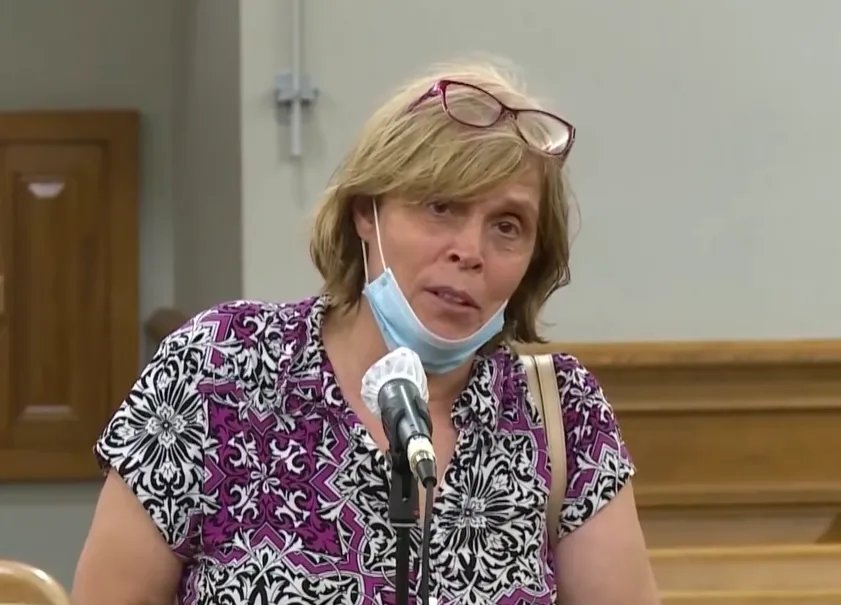
Lorena stood before Judge Caprio, her hands shaking slightly as she faced the charges that had been placed against her. A driver, Lorena was caught for multiple violations: two speeding tickets in a school zone and one red light violation. These charges, while seemingly straightforward, hid a deeper story of hardship and personal sacrifice.
It had been what Lorena described as “a very bad year.” She explained that the stress and emotional toll of the past few months had caused her to drive hurriedly, without the focus she usually prided herself on. This lack of attention, she said, was the result of a series of unfortunate events that had unfolded one after another, each more devastating than the last.
Lorena’s troubles began with the loss of her mother, Hilda, who had been the matriarch of their family. Hilda had passed away just ten months prior after suffering a stroke. For Lorena, the loss of her mother was not only emotional but also left a massive hole in her life. As the one who had taken care of everything, Hilda had been the pillar that held the family together.
With her gone, Lorena found herself in a role she never imagined she would have to play: the primary caregiver to her older brother, who was suffering from Alzheimer’s disease.
Lorena’s life became a daily whirlwind of doctor’s visits, hospital rooms, and caregiving duties. Her brother, who was 64, had been diagnosed with Alzheimer’s and was fully dependent on Lorena for his care.
She refused to put him in a nursing home, feeling it was her responsibility to care for him just as her mother had cared for the family. But the burden was immense.
As if the situation wasn’t complicated enough, another blow came when another brother was involved in a serious car accident. He was hit by a vehicle, and the accident led to him undergoing open-heart surgery. He was placed in intensive care for three weeks, fighting for his life.
Lorena found herself constantly rushing between two hospitals—Butler Hospital, where her brother with Alzheimer’s was being cared for, and the other hospital where her injured brother was recovering from surgery.
With the constant back-and-forth between hospitals, the stresses of caregiving, and the overwhelming grief of losing her mother, Lorena’s mind was preoccupied with everything but driving.
She admitted to Judge Caprio that it was likely the day her brother was in the car accident that she was caught speeding and running a red light. She was so distracted by the overwhelming circumstances that she didn’t even realize the severity of her actions.
Judge Caprio listened intently, understanding the immense pressure Lorena had been under. He acknowledged that she had dedicated her life to her family, often sacrificing her own needs to ensure the well-being of those she loved.
The judge was visibly moved by her story, and his compassion was evident as he made his ruling.
With a calm voice, Judge Caprio explained the consequences of Lorena’s actions. The bad news, he said, was that the total fines for her violations amounted to $185. However, there was also good news: Lorena would not be required to pay this amount.
Judge Caprio shared with Lorena that he often received donations from people all over the world who wished to help those in need. He explained that this fund, which he called the “Philomena Fund” after his late mother, was used to help people like Lorena—those who had given so much to others but found themselves in a tough situation.
Lorena’s story of selflessness and sacrifice resonated with the judge, and he decided that the fine would be covered by this fund.
The judge concluded by explaining that while the world may not always be fair, there were still moments of grace, and he was glad to provide one for Lorena. He expressed that her mother, Hilda, would undoubtedly be proud of her.
Just as his own mother would have been proud of him, Judge Caprio said, Hilda would look down on her daughter with admiration for the life she had lived.
In closing, the judge offered Lorena words of encouragement. “Keep doing the good work you’re doing,” he said. “Keep looking after your family, and know that your sacrifices don’t go unnoticed.”
As Lorena left the courtroom, there was a sense of relief in the air. The weight of the fines was lifted from her shoulders, and the kindness of strangers, through the Philomena Fund, had offered her a glimmer of hope in a year filled with hardship.
Lorena’s story is a testament to the unseen struggles many people face. It’s a reminder that behind every traffic ticket, there might be a story of love, sacrifice, and unspoken struggles. Judge Caprio’s compassion for Lorena highlights the importance of understanding the bigger picture and the power of kindness in times of need.