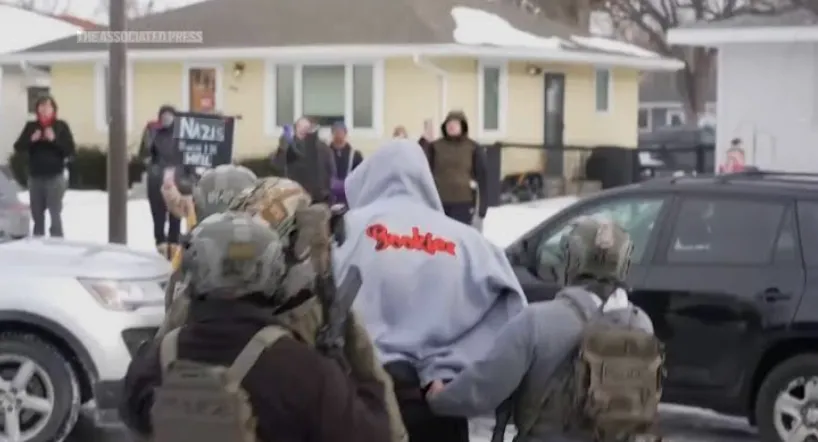
In parts of Minneapolis, the streets no longer feel like they once did. Storefronts that previously displayed bright windows and welcoming signs are now covered with sheets of plywood. Patrol vehicles idle at intersections. And in many neighborhoods—particularly those with large immigrant populations—residents say daily life has been replaced by uncertainty and vigilance.
What was once an ordinary rhythm of city life has been interrupted by a series of federal enforcement operations that have moved through several communities with striking speed. According to residents, the operations often happen early in the morning or late at night, when the streets are quiet and families are inside their homes. For those who witness them, the sudden presence of federal agents, flashing lights, and unmarked vehicles creates an atmosphere that many describe as both surreal and unsettling.
Some officials have characterized the operations as routine and necessary enforcement actions. But within affected neighborhoods, the experience feels anything but routine.
For many immigrant families who have spent years building lives in Minneapolis—working, raising children, and contributing to the local economy—the sudden shift has created a sense of vulnerability that is difficult to ignore.
Parents now weigh even the most ordinary activities with caution.
Walking children to school, visiting a grocery store, or attending a community gathering are decisions that some families now consider carefully. Conversations about safety happen quietly behind closed doors. Curtains remain drawn in some homes, not because residents want privacy, but because they fear attention.
The tension is visible on the streets.
Protests have emerged across several neighborhoods as residents and activists attempt to voice their concerns. Demonstrators gather holding signs and chanting slogans, calling for transparency and restraint. Many say they fear what could happen if their communities remain silent.
In several instances, however, these gatherings have turned tense. Law enforcement officers have used measures such as pepper spray to disperse crowds, creating scenes that have spread quickly across social media.
The air at these protests carries not only the sting of chemical spray but also the weight of frustration that has been building for days.
But the impact of the situation is perhaps felt most strongly inside people’s homes.
Reports of forced entries have circulated widely in affected neighborhoods. Residents say doors have been broken during early morning raids, leaving behind splintered wood and damaged locks.
Whether every report is verified or not, the stories have spread rapidly through word of mouth and online networks, amplifying fear among families who worry they could be next.
For many people, a home is supposed to represent safety and stability.
Now, some residents say that sense of protection feels uncertain.
A knock on the door—once an ordinary event—can trigger anxiety. Footsteps outside an apartment building may cause people to pause conversations and listen carefully.
Parents speak more cautiously, particularly when children are nearby.
In many households, children are absorbing the tension even if they do not fully understand it.
Teachers and counselors have reported that some students appear more distracted or anxious in school. Instead of focusing on homework or friendships, they worry about what might happen when they return home.
Some parents have chosen to keep their children inside more often, limiting outdoor activities or visits with friends. Others continue sending them to school, hoping routine will provide a sense of normalcy during uncertain times.
Either choice carries emotional weight.
At the same time, volunteers within the community have stepped forward to help support their neighbors.
In some neighborhoods, residents have organized informal watch groups, taking turns standing outside homes or walking through streets late into the evening. Their goal is not confrontation but reassurance—to let families know someone is watching out for them.
These volunteers also help share information about legal resources, emergency contacts, and community support services.
Local churches, advocacy organizations, and cultural groups have expanded their outreach efforts as well. Many are providing free legal consultations, counseling services, and emergency assistance for families who fear losing housing or employment during the current situation.
Community centers have quietly become gathering points where residents can share concerns and receive guidance.
In church basements and small meeting rooms, people sit together discussing their options and trying to make sense of what is happening around them.
For some, simply having a place to talk openly is a relief.
The economic consequences are also beginning to surface.
Business owners in several neighborhoods report a noticeable decline in customers. Shops that once relied on steady foot traffic are seeing fewer visitors. Some restaurants now close earlier than usual, while others operate with limited services behind locked doors.
Workers who depend on hourly wages feel the impact immediately.
When businesses slow down, employees lose hours—and sometimes entire shifts. That ripple effect spreads through families who already feel financially vulnerable.
Community leaders have attempted to calm tensions by calling for dialogue and understanding.
Local officials have held meetings and released public statements urging patience while emphasizing the importance of maintaining peace. But for many residents experiencing fear firsthand, words alone can feel insufficient.
Trust, once damaged, is difficult to rebuild.
Observers note that Minneapolis has already endured years of public trauma and national scrutiny. Many residents still carry emotional scars from previous events that placed the city under intense attention.
For them, the current atmosphere feels like another layer of stress placed on top of unresolved pain.
Boarded windows throughout certain areas of the city have become powerful symbols of that tension.
At first, many business owners installed plywood simply as a precaution against potential unrest. But as days passed, the boards remained, creating streets that feel less welcoming and more guarded.
Each boarded window reflects a mixture of fear and preparation—an attempt to anticipate uncertainty.
Even residents who are not directly affected by enforcement actions say they feel the emotional strain.
Conversations between neighbors have become shorter. Some people avoid gatherings altogether. Others choose to stay indoors more often, hoping to avoid becoming part of a situation they cannot control.
The quietness of certain streets is not necessarily a sign of calm.
Instead, it reflects a community trying to remain invisible while events unfold around them.
Yet amid the tension, moments of resilience continue to appear.
Neighbors bring food to families who are afraid to leave their homes. Volunteers knock on doors simply to check if people are okay. Teachers reassure students that they are safe at school.
These gestures may seem small, but they carry powerful meaning in uncertain times.
They remind residents that community still exists—even when trust in larger systems feels fragile.
The deeper question now facing Minneapolis is how the city moves forward.
Policies and enforcement strategies will certainly play a role, but many residents say rebuilding trust will require something more: honest dialogue, transparency, and respect for the people who call the city home.
Until that happens, life in parts of Minneapolis will likely continue under a cloud of uncertainty.
Behind boarded windows and closed curtains, families are waiting—for clarity, for reassurance, and for the moment when their homes once again feel like places of safety rather than vigilance.
For now, the city remains suspended between tension and resilience, its future shaped by how those two forces ultimately collide.