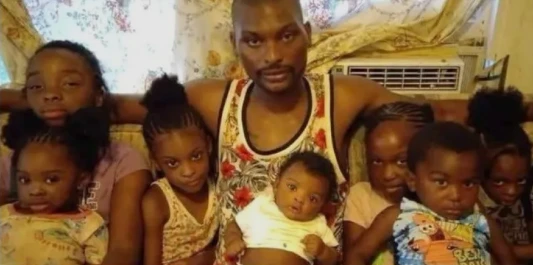
The morning began like any other in a quiet Shreveport neighborhood—but what unfolded inside that home would leave a community shaken and a family forever changed.
In the early hours, police were called to a residence where something had gone terribly wrong. When officers entered, they were met with a scene that would be described as one of the most devastating in recent memory. Eight children had been shot and killed, many of them while they were still sleeping. The silence inside the home was overwhelming—broken only by the reality of what had already happened.
Authorities later confirmed the victims: Jayla Elkins, 3; Shayla Elkins, 5; Kayla Pugh, 6; Layla Pugh, 7; Markaydon Pugh, 10; Sariah Snow, 11; Khedarrion Snow, 6; and Braylon Snow, 5. Each name represented a life just beginning—children with routines, laughter, and futures that would never have the chance to unfold. Some were siblings, some cousins, but all were part of the same extended family living under one roof.
According to local officials, the suspected gunman, Shamar Elkins, was the father of seven of the children and the uncle of the eighth. That detail alone added a weight that was difficult to process. This was not violence from outside—it came from within the very place meant to protect them.
Inside the home were also two adult women—both now fighting for their lives. One of them, Shaneiqua Elkins, the mother of four of the children, was shot in the face and remains in critical condition. The second woman, who also shared children with the suspect, was likewise found injured. Emergency responders rushed both women to the hospital, where doctors continue to work to stabilize them. Their survival now stands as the only thread of hope in a tragedy defined by loss.
As investigators began piecing together what led to that moment, early information pointed to a relationship in crisis. According to family members, Shamar Elkins and his wife were in the middle of separation proceedings and were scheduled to appear in court just days later. Tensions had reportedly been building, and on the night of the shooting, an argument broke out between them.
What happened next escalated with devastating speed.
According to statements shared with authorities, the argument turned into violence when Elkins opened fire inside the home. The details that followed are difficult to comprehend—not only because of the number of victims, but because of the manner in which the act was carried out. Police spokesperson Christopher Bordelon later confirmed that many of the children had been shot in the head while they were asleep, suggesting there was little to no chance for them to react or escape.
After the shooting, Elkins fled the scene. Authorities say he carjacked a vehicle and attempted to escape, leading police on a pursuit that ended when he was shot and killed by law enforcement. In legal terms, the suspect is no longer alive—but that does little to bring resolution to what was left behind.
Because what remains is not just a closed investigation—it is a shattered family.
For relatives, the grief is layered and complex. A cousin of the surviving women, Crystal Brown, spoke about the family dynamic, explaining that Elkins had four children with his wife and three with the other injured woman. The children, though from different mothers, were raised together, sharing the same home, the same daily routines, and the same sense of family.
Now, that shared life has been erased in a matter of minutes.
Outside the home, the community has struggled to process the scale of what happened. Neighbors who once heard children playing now face an unthinkable silence. Vigils have begun to form, with candles and balloons marking a space where grief is still too raw for words. Names are spoken softly. Photos are held close. And questions—many of them—remain unanswered.
Cases like this often leave people searching for explanations. How does a situation reach this point? Were there warning signs that went unnoticed? Could anything have been done differently?
At this stage, investigators continue to examine the timeline, the history of the relationship, and any prior incidents that may provide context. But even with every detail uncovered, there are limits to what facts alone can explain.
Because beyond the evidence is something harder to define—the emotional and psychological path that leads to a moment like this.
For the two women who survived, the road ahead is uncertain. Physically, they are still fighting. Emotionally, the weight of what they will face if they recover is almost impossible to measure. To survive such an event is to carry not only injury, but memory—of what was lost, of what cannot be changed.
And for the broader public, this case has become more than a headline. It has sparked conversations about domestic conflict, mental health, and the fragile line between tension and tragedy. It has reminded many that violence within families, though often hidden, can escalate in ways that are both sudden and irreversible.
Yet even with those conversations, one reality remains unchanged.
Eight children are gone.
Their stories now exist only through the memories of those who loved them. Through the names repeated in grief. Through the moments recalled by family and friends trying to hold onto something that cannot be replaced.
Justice, in the traditional sense, may not come. The person responsible is no longer alive to face trial. There will be no courtroom, no verdict, no sentence. Only the aftermath.
And in that aftermath, one question continues to echo—quiet, heavy, and unanswered:
What happened in those final moments… before everything was taken away?