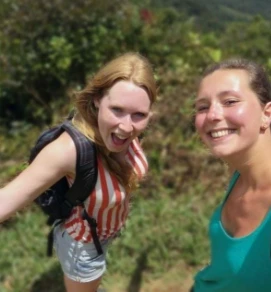
In April 2014, two young Dutch tourists, Kris Kremers and Lisanne Froon, embarked on a journey to Panama, hoping to learn Spanish and explore the country’s rich natural beauty. They had chosen to stay in the picturesque village of Boquete, known for its mountain landscapes and lush rainforest trails. It was a dream trip for these adventurous young women, who had no idea that their vacation would soon turn into a chilling mystery that would leave unanswered questions and haunting images behind.
Kris and Lisanne, both 21 years old, set out on April 1, 2014, to hike one of the most popular trails in the region—the Sendero El Pianista. This trail was well-trodden by tourists and appeared to be safe, marked by well-established paths and guides. The two friends were excited about their trek, equipped with their camera and phones, determined to capture the beauty of their surroundings. What seemed like an ordinary hike soon turned into a tragedy, one that would not only remain unresolved but also capture global attention for years to come.
At first, everything seemed normal. Kris and Lisanne took photographs during their hike, capturing moments of joy as they explored the scenic trail. They were seen smiling, enjoying the vibrant rainforest and towering trees, with no indication that anything was amiss. These images, taken in the early part of the hike, painted a picture of two young women fully immersed in their adventure, reveling in the majesty of Panama’s nature. The landscape was lush, the air fresh, and the bond between them evident. They were in their element, surrounded by a world full of beauty and possibilities.
However, as the day wore on, something shifted. After a certain point along the trail, the photos stopped, and the mood changed drastically. It was here that the first signs of trouble began to emerge.
By the afternoon of April 1st, Kris and Lisanne attempted to make emergency calls. In the remote region of the rainforest, mobile signal was weak, making it difficult for them to contact Panama’s emergency services. It was clear that something was wrong—two young women, stranded and unable to reach help, desperately trying to connect with the outside world. The calls they made went unanswered, and as the hours passed, their attempts grew more desperate. Their phones showed multiple attempts to dial emergency numbers, but none were successful.
In the days that followed, the situation grew more serious. The distress signals from their phones indicated a mounting sense of urgency, with no successful connection to rescue teams. The young women seemed lost and were trapped in a location with no way out. Their isolation and the looming sense of hopelessness were evident, yet no one knew their exact location or the full extent of their predicament.
The next disturbing clue came a week later, in the form of a camera. The camera, which had been with the women during their hike, revealed a series of photos taken in complete darkness. These images, captured on the night of April 1st, showed fragments of the jungle, including rocks, branches, and the forest floor. What was most unsettling was the peculiar arrangement of some of these objects, with some photos appearing to show items that had been placed in unnatural patterns. The photos did not appear to have any clear purpose—there were no people in the shots, no clear view of the surroundings, and no explanation for why they were taken at all. The lack of context raised more questions about what had happened during those hours.
It was as if the two women were trying to capture something, but what they were trying to document remained unclear. Why were they taking pictures in the pitch darkness? What had they seen or encountered that led them to take these strange photos? The unanswered questions surrounding these eerie images only deepened the mystery.
Several weeks after their disappearance, a breakthrough came when a local woman found a backpack near a river in the jungle. This backpack contained the belongings of the missing women, including their phones and the camera. The discovery of the bag, still in relatively good condition, raised more questions. Inside the backpack, investigators found the young women’s personal items, as well as a few key pieces of evidence—most notably, the camera with the strange photos. But while the belongings were intact, the real answers were still nowhere to be found.
The phones revealed some of the crucial details about their final days. The calls that had been made, the attempts at reaching help, and the photos all painted a picture of two young women trapped in an unrelenting situation. Yet, despite the discovery, there was still no clear explanation for what had happened to Kris and Lisanne, no final answers as to how or why they ended up in this dire situation.
A few months after the backpack was found, the worst fears were confirmed. Human remains were discovered in the jungle, some bones and fragments that belonged to Kris and Lisanne. The state of the remains was deeply unsettling. Some bones appeared to have been exposed to the elements for a long period, while others showed unusual characteristics, leaving investigators puzzled about the circumstances surrounding their deaths.
The discovery of their remains, although confirming that the young women had died, did little to explain the true nature of their deaths. The cause of their demise remained unclear—was it a tragic accident, or was something more sinister involved? The fact that the remains were in such a strange condition led to further questions about what had happened to them in the final days of their lives.
As the case unfolded, numerous theories began to emerge, each attempting to make sense of the available evidence. Some believed that Kris and Lisanne had become lost in the jungle, disoriented by the dense forest and harsh conditions. The isolation and lack of proper supplies could have contributed to their death. Others speculated that an accident, such as a fall or injury, had led to their entrapment, while some theorized that they had encountered a stranger along the trail.
One of the more chilling theories suggested that the young women had encountered someone who was not part of their hiking experience. Was it possible that they had met a stranger on the trail who posed a threat to them? Were they lured into danger by someone with ill intentions? The questions lingered, but answers remained elusive.
Others pointed to the remote location of their disappearance, suggesting that the dense, uncharted nature of the jungle might have made it impossible for them to find their way out. Could they have wandered off the trail and become lost in an area where no one could hear their cries for help? The environment, as beautiful as it was, could quickly become unforgiving for anyone caught unprepared.
Today, the disappearance of Kris Kremers and Lisanne Froon remains one of the most perplexing mysteries in recent history. The tragic deaths of these two young women, who went to Panama seeking adventure and new experiences, have left behind more questions than answers. What happened to them during those final days? Why were they unable to find their way out of the jungle? And most importantly, what truly led to their untimely deaths?
The case continues to generate debate, with many still seeking closure and answers. For the families of Kris and Lisanne, the loss is a painful one—two young lives lost in the blink of an eye, and a journey that ended in tragedy. The unanswered questions will likely haunt them forever, just as they continue to haunt the public who has followed the case.
As the years pass, the story of Kris Kremers and Lisanne Froon reminds us of the fragility of life, the unpredictability of adventure, and the dark side of our natural world. Their story is one of curiosity, exploration, and ultimately, the unknown—a mystery that will live on in the minds of all who have followed their story, as they continue to search for the truth behind the haunting photos, the dark jungle, and the lost souls of two young women.