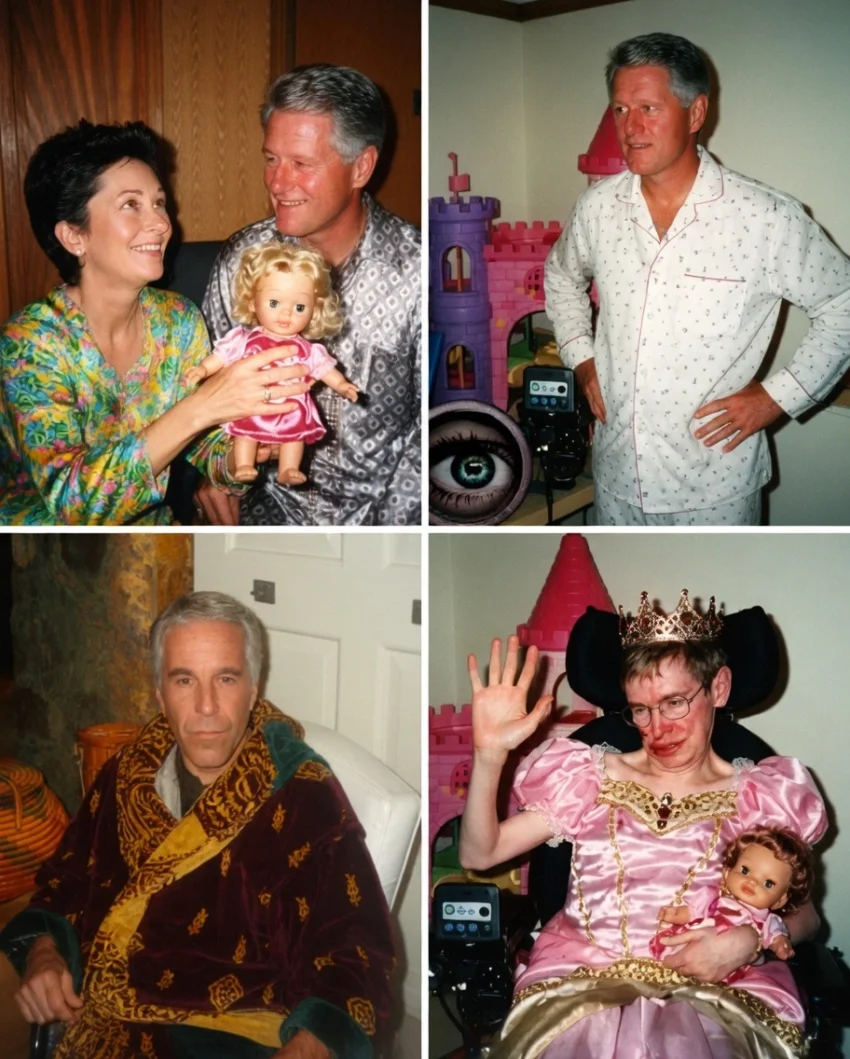
Few modern scandals have generated as much sustained intrigue—and confusion—as the case of Jeffrey Epstein. Years after his death, waves of documents, testimonies, and online speculation continue to surface, each promising new revelations about a network that once intersected with some of the world’s most powerful figures.
But as new “discoveries” circulate—strange artwork, cryptic emails, alleged sightings, and unsettling claims—a more complicated reality begins to emerge. The Epstein files are not just a collection of evidence; they have become a battleground where verified facts, partial truths, and viral misinformation collide.
The question is no longer simply what is in the files.
It is also: what is real, what is exaggerated, and what is being reshaped by the internet’s appetite for mystery?
The Epstein case has always existed at the intersection of power and secrecy. As a financier with connections spanning politics, business, and entertainment, Jeffrey Epstein operated within elite circles that made his eventual exposure both shocking and, to some, unsurprising.
His associate, Ghislaine Maxwell, later became a central figure in the legal aftermath, convicted for her role in facilitating abuse. Yet even with court rulings and extensive reporting, the case has never fully settled in the public consciousness.
Instead, it has evolved.
Each new document release, each resurfaced image, each rumor—no matter how thinly sourced—tends to reignite the narrative. The result is a constantly shifting landscape where new claims are layered onto an already complex foundation.
Among the most widely circulated elements tied to Epstein’s properties are unusual pieces of artwork reportedly found in his residences.
One painting frequently referenced depicts Bill Clinton in a blue dress. Another shows George W. Bush in a surreal, almost caricature-like setting.
These images, real or reproduced in media reports, have taken on a life of their own.
To some observers, they are interpreted as symbolic—suggesting hidden relationships, satire, or coded messages. To others, they are simply provocative or eccentric art, reflecting the tastes of a wealthy individual known for cultivating an unusual environment.
The challenge lies in interpretation.
Art, by nature, invites projection. Without clear context, it becomes a canvas not just for paint—but for speculation.
Another recurring element in the online discourse is the claim of sightings—particularly those involving Ghislaine Maxwell.
A widely shared video allegedly showing a woman resembling Maxwell walking freely in Quebec has circulated across social platforms, fueling debate about whether she could somehow be outside prison.
Yet such claims often illustrate a broader psychological phenomenon: pattern recognition under uncertainty.
When a figure becomes globally recognizable, any resemblance can trigger belief. Grainy footage, partial angles, and confirmation bias combine to create narratives that feel plausible—even when they conflict with verifiable facts, such as incarceration records.
In this sense, the viral video may reveal less about Maxwell’s whereabouts and more about how quickly uncertainty can transform into conviction in the digital age.
Perhaps the most intriguing—and controversial—category of claims involves email exchanges allegedly containing coded language.
References to figures like Baal or mentions of “shadow commissions” tied to events such as September 11 attacks have been cited as evidence of deeper conspiracies.
But here, interpretation becomes even more precarious.
Without full context—who wrote the emails, in what setting, with what intent—isolated phrases can be read in countless ways. Symbolic language, humor, metaphor, or even coincidence can be reinterpreted as evidence of hidden systems.
This does not mean that all such material is meaningless. It means that meaning is not always as clear as it appears.
And in a case already defined by secrecy, ambiguity tends to amplify itself.
At the heart of the Epstein case are not just documents or artifacts, but people.
Virginia Giuffre played a pivotal role in bringing attention to the network surrounding Epstein. Her testimony helped shape public understanding and legal proceedings, making her one of the most significant voices in the case.
Reports surrounding her death—depending on context and verification—have sparked renewed scrutiny and, in some circles, suspicion.
This reflects a recurring pattern: when key figures are associated with high-profile cases, any development connected to them tends to be interpreted through the lens of the broader narrative.
The risk, however, is that speculation can overshadow verified facts, complicating efforts to understand what actually occurred.
One of the most persistent themes in the Epstein saga is the perception of unequal accountability.
High-profile individuals connected—directly or indirectly—to Epstein have often denied wrongdoing or distanced themselves from his activities. Figures like Bill Clinton have faced public scrutiny, even in the absence of formal charges.
This dynamic fuels a sense of unresolved justice.
For many observers, the case raises broader questions: How does power influence accountability? Are certain networks insulated from consequences? And how much remains hidden?
These questions, while difficult to answer definitively, continue to drive interest in the case long after its legal milestones.
If the Epstein files represent a source of information, the internet represents the amplifier.
Since the release of various documents, a flood of content—some credible, some fabricated—has spread across platforms. Videos, images, and “leaked” claims circulate at a pace that outstrips verification.
This creates a paradox.
The more information becomes available, the harder it can be to distinguish fact from fiction.
In this environment, narratives compete not on accuracy, but on engagement. The most shocking version of a story often travels the farthest, regardless of its reliability.
The Epstein case persists not only because of what is known, but because of what remains uncertain.
There are unanswered questions about the full extent of his network, the identities of all victims, and the mechanisms that allowed his activities to continue for so long.
These gaps create space for speculation.
And where speculation exists, narratives—both grounded and imagined—will inevitably fill the void.
So what do the “strangest things” in the Epstein files actually represent?
Some are real elements—documents, testimonies, and artifacts that contribute to understanding a complex case. Others are interpretations, shaped by incomplete information. Still others may be entirely fabricated, emerging from the chaotic ecosystem of online content.
The difficulty lies in separating these layers.
Because in a story defined by secrecy, even truth can appear ambiguous.
Despite years of investigation, the Epstein saga feels far from over.
New documents may continue to surface. New interpretations will certainly emerge. And new waves of public attention will likely follow.
But as this process unfolds, one challenge remains constant:
How to pursue truth in an environment where mystery is not just a byproduct—but a driving force.
In the end, the Epstein files may reveal as much about our relationship with information as they do about the case itself.
Because in the search for answers, the line between discovery and belief is often thinner than it seems.