At twenty weeks, the ultrasound room fell unusually quiet.
The technician’s face remained neutral, but the pause lingered for just a moment too long. The words came calmly, almost clinically: “Single umbilical artery.”
The doctors explained that many babies with this condition grow normally, and that it often resolves with nothing more than extra monitoring and early delivery. They smiled gently, reassuringly.
But even without uttering the word, “genetic,” it hung in the air, thick and heavy.
More scans followed. What had once been an exciting, routine appointment became something to brace for. Every visit now carried a heavy mixture of hope and dread. The once exciting anticipation was replaced with an underlying fear. Slowly, the measurements began to slip. Percentiles dropped. The baby, once perfectly on track, now seemed to be falling behind. Her tiny body seemed to be shrinking with each passing appointment.
Inside the womb, she fought silently.
By twenty-eight weeks, life no longer had any predictable rhythm. It became a cycle of appointments and machines, of holding breath and watching screens. Non-stress tests twice a week. Growth scans every seven days. Each time, they waited for reassurance. Proof that she was still okay.
And more often than not, the tests failed.
Each failure sent them rushing to the hospital. Hearts pounding. Minds racing ahead to the worst possible outcomes. They were hooked up to advanced monitors, listening to faster heartbeats, watching jagged lines dance across the screens. Eventually, the readings would stabilize, just enough for them to be sent home.
Go home and wait.
Hope became fragile. Sleep became shallow. Every kick was counted. Every quiet moment felt dangerous. Nights stretched on endlessly as fear crept into the spaces where joy once lived.
At thirty-two weeks, the fear stopped being a theoretical threat.
This time, the hospital didn’t send them home.
Doctors gathered. Their voices lowered. Her baby’s heart rate was dropping. Not briefly. Not inconsistently. But dropping in a way that suggested she was running out of time.
Waiting was no longer an option.
The words were careful but urgent. If they delayed, they might lose her. If they acted immediately, she might survive—but at a cost they couldn’t yet understand. In reality, the choice wasn’t truly a choice at all.
Delivery could no longer be postponed.
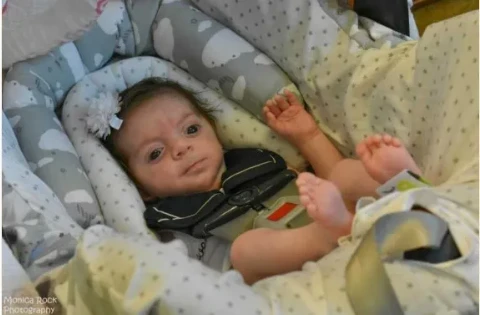
She entered the world eight weeks too early, weighing just under three pounds. A body impossibly small, skin translucent, limbs fragile and thin. She disappeared almost immediately beneath wires, tubes, and machines designed to keep her alive.
The NICU became home.
Ninety-two days stretched across two hospitals. Days marked not by sunrises or sunsets, but by the constant alarms of machines, medication schedules, and whispered conversations with nurses. Feeding tubes replaced bottles. Incubators replaced cribs. Time lost its meaning.
Feeding did not come easily. Milk slipped into her lungs instead of her stomach. Silent aspiration, they called it. Dangerous. Invisible. Terrifying. Weight gain stalled. Progress reversed. Each step forward seemed to invite two steps back.
Her body struggled in ways no newborn should ever have to.
The setbacks came one after another. Transfers between hospitals. More tests. More specialists. More waiting. Each time they thought they understood her needs, something else surfaced. It felt as if her tiny body was fighting battles no one could fully see.
Then came the test that changed everything.
At two months old, they were called into a quiet room. The kind of room families dread. A geneticist sat across from them, papers in hand, her words precise and measured. Their daughter had an extremely rare chromosome 17p duplication. So rare that fewer than two dozen cases had been documented worldwide.
There was no roadmap.
Doctors spoke in hypotheticals. They talked in probabilities. They discussed worst-case scenarios: walking, talking, eating independently—things that might never happen. They spoke of global developmental delays, neurological complications, and lifelong care. The words “unknown” and “no quality of life” echoed in the space between their breaths.
It felt like the ground disappeared beneath their feet.
They mourned quietly, not just for the diagnosis, but for the future they had imagined. The milestones they might never see. The simplicity of life that had slipped away without warning.
And then, slowly, endurance took over.
They learned to manage tubes, medications, appointments, and emergencies. They learned to advocate when answers were scarce. They learned to live in uncertainty without letting it consume them. Their days became structured around therapy sessions, doctor visits, and careful observation.
Progress came in small, easily overlooked moments. A stronger swallow. A steadier breath. A slight gain on the scale. Victories that meant nothing to the outside world but meant everything to them.
Hospital readmissions tested their resolve. Sleepless nights stretched their strength thin. Financial strain and emotional exhaustion pressed in from all sides. Still, they showed up. Every day. Every appointment. Every crisis.
Love became the constant.
Not the easy, effortless love they once imagined, but the kind forged through fear and persistence. The kind that chooses presence over despair. The kind that adapts, endures, and keeps going even when the path ahead remains unclear.
Hope did not arrive suddenly.
It grew quietly, in the spaces where resilience lived. It lived in the way their daughter responded to their voices. In the way she fought through setbacks with a strength disproportionate to her size. In the way her existence challenged every assumption the doctors had offered.
She was not a diagnosis.
She was here.
Their life would never look typical. Schedules revolved around care. Spontaneity disappeared. The future remained uncertain. But alongside the grief lived something unexpected—a profound gratitude for every breath, every moment, and every day she stayed.
They learned that hope does not always mean cure.
Sometimes, hope means presence. It means loving fiercely in the face of uncertainty. It means redefining what a meaningful life looks like and choosing it anyway.
Against the odds that said she should not be here, she remained.
And in her fight, her family found their own strength.
Not because the journey became easier—but because love taught them how to endure, and hope taught them how to stay.