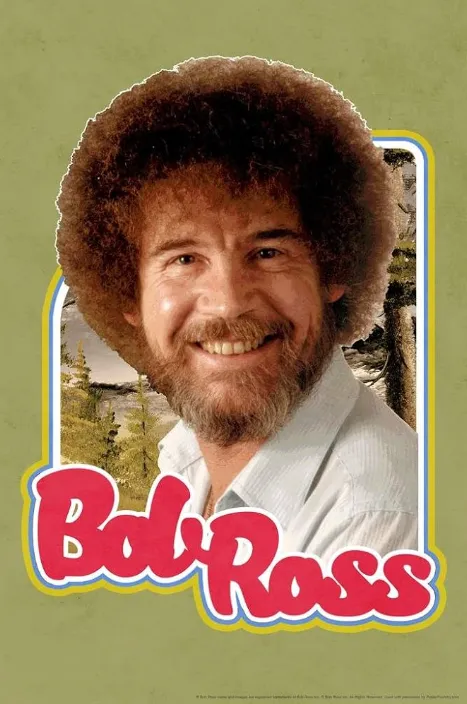
There are people the world remembers for the peace they brought… yet their endings are anything but peaceful.
Bob Ross was one of them.
He died on July 4, 1995, in Orlando, Florida, at the age of 52 after a brief battle with lymphoma. But the story of the “happy painter” doesn’t end with illness.
It ends with a quiet, bitter conflict that unfolded in the final days of his life.
To understand that ending, you have to look at the life he lived.
Born in 1942 in Daytona Beach, Florida, Bob Ross grew up in a working-class family. His father was a carpenter, and Ross found himself more comfortable building things than sitting in a classroom. He dropped out of school in the ninth grade and later joined the U.S. Air Force at 18.
He spent 20 years in the military, much of it stationed in Alaska. There, surrounded by vast landscapes, he began to paint—not for fame, but for peace.
As a drill sergeant, he was required to shout constantly.
And he hated it.
Ross later promised himself that if he ever left the military, he would never raise his voice again.
And he didn’t.
After leaving the Air Force, he studied under painter William Alexander and mastered the “wet-on-wet” technique, allowing him to complete an oil painting in under 30 minutes.
That timing changed everything.
In 1983, The Joy of Painting premiered.
A simple format.
A calm voice.
And landscapes that appeared almost magically on canvas.
But Ross wasn’t just teaching people how to paint.
He was teaching them how to believe in themselves.
“There are no mistakes… just happy accidents.”
That message resonated.
Over time, Ross built more than a show—he built a business empire. Art supplies, instructional books, workshops, and licensing deals. By 1995, his company was worth around $15 million.
But behind the calm voice and gentle smile, his health was quietly declining.
Ross had smoked for years. He had already survived heart attacks and a previous cancer diagnosis.
In 1994, he was diagnosed with lymphoma.
In his final televised appearances, viewers could see the change—he looked thinner, weaker. His voice, once smooth and steady, began to fade.
Soon, he could no longer paint.
The man who had painted hundreds of landscapes… no longer had the strength to lift a brush.
And as his health failed, another battle began.
Not on canvas.
But over everything he had built.
His longtime business partners, Walt and Annette Kowalski—who had helped launch his career—entered into a legal struggle over control of his company.
They wanted ownership.
His name.
His image.
Everything tied to Bob Ross.
According to reports, Ross spent some of his final days arguing over the phone from his deathbed.
A man known for calm… caught in a storm he could not escape.
But in the end, Ross made one final decision.
He changed his will.
He transferred the rights to his name and likeness to his son, Steve Ross.
And he left his estate to his third wife, Lynda, whom he married shortly before his death.
It was his final act of control over his own legacy.
When Bob Ross died, his funeral was simple—just as he had lived.
Only close friends and family attended.
No spectacle.
No noise.
Just quiet goodbye.
In the years after his death, his presence faded. He became a nostalgic memory for those who had grown up watching him.
Until the internet brought him back.
In 2015, The Joy of Painting was streamed online, introducing Ross to a new generation.
And suddenly, the “happy painter” was alive again in the hearts of millions.
Today, Bob Ross is more than an artist.
He is a symbol.
Of calm.
Of kindness.
Of finding beauty in simple things.
But behind that image is a story many don’t know.
A man who spent his life bringing peace to others…
yet faced conflict and struggle in his final days.
And perhaps the most haunting question remains—
when a legacy is built on kindness… what happens when others try to claim it after you’re gone?