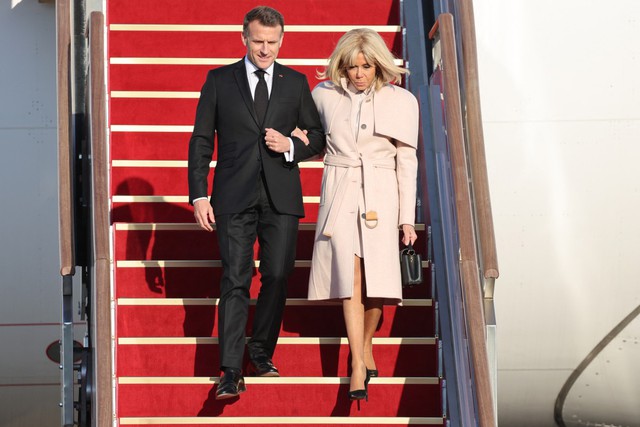
French President Emmanuel Macron has sharply criticized comments made by Donald Trump about his marriage, calling them “not appropriate” and “not in good taste.”
Speaking to reporters during a visit to South Korea on April 2, Macron dismissed Trump’s remarks after the former U.S. president appeared to mock him during a luncheon in Washington, D.C. the previous day.
At the April 1 event, Trump — while criticizing European allies over their limited involvement in the Iran conflict — singled out France and took aim at Macron in a personal and highly unusual way.
Imitating a French accent, Trump reportedly said that Macron — whom he claimed was “treated very badly by his wife” — was still “recovering from a punch to the jaw.” He added that the United States did not need France’s help in dealing with Iran, though he said he had still reached out.
The comments appeared to reference a viral video from May 2025, in which France’s First Lady, Brigitte Macron, was seen placing her hand on the president’s face and lightly pushing him as he prepared to exit an aircraft. The moment sparked speculation online, though Macron later dismissed it as a lighthearted interaction between the couple and denied any marital issues.
Responding to Trump’s remarks, Macron said:
“These comments are not appropriate and not in good taste. I will not respond further — they are not worth my time.”
The remarks have drawn backlash across the French political spectrum.
Yaël Braun-Pivet, President of the French National Assembly, condemned Trump’s comments, saying:
“At a time when we should be discussing the future of the world — including the situation in Iran, where lives are at stake — it is unacceptable for a president to engage in mockery and ridicule.”
Manuel Bompard, a senior figure from the left-wing party La France Insoumise (LFI), also defended Macron despite political differences.
“Everyone knows I strongly disagree with President Macron, but what Donald Trump said about his wife is simply unacceptable,” Bompard told BFMTV.
The exchange highlights growing tensions between Trump and key European allies, as disagreements over the Iran conflict continue to widen.