There are cases that begin with a single moment of violence. And there are others that unfold slowly—quietly—until one day, everything stops.
This was the second kind.
On March 23, 2026, police were called to a home on Monticello Drive in Indianapolis for what was initially reported as a medical emergency. Inside, they found a 4-year-old boy unresponsive.
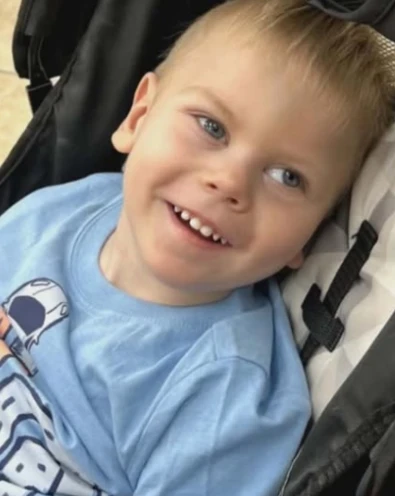
That child was Malachi Lovely.
He was pronounced dead shortly after.
At first glance, it might have seemed like a sudden tragedy. But as investigators began to look closer, a different picture started to emerge—one that hadn’t formed in seconds, but over time.
Malachi wasn’t just any child. He had cerebral palsy, a condition that required constant care, attention, and protection. He depended on the adults around him for everything—movement, feeding, safety.
And according to investigators, that care had not been there.
Inside the home, conditions were described as unsafe and unsanitary. Dirty dishes stacked up. Clothing scattered. Floors covered in grime. It was not a place prepared to care for a vulnerable child.
But the most disturbing detail was where Malachi had been found.
Authorities stated he had been confined to a basement closet—kept there for extended periods of time.
Not a bedroom.
Not a space meant for a child.
A closet.
When he was discovered, it wasn’t by an adult.
It was a sibling.
The child reportedly found him unresponsive, with blood on his mouth and his eyes rolled back—an image no child should ever have to see, and one that would likely stay long after that moment ended.
By then, it was too late.
As the investigation unfolded, questions began to surface—not just about what happened that day, but about everything that came before it.
Because Malachi’s story did not begin on March 23.
Records revealed that Indiana Department of Child Services had already been involved with the family. In April 2025, Malachi had been removed from the home.
Something had already been wrong.
But just two months later, in June 2025, he was returned.
What changed during that time?
What assurances were made?
And most importantly—what was missed?
Those questions now sit at the center of a case that is no longer just about one home, but about a system designed to protect children.
On April 1, 2026, 37-year-old Angel Lovely was charged with two counts of neglect of a dependent resulting in death. Her boyfriend, Nicholas Bergdoll, also 37, was charged with two counts of neglect of a dependent resulting in serious bodily injury.
The charges reflect more than a single act. They reflect a pattern—decisions, omissions, and conditions that, over time, led to an outcome that could not be reversed.
But even as charges are filed, there are layers to this case that go beyond the courtroom.
Because neglect is not always loud.
It does not always leave immediate marks.
Sometimes, it builds in silence—behind closed doors, out of sight, unnoticed until it reaches a point where it can no longer be ignored.
And in cases involving children with disabilities, that silence can be even more dangerous.
Malachi could not advocate for himself.
He could not explain what was happening.
He relied entirely on others to recognize his needs, to respond, to intervene.
When that chain breaks—even once—the consequences can be severe.
When it breaks repeatedly, over time, the outcome becomes something else entirely.
Something final.
For the community, the case has raised a difficult realization: this was not a hidden situation in the sense of being impossible to detect. There had been prior involvement. There had been warning signs.
And yet, somehow, the system reset.
The child returned.
The conditions continued.
And the outcome unfolded.
For those who hear this story, one detail tends to linger longer than the others.
Not just that Malachi died.
But where he was found.
A closet.
A confined, silent space—removed from the rest of the home, removed from visibility, removed from help.
It becomes more than a location.
It becomes a symbol of everything that went unseen.
Everything that went unaddressed.
Everything that continued when it should have stopped.
In the days following his death, the case has drawn attention not only to the individuals charged, but to the broader systems that intersected with his life. Child services. Oversight. Follow-up. Assessment.
Because in cases like this, responsibility rarely sits in one place alone.
It spreads.
Across decisions.
Across time.
Across moments where intervention could have changed the outcome—but didn’t.
Malachi Lovely was four years old.
A child who needed care, protection, and consistency.
A child who depended on a system of adults and institutions to recognize when something was wrong.
And somewhere along that chain, something failed.
The investigation will continue. The legal process will move forward. Evidence will be presented. Decisions will be made.
But for Malachi, those steps come after the fact.
They do not change what has already happened.
They do not return what has been lost.
And they do not answer the question that now sits at the center of this case:
When a child is already known to be at risk… how many chances are there before the system fails them for the last time?